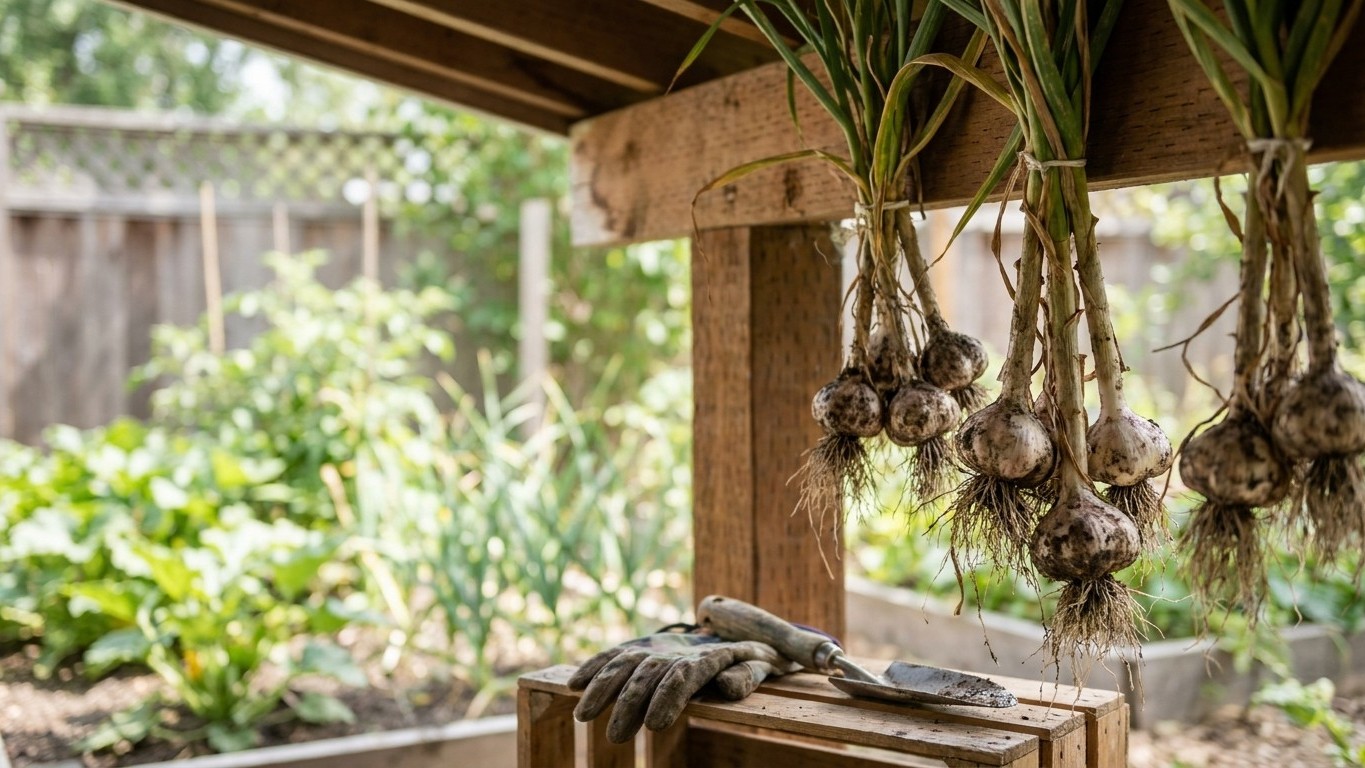

Garlic in Vermont comes out of the ground once the bottom leaves have died back but the top ones are still standing green, usually in the thick of summer after a fall planting the year before. Pull it too soon and the bulbs are undersized with loose wrappers. Wait too long and the cloves split apart underground, which shortens how long they’ll keep. Curing comes next: weeks of shade and airflow before anything goes into winter storage.
When garlic is ready to lift in Vermont
The plant tells you when it’s ready, not the calendar. Garlic dies back from the bottom up, so the signal to watch is the ratio of brown, collapsed leaves to green, upright ones. When roughly half the leaves have died back and five or six leaves up top are still green, it’s time to dig a test bulb. Pull one plant, brush off the dirt, and slice it in half. The cloves should be plump and clearly separated, with the wrapper layers around the whole bulb still intact and papery rather than split or slimy.
Pulling early isn’t a small mistake. A bulb harvested while too many leaves are still green often has cloves that haven’t finished sizing up, and the wrappers, which are the bulb’s only real protection in storage, haven’t matured enough to seal properly. That garlic tends to shrivel fast once it’s off the plant. Waiting past the point where most of the leaves have collapsed carries the opposite risk. The outer wrappers start to break down in the soil, individual cloves can push apart from each other, and once a bulb has “burst” open like that, it picks up soil-borne rot organisms far more easily and won’t store through winter no matter how well it’s cured afterward.
Reading the plant instead of the date
Vermont’s growing season varies enough across the state that fixing a single harvest date for the whole territory wouldn’t hold up. The Champlain Valley warms earlier in the season than the higher ground in the Green Mountains or the Northeast Kingdom, and a garden at elevation can lag a garden down near the lake by a noticeable stretch. No source publishes a county-by-county harvest calendar for Vermont garlic, so the leaf test remains the most reliable guide regardless of where in the state a bed sits. A wet or unusually dry final stretch before harvest can also shift things by a few days either direction, which is one more reason to check plants directly rather than mark a date on the wall calendar back in the fall when the cloves went into the ground.
Hardneck types, which dominate home gardens across Vermont because they handle cold winters better than softneck strains, tend to signal readiness fairly clearly through their leaf pattern. Softneck garlic can be a touch more subtle about it, with leaves that flop rather than fully brown, so the test-bulb dig matters even more with those.
Curing it, and where to hang it here
Fresh-dug garlic isn’t finished when it comes out of the ground. It needs a curing period to dry down the wrappers, seal the neck, and let the flavor settle before it goes into long-term storage. Skip this step or rush it, and bulbs that looked perfect at harvest can mold or shrivel within weeks.
Don’t wash the bulbs. Brush off loose soil with a dry hand or soft brush and leave the roots and the leaves attached, since trimming too early opens a path for moisture and rot organisms to get into the bulb before it’s had a chance to seal itself. Move the whole plants, dirt and all, straight out of direct sun. Sunlight during curing can scorch or bleach the outer wrappers, which are the same wrappers you’re depending on to protect the bulb for the next several months.
Finding the right spot in a Vermont house or yard
An open barn bay, a three-season porch, a covered breezeway, or a garage with the door cracked for airflow all work, as long as the space stays shaded, dry, and out of the rain. Vermont summers can run humid for stretches, and stagnant damp air is the enemy of curing garlic just as much as direct sun is. If a curing space feels sticky and still, a small fan aimed across the bulbs, not directly at them, helps move that moisture out. Bunch the plants loosely, five or six stems per bundle, and hang them or lay them on a screen or wire rack so air reaches all sides of every bulb. Piling garlic in a heap while it cures is one of the more common ways to lose a chunk of the harvest to mold before it ever reaches the pantry.
Curing generally takes a few weeks. It’s finished when the outer wrappers feel papery and dry to the touch, the roots have gone wiry and brittle, and, for hardneck varieties, the neck feels tight rather than soft or damp. Softneck garlic is ready to trim once the leaves themselves have fully dried down.
Storing it through a Vermont winter
Once curing is done, trim the roots close and cut the tops down to an inch or two above the bulb, unless the plan is to braid softneck garlic, in which case the leaves stay on. Sort through the harvest and set aside anything bruised, undersized, or with a soft spot. Those bulbs should go into the kitchen first, since they won’t hold as long as the firm, well-sealed ones set aside for deeper winter storage.
The right storage spot is cool, dark, and dry, with some airflow, but it should not sit near freezing. A mudroom, an unheated pantry, or a cellar corner that stays above freezing all winter tends to work better than a fully unheated shed or an uninsulated garage once the cold really sets in. This is where Vermont’s fall weather matters directly. At the Burlington station, NOAA’s 1991-2020 Climate Normals put the first fall freeze, the 30 to 70 percent probability window for temperatures dropping to 32°F, between October 3 and October 13. That’s a midpoint, not a guarantee: in roughly half the years on record, that freeze arrived later than this window, and Burlington sits in the mildest corner of the state, right on Lake Champlain. Gardens up in the Green Mountains or out in the Northeast Kingdom typically see their first freeze arrive well ahead of that Champlain Valley window.
Practically, that means an unheated porch or detached garage used for summer curing can swing close to freezing not long after that window passes in milder parts of the state, and sooner elsewhere. Garlic stored in a spot that dips near or below freezing tends to turn soft and unusable once it thaws, so bulbs need to move somewhere more insulated, an interior closet, a basement stairwell, or a covered root cellar, before overnight lows start dropping that far. Checking stored bulbs every few weeks through winter and pulling any that have gone soft or started sprouting keeps that spoilage from spreading to the rest of the batch. Larger cloves from this same harvest are also what most Vermont growers set aside to replant that same fall, keeping the cycle going from one summer’s crop to the next.
What goes wrong here
Most storage failures trace back to curing conditions rather than anything that happens later. Garlic cured in direct sun bleaches and can develop soft spots before it ever reaches the pantry. Garlic cured in a closed, humid space grows mold on the wrappers, sometimes before the curing period is even finished. And garlic stored too warm through the winter sprouts early, using up the clove’s stored energy and leaving a rubbery, hollow bulb by spring.
Insects are the other piece. University of Vermont Extension documents a specific set of pests for this territory, and only a few of them are relevant to a garlic bed directly.
| Pest | Relevance to garlic |
|---|---|
| Leek moth | Larvae feed on allium foliage and can tunnel into leaves |
| Swede midge | Attacks growing points of several crops, including alliums |
| White grubs | Soil-dwelling larvae that chew roots and underground bulbs |
| European chafer | Its grubs are among the white grub pests found in garden soil |
| Asian jumping worms | Disrupt soil structure and nutrient cycling in garden beds |
| Flea beetles | Chew foliage on a range of crops earlier in the season |
The remaining pests on University of Vermont Extension’s documented list for this territory, boxelder bug, Colorado potato beetle, dark-winged fungus gnats, green stink bug, spongy moth, and spotted wing drosophila, are worth knowing about in a Vermont yard generally, but they aren’t the ones a garlic grower needs to watch most closely.
Common questions
Can I harvest garlic early if leaves are still green in Vermont?
Pulling garlic while most of the leaves are still green usually means smaller cloves and wrappers that haven’t fully developed, which shortens how long the bulbs will keep. It’s better to wait for roughly half the leaves to die back first.
How long does cured garlic last in Vermont storage?
No specific storage-life figure is published for this territory. Well-cured bulbs kept cool, dark, and above freezing generally outlast anything stored warm or damp, but exact timelines depend on the variety and how the bulbs were cured.
Do I need to wash garlic before curing?
No. Washing introduces moisture right when the bulb needs to dry down and seal its wrappers. Brush off loose soil by hand instead and leave the roots and tops attached until curing is finished.
What’s the difference between curing and storage?
Curing is the drying-down period right after harvest, done in a shaded, airy spot for a few weeks. Storage is what happens after curing is complete, once the bulbs are trimmed and moved to a cool, dark spot for the rest of the winter.