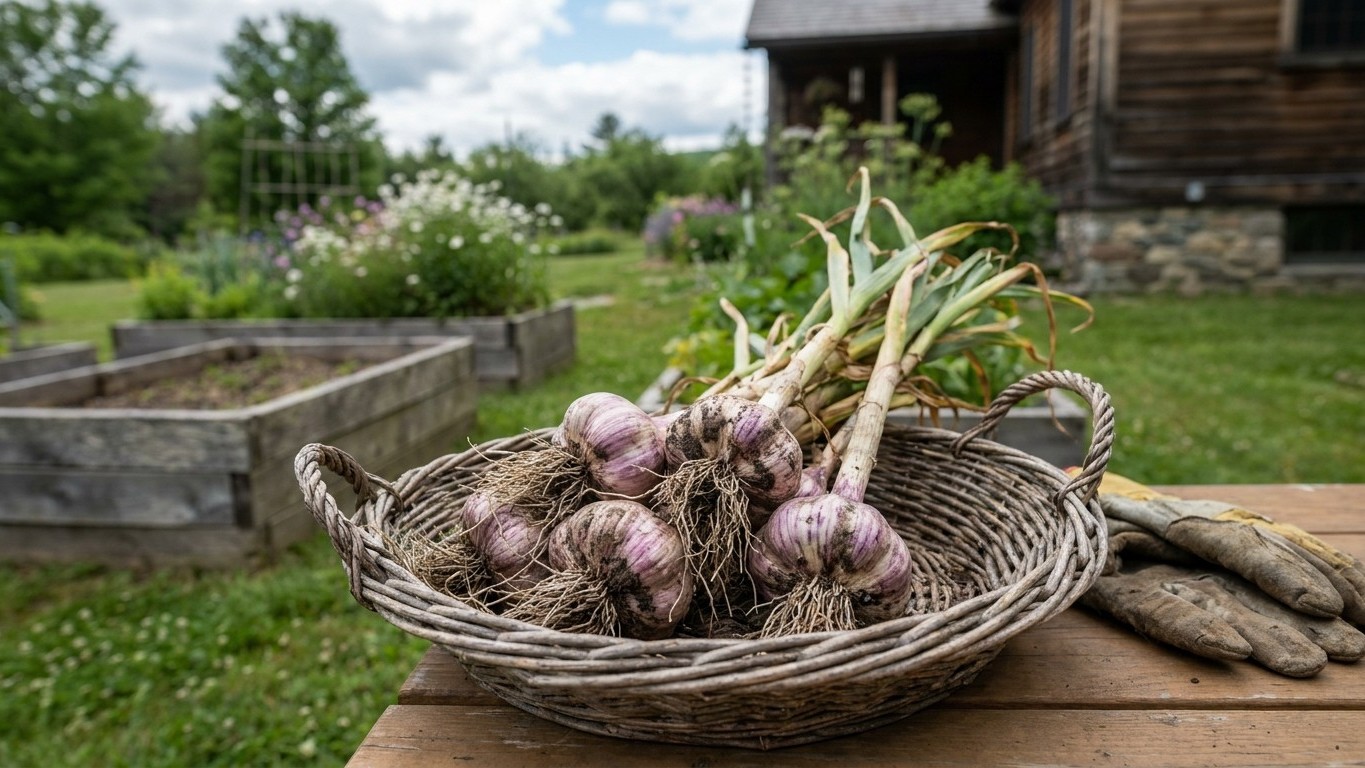

Vermont has all the cold garlic could ask for. NOAA NCEI’s 1991-2020 climate normals put the region’s average run of freezing weather well past the six to eight weeks University of Georgia Extension (publication C854) says a clove needs after planting to divide into a full head. The action that follows: plant a hardneck variety in mid to late September and stop worrying about whether winter will do its job, because here it will.
Will garlic get the cold it needs in Vermont

Garlic does not split into cloves on its own. A single clove planted in fall has to sit through a real stretch of cold, generally reckoned at six to eight weeks below 40°F, before it will divide underground into the cluster of cloves you expect at harvest. Skip that cold and you lift a solid, round bulb that looks more like a scallion base than garlic. This is the one step that trips up growers moving in from milder states, and it is also the one Vermont solves without any help from the gardener.
Vermont’s winters put in an average of 30.4 weeks with air temperatures below 40°F, according to the local climate record behind the University of Georgia Extension threshold. That is nearly four times the six-week minimum and well past the eight-week upper end of the requirement. There is no version of a Vermont winter, in any county, that leaves garlic short of vernalization. The risk here runs the other way: a bulb going into a Vermont winter needs to be established enough to survive it, not worried about getting cold enough.
Because the cold is never in question, the two workarounds that matter in warmer states, pre-chilling cloves in a refrigerator before planting, or falling back on a softneck variety bred for mild winters, are not something a Vermont grower needs to reach for. That said, a softneck still has a place here for its storage life, and the Growing Garlic in Virginia guide is the one to read if you are comparing notes with a grower in a state where the vernalization math is genuinely tight. In Vermont, the question is never whether the clove will split. It is whether you gave it the right start in fall and the right cover through winter, which is what the rest of this guide is about.
When to put the cloves in
NOAA NCEI’s 1991-2020 climate normals put Burlington’s first fall freeze between October 3 and October 13. That is a range, not a date, and Burlington sits on the shore of Lake Champlain, the mildest corner of the state. Higher ground in the Green Mountains and the Northeast Kingdom sees its first freeze measurably earlier, so a grower there should consult When to Plant Garlic in Vermont and plan on the front edge of that calendar or ahead of it, not the back edge.
Every one of the Garlic Varieties That Suit Vermont Winters growers rely on in this guide is set out mid September to late September, which works out to roughly two to four weeks ahead of that Burlington frost window. That gap is the point: the clove needs enough time in warm-enough soil to grow roots before the ground locks up, but not so much time that it pushes leaves above ground before winter arrives. A clove that roots without leafing out heavily goes into winter in the best shape. One planted too early spends fall growing top growth it will lose to hard freezes, wasting energy the bulb needed for root development instead.
What moves the date
A few local conditions shift this window earlier or later than the Burlington range suggests:
- Elevation: each rise in elevation brings the first freeze forward, sometimes by weeks in the higher valleys.
- Proximity to Lake Champlain: the lake’s mass moderates fall temperatures nearby, which is why Burlington’s own freeze date runs later than most of the state.
- Cold air drainage: low-lying beds and frost pockets freeze before open, sloped ground nearby.
If you garden away from the lake, the safer read is to treat the September planting window as a hard target rather than a suggestion, and to lean toward the earlier half of it.
Which types suit Vermont
Hardneck and softneck garlic are not interchangeable, and the difference is winter. Hardneck varieties evolved for cold climates: they need a real winter to perform, throw a flower stalk called a scape that most growers cut before harvest, and tend to produce fewer, larger cloves arranged in a single ring. Softneck varieties come out of milder growing regions, skip the scape, and generally store for longer stretches in a root cellar or pantry.
Given that Vermont clears the vernalization requirement several times over, hardneck is the variety group this state is built for. Growers here have a long list to choose from: Bavarian Purple, Blue Music, Chesnok Red, Duganski, Fall Festival, Georgian Crystal, Georgian Fire, German Red, German White, and Ivan all go into the ground on the same mid to late September window as the softnecks. Vermont’s climate is close enough to Michigan’s for the two states to share this hardneck-first logic, and the Growing Garlic in Michigan guide covers the same cold-climate reasoning if you want a second reference point.
Softneck is not off the table. Early Red Italian, Inchelium Red, Italian Late, and Lorz Italian will all get their vernalization here just as easily, and a softneck’s longer storage life is worth having in the kitchen even in a state that does not strictly need it for winter survival. A common approach is to plant mostly hardneck for flavor and scapes, with a shorter row of softneck set aside purely for the pantry, since it will still be firm months after the hardneck heads have started to soften.
Soil and bed preparation
Garlic spends eight to nine months in the ground here, through freeze, thaw, and mud season, before it is lifted the following summer. Drainage matters more than fertility for a crop that sits in the same soil that long. A clove sitting in standing water through a wet fall or a spring thaw will rot before any disease organism gets the chance, and there is no mulch or amendment that fixes a bed that does not drain.
Work the bed several weeks before the September planting window so any amendments have time to settle before the cloves go in. A rough sequence that works for most Vermont soils:
- Choose a raised bed or raised rows on any site with heavy clay or a high water table.
- Work in finished compost or well-rotted manure to loosen the soil structure ahead of a long season in the ground.
- Pull perennial weeds now. A garlic bed is nearly impossible to weed by hand once mulch goes down in fall.
- Avoid planting garlic where onions, leeks, or garlic grew the previous two years, to keep soil-borne disease pressure from building in one spot.
Vermont’s rocky ground makes deep, well-worked soil worth the extra effort at this stage. A clove pushed against a stone as it tries to swell into a bulb comes up misshapen, and there is no fixing that once it is planted.
What the climate here favours, and what it does not
UC IPM’s Pest Management Guidelines for Onion and Garlic (UC ANR Publication 3453) publish soil temperature ranges for the fungal diseases most likely to trouble garlic. Cross those ranges against Vermont’s monthly mean air temperatures across the growing season and a pattern shows up, though it needs a caution attached before any of it means much: the published thresholds are soil temperatures, and the figures used here are air temperatures. Soil lags air by weeks and swings far less, so a month with a mean air temperature in range is a tendency toward disease conditions, not a soil reading, and never a diagnosis.
| Disease | Published range | Months in range (Sept-July) | Reading |
|---|---|---|---|
| White rot (Sclerotium cepivorum) | 50-75°F | 4: September, May, June, July (1 at optimum) | Highest local pressure of the four |
| Fusarium basal rot (Fusarium oxysporum f. sp. cepae) | 59-90°F | 3: September, June, July | Moderate overlap |
| Southern blight (Sclerotium rolfsii) | 86-95°F optimum | 0 | Outside its optimum all season, not absent |
| Pink root (Setophoma terrestris) | 75-85°F optimum | 0 | Outside its optimum all season, not absent |
White rot has the widest window here, with Vermont’s mean air temperatures falling inside its published 50 to 75°F range in four months of the growing season, including one month at the pathogen’s own optimum. Fusarium basal rot overlaps in three months. Neither of those counts means the disease is present or will appear. It means the climate does not rule it out, and infected planting stock or contaminated soil are what actually bring these fungi into a bed, cold winter or not.
Southern blight and pink root fare differently. No month of Vermont’s growing season reaches either pathogen’s published optimum, which is a real piece of good news for a state that otherwise skews cool. Outside the optimum, both diseases are less active, though a grower who brings in infected cloves is not protected by the climate alone. Buying clean, certified seed stock remains the single best defense against every disease on this list, in any state.
Getting it through the winter
A shallow-planted clove is the most common cause of winter losses here, not raw cold. Garlic wants roughly two to three times its own height of soil above the clove, and a bed that heaves with the freeze-thaw cycles common through a Vermont winter can push a shallow clove partway out of the ground, exposing it to drying and cold injury it would otherwise never face.
Mulch is the second line of defense and the one most guides underplay. Once the ground has begun to firm up with cold, lay four to six inches of straw or shredded leaves over the bed. That timing matters: mulch laid too early traps warmth and can encourage the top growth this crop is better off without going into winter, while mulch laid after the ground freezes hard is fighting the freeze-thaw damage it was meant to prevent.
Pull the mulch back partway, not entirely, once the snow melts and new green shoots start pushing through in spring. Leaving the full winter depth in place traps moisture against emerging shoots and can promote rot, but stripping it off completely removes protection against the last hard frosts of the season. A thinner layer left in place through spring also suppresses the first flush of weeds, which matters in a state where the growing season is short enough that garlic cannot afford much competition.
Harvest and curing here
Garlic tells you when it is ready far more reliably than any date on a calendar does. Watch the lower leaves: when the bottom third to half of them have browned while the top few stay green, the bulb has generally finished sizing and it is time to lift. Pulling too early leaves cloves undersized and papery skins underdeveloped, while waiting until every leaf has died back risks the bulb splitting its wrapper underground, which cuts its storage life sharply.
Curing is where a lot of an otherwise good harvest goes wrong, and Vermont’s humid summer weather makes it easy to rush this step. Cure whole, unwashed bulbs out of direct sun with steady airflow for several weeks, not days, before trimming roots and tops. A garage or open-sided shed with a fan running works better here than a closed room, because humid summer air slows the drying that protects garlic from mold in storage. Bulbs that feel dry on the outside can still be damp at the neck, and that hidden moisture is what causes storage rot months later, long after the harvest itself looked like a success.
Local help
County-level frost dates, soil testing, and current disease reports for your part of Vermont are all things a statewide average cannot give you. UVM Extension is the place to check before you finalize a planting date, particularly if you garden away from the Champlain Valley, where the ground runs colder than the statewide picture.
Common questions
Can I Plant Garlic in spring in Vermont instead of fall?
You can plant in spring, but expect a smaller bulb, because the clove misses most or all of its cold requirement and often fails to divide properly. Fall planting ahead of the season’s first freeze is what lets Vermont’s long, cold winter do the vernalization work for free.
Do I need to cut the scapes on hardneck garlic?
Most growers cut the curling flower stalk, called a scape, once it forms in early summer, because leaving it on diverts energy away from bulb sizing. Cut scapes are also edible and commonly used the way you’d use green garlic.
My garlic heaved out of the ground over winter. Is it ruined?
Not necessarily. Push the clove back down to its original depth and refirm the soil around it as soon as you notice, ideally before a hard freeze sets in again. A clove that heaved but stayed rooted usually recovers, though repeated heaving over several freeze-thaw cycles does more damage each time.
How long does homegrown garlic actually keep in storage?
It depends heavily on the type and how well it was cured, and this guide deliberately avoids giving a single number because it varies by variety and by how completely the bulb dried. As a general pattern, softneck types tend to outlast hardneck types in storage, which is the main reason growers keep a row of softneck even in a hardneck-favoring climate like Vermont’s.
Should I plant garlic from the grocery store?
It’s not a good idea. Grocery store garlic is often treated to prevent sprouting, may carry diseases like white rot with no way to trace the source, and is rarely suited to a cold climate. Certified seed garlic from a supplier who names the variety and its disease status is worth the extra cost.