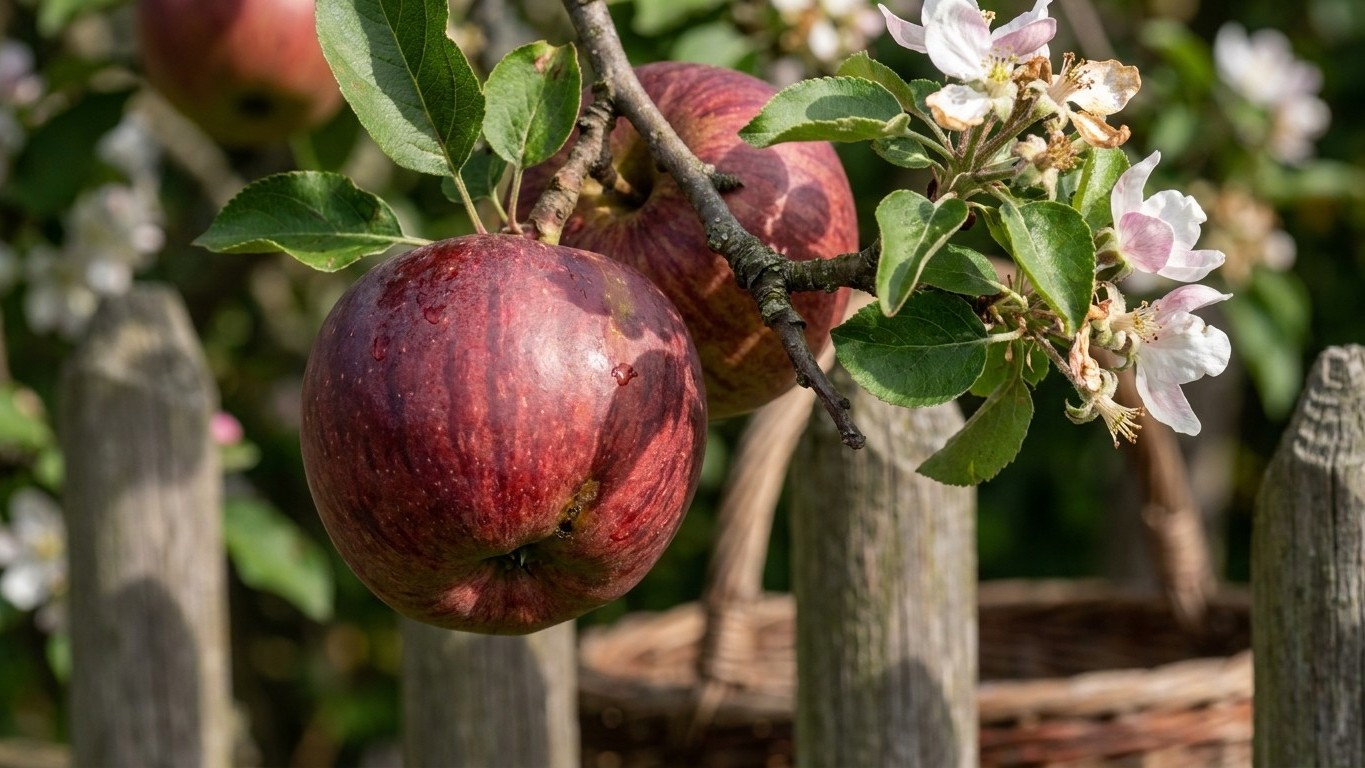

The right day to pick an apple in Washington isn’t a date on a calendar. It’s a stage the fruit reaches: background skin color, seed color, and how easily it lets go of the spur. Most of the state’s commercial fruit comes off trees in the eastern valleys, on a timeline set by heat accumulation, not by what a wall calendar says in western Washington. Storage life after that varies from a couple of weeks to most of the winter, depending entirely on which variety you’re holding.
When apples are ready to pick in Washington
Growers judge readiness with three checks working together. Background color is the first: the green undertone behind any red blush should be shifting toward yellow-green, not staying hard green. Seeds should have turned from white to brown. And the fruit should separate from the branch with a gentle upward twist rather than a tug that strips bark or leaves the stem behind. Taste is the tiebreaker. Starch-to-sugar conversion (commercial orchards use an iodine test to check this directly) confirms what the color and separation are already telling you.
Washington’s commercial apple belt sits east of the Cascades, in the Yakima, Wenatchee, and Okanogan valleys, a dry, continental climate with hot summers and cold winters that’s a different world from the coast. No figure for frost timing or growing-degree accumulation in those valleys is available in the sources behind this article, so a specific harvest calendar for that region isn’t published here. What is on record comes from the Seattle area on the western side of the state, and it should not be stretched to cover the eastern growing districts.
What the western Washington frost window means for backyard trees
For growers around Puget Sound, NOAA’s 1991-2020 Climate Normals for station USW00024233 put the last spring freeze (32°F) in a window running from February 27 to March 18, and the first fall freeze arriving between November 13 and November 30. That’s a wide band, not a single date, because it marks when freeze probability sits between 30% and 70%, meaning the actual date shifts year to year. For an apple tree, that window matters twice: once at bloom, when a late frost can wipe out a season’s fruit set, and again at harvest, when a hard fall freeze can force you to pick before full maturity.
Winter cold itself is a separate question from timing. The mean daily minimum of the coldest month at the Seattle reference station is 37.1°F, mild enough that almost any apple variety survives the winter there without dying back. Survival and proper flowering aren’t the same filter, though, and that distinction shapes which varieties actually perform well on that side of the state.
Which ones keep, and which must be eaten
Every apple variety falls somewhere on a spectrum between “eat this week” and “forget it in the crisper until spring.” The difference comes down to flesh density, skin thickness, natural acidity, and moisture content at harvest. Early-season varieties tend to have softer, more open flesh and higher moisture, which makes them delicious right off the tree and unforgiving in storage. Late-season varieties, picked when the air has already turned cold, carry firmer flesh and higher acid, both of which slow the breakdown that eventually turns a stored apple mealy.
| Category | Typical harvest window | How long it keeps |
|---|---|---|
| Early-season (soft, high-moisture types) | Late summer | A few weeks, best eaten fresh or processed quickly |
| Mid-season (moderate density) | Early to mid fall | Roughly a month or two under proper cold storage |
| Late-season (dense, high-acid types) | Mid to late fall | Several months in a cold, humid space |
Where an eastern Washington orchard is picking specific commercial varieties on a tight commercial calendar, that data isn’t part of the sourced record here. What holds true regardless of region is the mechanism: an apple that’s soft and juicy at harvest degrades fast in storage no matter where it grew, and a dense, tart apple picked late in the season is the one worth setting aside for winter. If you’re not sure which category your tree falls into, a squeeze test at harvest tells you almost as much as a calendar date would.
Bruising accelerates the clock on every category. A dropped apple, even one that looks fine, starts breaking down internally within days. Sort your harvest before it goes into storage, not after, and set aside anything with a soft spot or a break in the skin for the kitchen counter rather than the cold room.
Storing them through a Washington winter
Cold storage for apples works on two dials: temperature and humidity. The target range most fruit keeps well in sits just above freezing, with high humidity around it to keep the skin from wrinkling and drying out. A root cellar, an unheated but insulated garage, or a spare refrigerator all get you there, but the right choice depends on which side of the state you’re on.
On the western side, the mild coldest-month minimum of 37.1°F recorded at the Seattle station means an unheated space isn’t reliably cold enough on its own. A garage or shed there will often sit warmer than ideal storage temperature through the winter, which shortens keeping time even for a variety built to last months. A dedicated refrigerator, kept a few degrees warmer than a kitchen fridge normally runs, solves that problem directly. No comparable coldest-month figure for the eastern valleys appears in the sources behind this article, so a direct comparison isn’t possible here, but the region’s colder, drier continental winters are well documented to make passive cold storage more workable there.
A few habits protect fruit once it’s in storage:
- Keep apples away from potatoes, onions, and other ethylene-sensitive produce; apples release ethylene gas that speeds ripening in whatever sits near them
- Store in perforated plastic bags or wrapped individually in paper to hold humidity without trapping condensation
- Check the stored fruit every few weeks and pull anything showing soft spots or a strong fermented smell before it spreads
- Avoid stacking more than a couple of layers deep, since weight bruises the fruit on the bottom
What goes wrong here
The most common failure on the western side of the state isn’t cold, it’s dampness. A mild, wet spring during bloom creates ideal conditions for fireblight, a bacterial disease that spreads through blossoms and can kill young wood fast; it’s a well-known problem for apple growers in maritime Pacific Northwest climates, and it hits varieties with tender new growth hardest.
The mild-winter trade-off shows up here too. Because the coldest month’s mean minimum sits at 37.1°F, some high-chill varieties don’t accumulate enough winter cold to break dormancy cleanly, which shows up as patchy, uneven bloom the following spring. A grower tempted to switch to a low-chill variety to fix that problem needs to accept what comes with it: low-chill varieties break dormancy on less accumulated cold, which means they flower earlier, and earlier flowering lands closer to, or even inside, the February 27 to March 18 last-frost window recorded at the Seattle station. Given that this window represents only a 30-70% freeze probability rather than a guaranteed hard freeze, the practical read is that the frost risk from earlier bloom is usually the lesser problem compared to the reliability loss from picking a variety that won’t chill properly in a mild winter. That’s the trade worth making on the western side of the state, not the reverse.
Storage failures usually trace back to one of two mistakes: picking too early, before starch has converted and flavor has developed, or holding fruit in a space too warm to slow it down. Both are fixable with the same fix, patience at harvest and a genuinely cold storage spot afterward, but they’re easy to get wrong the first year with a new tree.
Common questions
What month do apples get picked in Washington?
There’s no single month that applies statewide. Readiness is set by the fruit’s stage (background color, seed color, ease of separation), and that stage arrives at different times depending on variety and local climate. Eastern Washington’s commercial valleys and the mild, maritime western side of the state don’t run on the same clock.
Do apple trees need cold winters to grow well near Puget Sound?
They need enough winter chill to flower properly, which is a separate question from surviving the cold. With a coldest-month mean minimum of 37.1°F at the Seattle reference station, winters there are mild enough that survival isn’t the concern for most varieties; chill accumulation for high-chill types can be.
How long do stored apples actually last?
It depends heavily on the variety’s density and acidity at harvest. Soft, early varieties are best used within a few weeks. Dense, late-season varieties held at cold temperature and high humidity can last several months, which is why growers who want fruit through winter choose those varieties deliberately rather than by accident.
Where can I get guidance specific to my part of Washington?
Local conditions vary enough within the state that a general guide only goes so far. Washington State University Extension publishes region-specific guidance through its county offices, which is the more reliable next stop for anyone growing in a particular valley or microclimate.