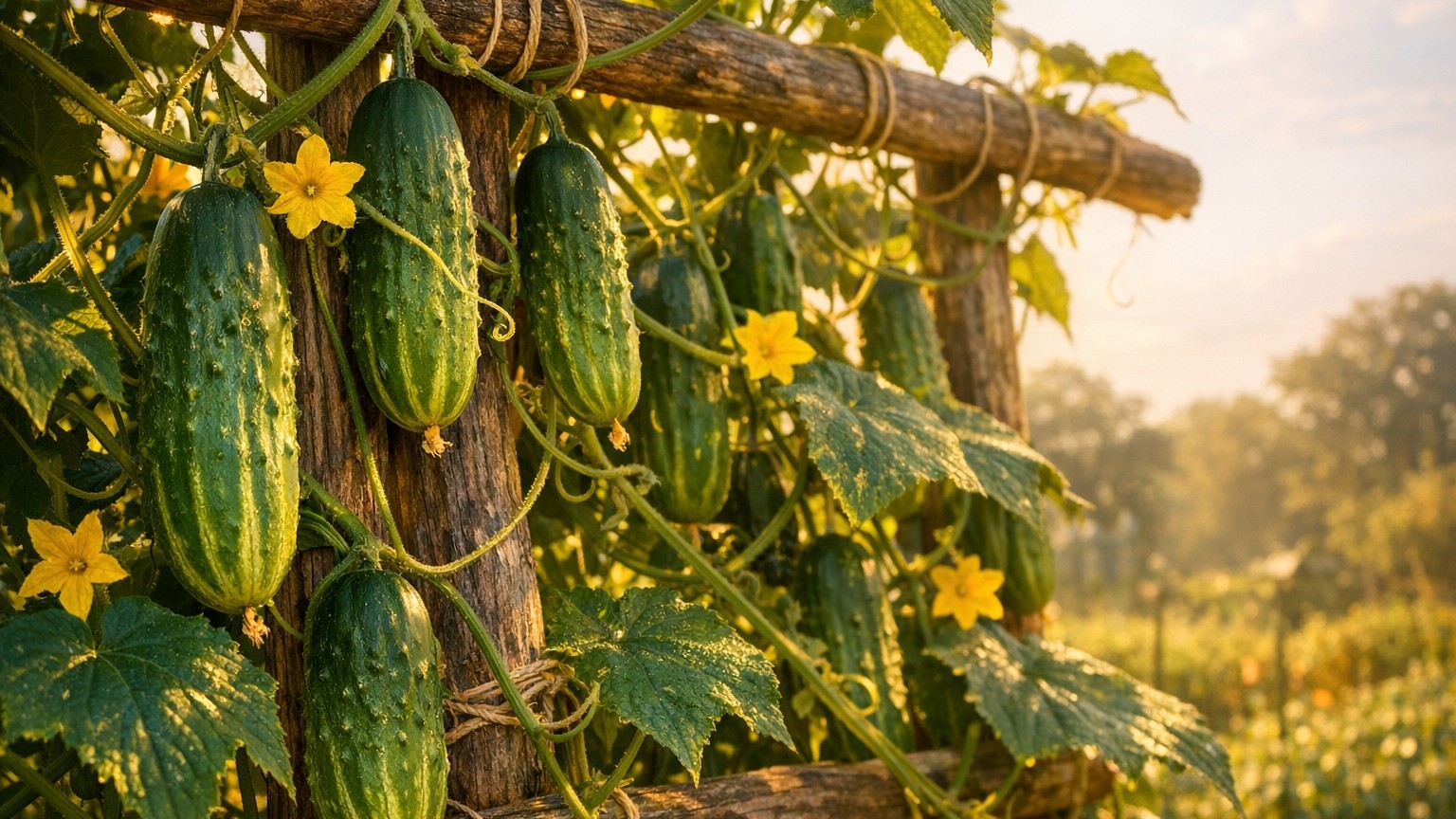

Cucumbers in New Mexico do best when the choice is made by type, not by chasing a specific brand name. Bush and vining pickling or slicing cucumbers bred for fast fruit-set and steady heat tolerance outperform long-season or humidity-loving types almost everywhere in the state. The exact variety that works in your yard is a question for your county extension office, not a state-wide list.
The short answer for New Mexico
Start with the two numbers that actually govern a cucumber crop here: the freeze window and the heat load. At the reference weather station, the last spring frost falls between March 31 and April 12, and the first fall frost arrives between October 29 and November 9. That is a probability band, not a guarantee, and it comes from an airport station. Suburban and rural gardens typically see the last frost later and the first fall frost earlier, often by one to two weeks, and more than that at higher elevation. So the working season at the reference point runs close to 200 days, but a garden in the foothills or up a canyon should plan on something shorter.
That season length is generous enough for almost any cucumber type to mature. The real constraint is the other number: 42.5 days a year averaging 90F or higher. That is a heavy heat load, and it is what decides which type actually performs, not the calendar. Cucumbers stressed by repeated 90-plus days tend toward bitterness, blossom drop and stalled fruit-set, regardless of how many weeks are left before frost.
Given that combination, long enough season but heavy summer heat, the types worth planting are the ones that set fruit fast and keep producing through a hot stretch rather than the ones bred for a short cool season or a humid one. Bush habit types suit small beds and containers and finish quickly, which matters if a gardener wants to dodge the worst of the mid-summer heat window. Vining types, trellised rather than left on the ground, catch more airflow and are easier to water precisely at the root, which counts for something given how little rain falls in a New Mexico summer.
| Type | Growth habit | Watering need | Best fit here |
|---|---|---|---|
| Pickling | Bush or compact vine | Frequent, shallow, even | Fast turnover before peak heat |
| Slicing / burpless | Vining | Deep, less frequent | Trellised for airflow and easier watering |
| Parthenocarpic (seedless-type) | Vining, often trellised | Consistent moisture | Useful where pollinators are scarce or wind is strong |
None of that names a cultivar, and it shouldn’t. Ask your county extension office which pickling, slicing or burpless varieties they have actually trialled in your soil and your elevation. That answer changes from Taos to Las Cruces, and no state-wide page can give it honestly.
What will not work here
Two failure patterns show up again and again in this climate, and both trace straight back to the facts above. The first is watering on a weekly schedule. Summer rainfall across June, July and August averages only about 3.5 inches, and June itself, the driest month, brings just 0.57 inches. A cucumber vine watered once a week on that kind of rainfall, especially paired with 42.5 days above 90F pulling moisture out of the soil, will produce bitter, misshapen fruit or simply stop setting new ones. Cucumbers need steady, near-daily moisture at the root during fruit development; a weekly soak does not substitute for that, no matter how deep the soak.
The second failure is planting a long-maturing or humidity-dependent type and assuming the reference station’s roughly 200-day window applies everywhere. It does not. Gardens above the valley floor, or simply further from the reference city, see frost arrive earlier and leave later, sometimes by two weeks on each end. A type that needs every one of those 200 days to finish is gambling with a much shorter real season the moment elevation or distance from the reference station enters the picture.
There’s also a spacing mistake worth naming directly. Because summer humidity is low here compared to much of the eastern half of the country, growers sometimes assume close spacing and ground-level vines are safe from the fungal problems that plague humid regions. That’s true as far as it goes, but it ignores the heat side of the equation: vines packed close together and left flat on hot soil bake from below, and fruit sitting on 90-degree ground scalds and rots at the point of contact. Trellising isn’t just a disease precaution in New Mexico; it’s a heat-management one.
Finally, container growing without attention to soil volume is a quiet failure mode. A small pot dries out within a single 90-degree day even with the modest summer rain totals doing nothing to help, and cucumbers in a stressed, dry container turn bitter fast. If containers are the only option, size and watering frequency need to compensate for both the heat days and the thin summer rainfall, not just one or the other.
What changes across New Mexico
New Mexico is not one growing region, and the hardiness zone range makes that plain: the state spans USDA zones 4b through 9a. That is one of the widest spreads of any state in this series, and it means there is no single planting answer for “New Mexico” as a whole. A zone 4b garden at altitude in the north is working with a fundamentally shorter frost-free window and cooler soil than a zone 9a garden in the low desert near the southern border.
For a reader gardening in the higher, cooler part of that range, the practical shift is to lean toward the faster-finishing bush and compact vine types discussed above, start seed indoors or wait for soil to warm well past the reference station’s early-April frost date, and accept that the first fall frost may arrive noticeably before the reference station’s late-October to early-November window. For a reader in the low desert end of the range, the season is long and mild enough that a second planting later in summer, timed to mature after the worst of the 90-degree stretch has passed, is often realistic where it would not be further north.
The heat load (that 42.5-day average above 90F) is measured at one reference station and will run higher in the low desert basins and lower at elevation, which reinforces the same pattern: altitude buys cooler summers but a shorter season, low elevation buys a long season but harsher heat stress. Neither extreme is described accurately by a single statewide recommendation.
None of this tells an individual reader which zone applies to their own address. That’s what the USDA Plant Hardiness Zone Map is for, and it’s worth checking before assuming either end of the 4b-9a range describes a particular yard.
Where to check this for your own county
New Mexico State University’s Cooperative Extension Service is the source that turns this state-level picture into something usable on a specific piece of ground.
Two things are worth asking for specifically. First, the local planting calendar for vegetable crops, which will reflect the real frost dates for that county rather than the reference station figures, which run later in spring and earlier in fall once you leave the airport station itself. Second, a list of cucumber varieties trialled or recommended for that county, which will name actual cultivars, because a variety that thrives in Albuquerque’s clay-heavy valley soil is not automatically the right pick for sandy soil near Las Cruces or a cooler plot near Taos.
A county-level recommendation beats a state-level one every time, for the simple reason that soil, elevation, water source and local pest pressure all vary within New Mexico’s borders far more than they vary within, say, a small eastern state. Treat it as the first stop, not the last one.
Checking this against your own garden
Every date and average is a regional probability, not a promise about a specific yard, and a gardener’s own observations settle the question faster than any calendar. Three signals are worth tracking by hand, literally.
- Soil warmth by feel: cucumber seed sits and rots in cold soil no matter what the calendar says. Push a finger a couple of inches into the bed in the morning; if it still feels cool rather than mild, the soil hasn’t caught up to the season yet, whatever the reference station’s frost date suggests.
- The first flush of male flowers: cucumbers typically produce male blossoms before female ones. Seeing that first flush confirms the plant has moved past establishment and into reproductive growth, a better sign of local readiness than counting days since planting.
- The first true leaves: the rounded seed leaves that emerge first aren’t the plant’s real foliage. Once the next set, the jagged true leaves, appears, the plant is drawing on its own root system rather than seed reserves, which is the point at which watering and feeding routines should shift to match actual growth.
None of these require a thermometer or any equipment beyond a hand and a bit of attention. Watching for them, rather than relying only on the frost-date window cited earlier, is what tells a New Mexico gardener whether their own patch of ground is running ahead of or behind the regional average this particular year.