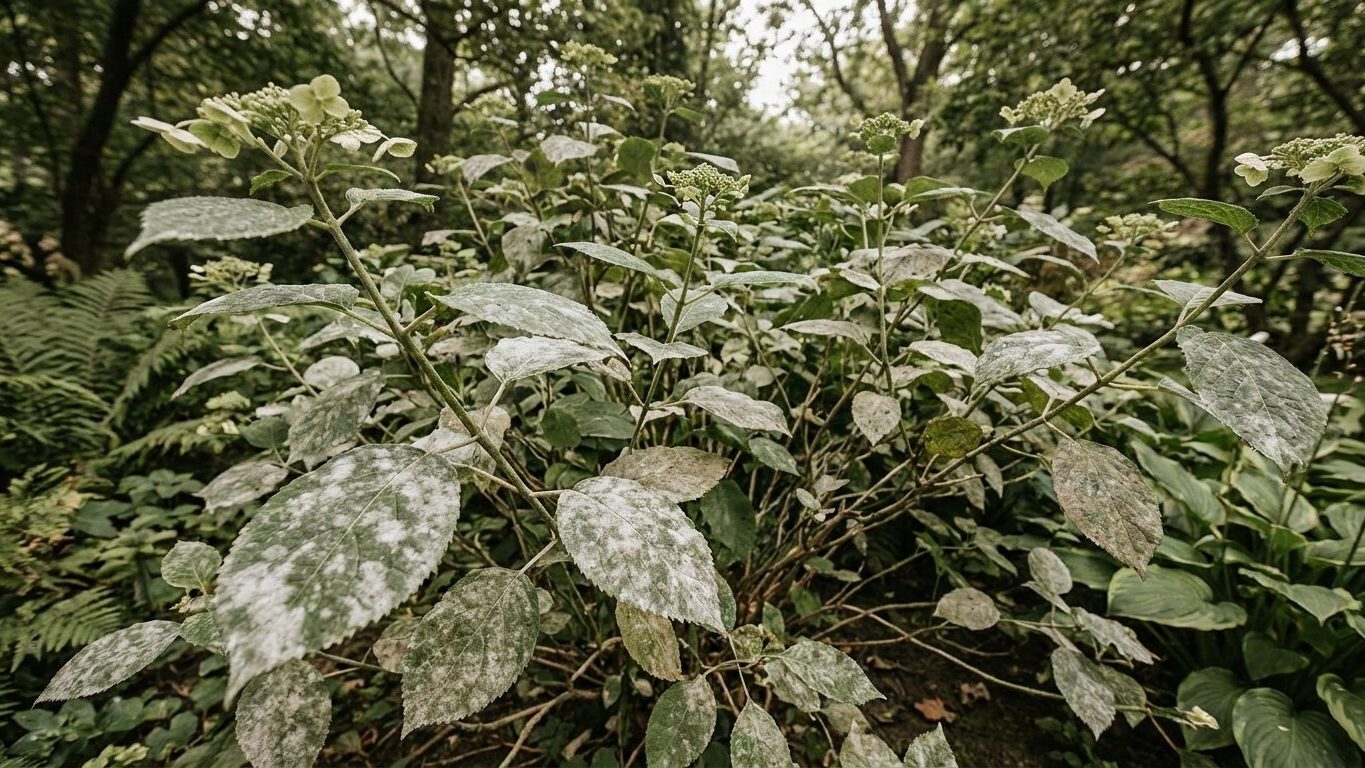

That white, flour-like coating across your hydrangea’s leaves is almost certainly powdery mildew, a fungal disease that looks worse than it usually is. It moves fastest in still, shaded air with weak circulation, exactly where many bigleaf and mountain hydrangeas sit for sun protection. Death is rare; disfigured leaves and a lighter bloom season are the real cost.
What you are looking at
Powdery mildew rarely kills a hydrangea outright, and it moves at a pace measured in weeks rather than days. What starts as a faint dusting on a few leaves can, in a shaded, crowded planting, cover most of the canopy by the end of a humid stretch. The disease is cosmetic until it becomes chronic, at which point it drains the plant’s energy and cuts into next year’s flowering.
Early white spots on the upper leaf surface
The first sign shows up as small, roughly circular patches of white to gray powder sitting on top of older, lower leaves first, the ones closest to the ground and farthest from moving air. Rub a finger across one and the powder smears rather than washing away in dew, which is the first clue separating it from ordinary water residue. The edge of each patch is fuzzy, not sharply drawn, and there is no colored ring or halo around it, unlike a true leaf spot lesion.
Powdery coating spreading across leaf and stem
Left alone, the dusting merges into larger blotches that can cover most of a leaf’s surface, front and back, and creep onto young stems and flower bracts. At this stage the leaf underneath the coating often looks slightly yellow or pale green, sometimes with a faint purplish blotch beneath the white film. Leaves may curl or pucker along the coated areas, but they do not wilt or collapse the way a vascular disease would make them do.
Distorted new growth and stunted buds
On the newest shoot tips, a heavy infection twists and stunts emerging leaves before they even unfurl, and flower buds already carrying mildew film often open smaller and paler than they should. This is the stage where the disease stops being purely cosmetic, because a plant that keeps losing new growth to mildew season after season blooms less each year even if no single leaf dies.
What it is not
Three things get mistaken for powdery mildew often enough that the mix-up is worth sorting out before you treat anything, because the wrong response wastes a season and, in the case of a bacterial problem, can push a treatable issue toward one that has no cure.
Leaf spot
Leaf spot lesions are angular or roughly round, brown to purple, and sunk slightly into the leaf tissue with a defined margin, sometimes ringed by a yellow halo. There is no powdery texture to rub off; the spot is part of the leaf itself, not a coating sitting on top of it. Leaf spot tends to start on lower, older leaves too, which is exactly why growers confuse the two at first glance, but a spotted leaf held up to the light shows dead, papery tissue rather than a dusty film you can wipe away.
Bacterial wilt
Bacterial wilt does not produce any white coating at all. Instead, individual stems or one side of the plant droop and collapse while the rest of the plant looks normal, often within days rather than weeks. Cut a wilting stem crosswise and a healthy hydrangea shows clean, pale tissue, while a bacterially infected one often shows discoloration in the water-carrying tissue just under the bark. Mistaking this for mildew and reaching for a fungicide changes nothing, because the pathogen is bacterial, and by the time the wilt is obvious, the affected stem is usually not coming back.
Mineral or spray residue
Hard water left to dry on foliage, or the chalky film left behind by some horticultural sprays, can look like a light mildew dusting from a few feet away. The tell is texture and pattern: mineral residue sits in uneven splash spots that follow where water droplets landed and dried, it does not smear when rubbed the way mildew powder does, and it never spreads leaf to leaf over the following week. Treating residue as disease means spraying a plant that was never sick in the first place, which wastes product and, with some fungicides, adds unnecessary stress to leaves that didn’t need it.
Where it comes from and when it strikes
Powdery mildew on hydrangea is caused by fungal species that survive the off-season as tiny resting structures on fallen leaves and in bark crevices, then release wind-borne spores once conditions turn favorable. Unlike many leaf diseases, this fungus does not need standing water on the leaf surface to infect it; what it needs is high humidity in the air around the leaf combined with a dry leaf surface, which is exactly the combination produced by warm, humid days followed by cooler nights.
Shade and still air matter as much as moisture. A hydrangea tucked against a fence or wall, planted too close to its neighbors, or shaded by a building with little breeze reaching it, holds a pocket of humid air right at leaf level even when the rest of the yard feels dry. That trapped air is where spores settle, germinate, and spread from leaf to leaf without ever needing rain. Spores travel easily on wind over long distances, which is why an infection can appear on a plant with no obvious local source, and infected transplants or nearby ornamentals can also carry the fungus into a bed that was clean the year before.
Once established, the fungus keeps producing new spores through the growing season as long as warm, humid stretches keep recurring, which is why symptoms often flare, seem to stall, and flare again rather than following one steady curve.
What to do about it now
Start by removing the worst-affected leaves and any fallen leaf litter under the plant, bagging or discarding it rather than composting it, since the fungus can persist on dead tissue. This does not cure leaves that are already heavily coated, and being honest about that matters more than promising a fix: a badly infected leaf will not turn green and clean again, but removing it stops it from seeding new infections on the leaves around it.
Improving airflow is the single change most likely to slow the disease down, because the fungus depends on that pocket of still, humid air near the foliage. Thin out crowded interior growth, widen the gap between the hydrangea and its neighbors where you can, and avoid overhead watering that wets the canopy in the evening, switching to watering at the base of the plant in the morning instead so any moisture on the leaves dries quickly. A layer of mulch over the root zone helps keep splash and soil-borne spores off the lowest leaves, useful since both bigleaf and panicle hydrangeas are shallow-rooted and already benefit from mulch for moisture reasons.
Where the infection is moderate and airflow has already improved, sulfur-based or potassium bicarbonate fungicides labeled for powdery mildew, or a light horticultural oil, can protect new growth from further infection, though they will not restore leaves already coated. Since hydrangeas are grown as ornamentals, not a food crop, there is no harvest-safety question here; the only documented toxicity concern with this genus is with bigleaf hydrangea itself, and only if a large quantity of bark, leaves, flowers or stems is eaten, which has nothing to do with a mildew infection.
Keeping it out next season
Sanitation carries most of the weight going into next year: rake and discard fallen leaves rather than letting them sit under the plant over winter, and clean any stakes, cages or pruning tools that touched infected material before storing them. Spacing new plantings wide enough for air to move between them, and pruning for an open center rather than a dense thicket, addresses the still-air problem at its root instead of reacting to it after the fact.
The extension source behind this page does not publish specific powdery-mildew-resistant hydrangea cultivars or resistance letter codes the way some vegetable seed packets carry disease-code letters, so no cultivar names are given here as mildew-proof. What does shift the odds is choosing the right type for the site: panicle hydrangea is the one type in the genus that takes full sun well, which the source itself describes as a useful substitute for bigleaf hydrangea where that species is not winter hardy, and a sunnier, breezier spot naturally works against the humid, still conditions mildew favors.
| Type | Wood it flowers on | Light tolerance | Mildew-relevant note |
|---|---|---|---|
| Bigleaf / mop-head (H. macrophylla) | Last year’s wood | Dappled to deep shade; avoid afternoon sun | Shade requirement raises still-air risk |
| Panicle / peegee (H. paniculata) | Current season’s growth | Full sun tolerant | Also susceptible to rust and bud blight per source |
| Smooth (H. arborescens) | New wood | Hardiest of the genus | Sanitation still matters even in open sites |
| Oakleaf (H. quercifolia) | Old wood | Partial shade tolerant | Good airflow around its larger leaves helps |
| Mountain (H. serrata) | Old wood | Similar to bigleaf | Buds tolerate late frost better than bigleaf |
Pruning timing, winter hardiness by zone, and how deep to mound protection all depend on which of these types you’re growing and where you garden, which is why those specifics live on the type and state pages in this guide rather than here.
Common questions
Will powdery mildew kill my hydrangea?
Rarely. It weakens the plant and cuts into flowering if it becomes chronic year after year, but a single season’s infection, even a heavy one, is usually cosmetic rather than fatal.
Can I still let the plant flower if it has mildew?
Yes. The flowers themselves are not toxic to the plant’s overall health from mildew alone, and unless the disease has stunted the buds badly, the plant can still bloom while you work on airflow and sanitation for next year.
Does moving my hydrangea into more sun fix mildew?
It can help by drying leaves faster and breaking up still air, but only panicle hydrangea genuinely tolerates full sun well; moving a bigleaf or mountain hydrangea into afternoon sun trades a mildew problem for leaf scorch.
Is the white powder dangerous to touch or breathe?
No specific human hazard is documented for this fungus on hydrangea beyond routine caution when handling any garden fungicide, and it is unrelated to the plant’s own documented toxicity, which applies only to bigleaf hydrangea eaten in large quantity.