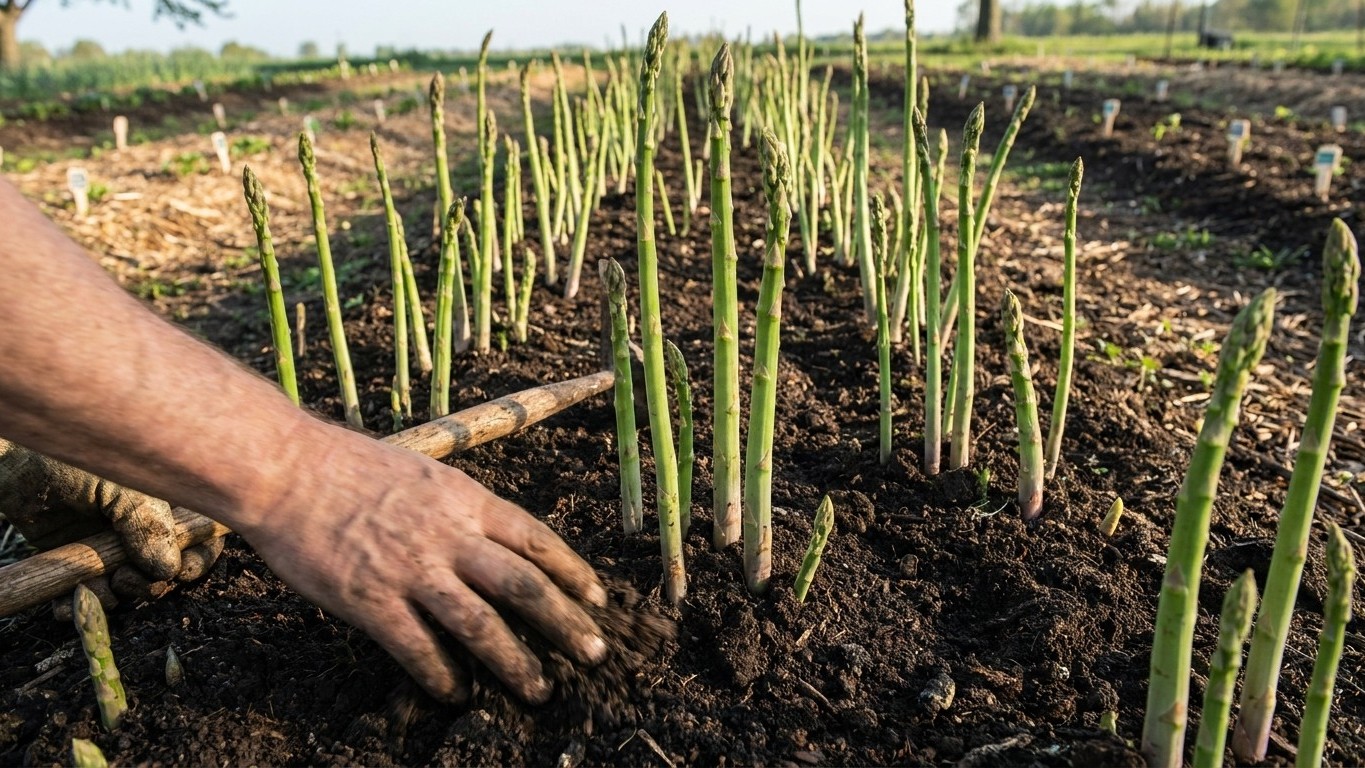

Jersey King asparagus is an all-male hybrid cultivar recommended by Clemson Cooperative Extension for home gardens across the Southeast and beyond. It sets no seed, sends its energy into spears instead of berries, and needs a bed prepared for a long game: two to three years of patience before the first real harvest, and decades of production after that.
All-Male Hybrid or Open-Pollinated: What Jersey King Actually Buys You
The label “all-male hybrid” sounds like a technical footnote. It isn’t. An open-pollinated asparagus variety produces roughly half female plants, and those females make berries. The berries drop, overwinter in the soil, and sprout the following spring as volunteer seedlings scattered through the row. Anyone who has weeded a mixed asparagus bed knows the drill: pulling baby asparagus plants out from between the crowns you actually want, season after season, because the females never stop reseeding themselves.
Jersey King skips that problem entirely. As an all-male hybrid, it sets no seed at all. Every bit of energy the plant would otherwise spend on flowers and berries goes into spear production instead. No berries means no volunteer seedlings, no crowded rows, no mystery plants competing with the crowns you paid for. Clemson Cooperative Extension lists Jersey King among its recommended all-male hybrid cultivars for exactly this reason: it keeps the bed clean and lets the grower control spacing for the life of the planting.
What the label does not tell you, because no source publishes it, is a yield number or a days-to-maturity figure for Jersey King specifically. Those numbers simply aren’t part of the published record for this cultivar or its all-male relatives. What matters more for planning purposes is the mechanism: an all-male hybrid puts its resources toward spears rather than reproduction, and that changes how the bed behaves for as long as it’s in the ground, not just in the first season.
The Real Timeline: Two to Three Years Before Any Harvest
Here’s the part that changes whether someone should plant asparagus at all this year. Clemson Cooperative Extension is direct about it: “asparagus takes two to three years to begin production.” That’s not a rough estimate tucked into fine print. It’s the baseline expectation for the crop, Jersey King included.
Crowns planted this spring won’t give a full harvest next spring, or even the spring after that. Clemson spells out the timeline further, noting that “crowns may need two to three full growing seasons before limited harvesting can be done in the third or fourth year.” Limited harvesting is the key phrase there, and it deserves to be read literally. It does not mean a full cutting season starting in year three. It means a handful of light pickings, spread thin, while the plant continues building the root system that will support real production later.
For two or three growing seasons, the job is maintenance without reward: weeding, watering, watching fern grow tall and fall over in autumn, and doing it all again the next year. No spears to eat, no harvest to show for the work. That’s a real cost in time and bed space, and it’s worth weighing before committing a garden plot to asparagus rather than a faster-producing vegetable.
The payoff on the other side of that wait is what makes growers stick with it anyway. Once an asparagus bed matures, it keeps producing for fifteen to twenty years or longer with basic upkeep. Few vegetable plantings offer that kind of return on a multi-decade timescale. But the two-to-three-year gap between planting and any meaningful harvest is not a footnote. It’s the central fact anyone considering asparagus needs to plan around.
Planting Depth: Why the Trench Gets Filled Gradually
Most people picture planting a crown the way they’d plant a bulb: dig a hole to the right depth, drop it in, cover it, done. Asparagus doesn’t work that way, and skipping the actual method is one of the more common reasons a new bed struggles.
Clemson Cooperative Extension’s guidance starts with the trench itself: “Set the crowns 15 to 18 inches apart and 6 to 8 inches deep.” That’s the target depth, but it is not where the crown starts out. The second half of the instruction explains the actual process: growers should “continue to pull soil over the crowns (about 2 inches every two to three weeks) until the trench is filled, and the crowns are 6 to 8 inches deep.”
In practice, that means the crown goes into an open trench first, with only a light covering of soil, not a full 6 to 8 inches all at once. As the spears begin to emerge and grow, the grower pulls in another couple of inches of soil roughly every two to three weeks. The trench fills gradually, in stages, tracking the plant’s own growth rather than being buried all at once on planting day.
This sequencing matters because burying a crown at full depth immediately can smother emerging spears before they ever break the surface, and it deprives the plant of the shallower, warmer soil it needs early on to get established. The ranges Clemson gives (15 to 18 inches apart, 6 to 8 inches deep, roughly 2 inches every two to three weeks) aren’t arbitrary padding. They reflect real variation in soil type, crown size, and regional climate, which is exactly why they’re worth keeping as ranges rather than rounding them down to a single tidy number.
When to Stop Cutting: The Pencil-Size Rule
Every asparagus grower eventually asks the same question: how long can I keep harvesting once the season starts? Clemson Cooperative Extension answers it with a rule tied to the plant itself rather than a date on the calendar: “Stop harvesting when the diameter of the spears has been reduced to pencil-size and allow the spear to grow to full height.”
The logic behind that rule comes down to how the plant stores and spends energy. Each spear cut during harvest represents stored reserves the crown built up the previous summer through photosynthesis in its ferny top growth. Early in the season, spears come up thick because reserves are high. As harvest continues, the plant draws down those reserves, and the spears it sends up get progressively thinner. Once they’ve narrowed to about pencil width, that’s the bed signaling it’s running low.
At that point, continuing to cut would push the plant deeper into debt it can’t repay before winter. Letting the pencil-thin spears grow out into full fern instead gives the plant the summer months it needs to photosynthesize and rebuild the underground reserves that next year’s harvest, and the harvest after that, will depend on.
No calendar date could do this job as well, because growing seasons shift by region, by weather year to year, and by how mature the bed already is. A gardener in coastal South Carolina and one in the Upper Midwest will hit pencil-size spears on completely different weeks. The sign works everywhere the plant grows; a fixed date wouldn’t.
Common questions
How long before Jersey King asparagus produces a real harvest?
Clemson Cooperative Extension states that asparagus generally takes two to three years to begin production, with crowns often needing two to three full growing seasons before even limited harvesting can start in the third or fourth year. Full, regular harvests come after that establishment period.
Why does Jersey King asparagus not reseed itself in the bed?
Jersey King is an all-male hybrid, so it sets no seed. Without berries and seed drop, there are no volunteer seedlings sprouting between the crowns the following spring, unlike open-pollinated varieties where female plants reseed the row.
How deep should asparagus crowns be planted?
Clemson recommends setting crowns 15 to 18 inches apart and eventually 6 to 8 inches deep, but not all at once. Soil is pulled over the crowns gradually, about 2 inches every two to three weeks, until the trench fills in and reaches full depth.
When should someone stop cutting asparagus spears each season?
Stop when spear diameter narrows to about pencil-size, per Clemson Cooperative Extension guidance. At that point, let the remaining spears grow to full height and fern out, which lets the plant rebuild the energy reserves it needs for next season’s harvest.