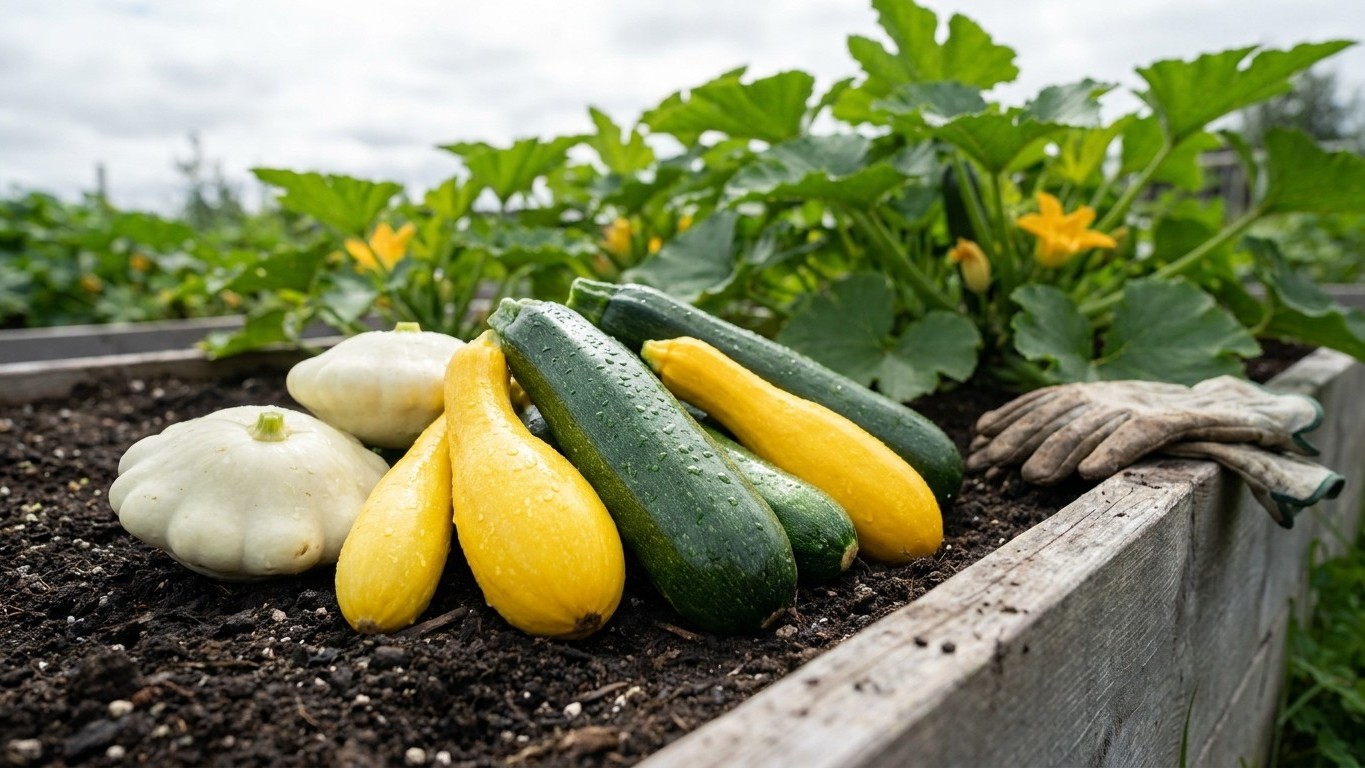

Zucchini, yellow straightneck, yellow crookneck, and pattypan or scallop types all perform well across Pennsylvania. The choice between them should hinge on heat and disease pressure, not on whether the season is long enough, because every standard summer squash matures fast enough to fit inside even the state’s shortest frost-free window.
The short answer for Pennsylvania
Start with the number that actually decides this: at the reference station in Philadelphia, the frost-free window runs from around March 29-April 6 in spring to November 5-16 in fall. That is close to seven months of growing time in the mildest corner of the state. A bush zucchini, a yellow straightneck, or a pattypan squash typically reaches first harvest in the range of six to eight weeks from sowing. Even allowing for a slow start and a second or third succession planting, none of the standard summer squash types come close to running out of season here, even in the parts of Pennsylvania where spring arrives two to four weeks later.
That single fact reframes the whole decision. On a page about winter squash or long-season melons, season length would be the first filter. Here it barely matters. The real variable is Pennsylvania’s summer climate profile: a moderate 24 days a year at or above 90F, paired with about 12.7 inches of rain spread across June, July, and August (June the driest at 4.04 inches, July 4.38, August 4.29). That is not a hot, dry climate that punishes tender plants, and it is not a bone-dry one that demands drought-tolerant selections. It is a warm, humid, thunderstorm-driven summer, and that points the decision toward disease tolerance and airflow rather than heat survival.
For most home gardens, that means bush-type zucchini and yellow squash are the dependable default statewide: compact, fast, and easy to keep dry at the base. Pattypan and scallop types do just as well and often show a bit more tolerance for the up-and-down soil moisture that comes with thunderstorm rainfall rather than steady soaking rain. Long, trailing Italian-style summer squash (the kind that ramble like a vine rather than sit in a bush) are the one category to hold back on in the shorter-season parts of the state, simply because they take longer to hit full production and have less margin if the spring start slips.
In short: the type of summer squash matters less here than how it is spaced, watered, and watched for disease. That is the part a generic planting guide will not tell you, and it is where a Pennsylvania garden actually wins or loses its squash crop.
What will not work here
The failure pattern in Pennsylvania is rarely “the plant ran out of season.” It is almost always disease pressure or a watering habit that does not match how the rain actually falls. That distinction matters, because it changes what a gardener should fix.
Take the long-vining Italian summer squash types, sometimes grown for their pale, ribbed fruit picked young. They need more total growing days to hit their stride than a bush zucchini does, and in the northern tier or the higher elevations of the Alleghenies, where last frost can land two to four weeks after the Philadelphia date, that extra lag matters. A trailing type sown on the same calendar date as a bush zucchini in those regions may still produce, but it will produce later and less, and a grower expecting the same yield curve as in the southeast will be disappointed. This is not a season that defeats them outright; it is a season that shrinks their margin for error.
Weekly watering schedules are the more common failure, and they fail because of how Pennsylvania’s summer rain actually arrives. Roughly 4 inches a month sounds like plenty, but that figure is a normal, not a delivery schedule. When rain lands as a single summer thunderstorm rather than a steady soak, a good share of it runs off before it reaches the root zone, especially on compacted soil. Add in 24 days a year of 90F heat driving evaporation, and a squash plant watered only once a week can sit dry for stretches even in a “normal” rainfall month. The fix is not more water overall; it is checking soil moisture between storms rather than trusting the calendar.
Tight spacing is the third failure, and it is a humidity problem more than a heat one. Summer squash planted close together holds moisture on its leaves longer after rain or morning dew, and Pennsylvania’s humid summer air slows that drying further. Powdery mildew is the predictable result, showing up as a pale dusting on leaves by mid to late summer in crowded plantings. Wider spacing than a seed packet’s minimum, and airflow between plants, does more to prevent this than any variety choice.
What changes across Pennsylvania
Pennsylvania is not one growing climate. The USDA Plant Hardiness Zone Map (2023 edition, built on 1991-2020 winter minimum temperatures) places the state across zones 5a to 7b, a spread wide enough that a single statewide sowing date does not exist. There is no one answer here, only a range, and where a given garden falls inside that range changes the practical calendar more than the squash variety does.
The Philadelphia dates cited above (last frost March 29-April 6, first frost November 5-16) sit at the mild end of that spread, in the warmer 7b corner of the southeast. The northern tier and the higher ground of the Alleghenies run colder, corresponding to the 5a end, and their last spring frost typically lands two to four weeks later than Philadelphia’s. A gardener in one of those areas working from the southeastern date range risks direct-sowing or transplanting into soil that has not yet warmed enough, and into a frost risk that has not yet passed.
| Region tendency | Approximate zone range | Practical shift from Philadelphia dates |
|---|---|---|
| Southeast (Philadelphia and similar low-elevation, urban-influenced areas) | Warmer end, 7a-7b | Dates as given; earliest safe start in the state |
| Central Pennsylvania, moderate elevation | Mid-range, 6a-6b | Push planting roughly one to two weeks later |
| Northern tier and Allegheny high country | Colder end, 5a-5b | Push planting roughly two to four weeks later |
This table is a tendency, not a lookup table for any one address. Elevation, slope, and how close a garden sits to a city or a large body of water all shift a location within that range, sometimes by a full zone in either direction. The right move is not to guess a zone from a rough regional description, but to check the USDA map directly for the specific location before setting a sowing date.
Where to check this for your own county
This page gives Pennsylvania’s statewide picture, built from a single reference station. That is useful for understanding the pattern, but it is not a substitute for a county-level recommendation, and county data will beat this page every time it is available.
Penn State Extension is the place to look. Two things there are worth searching for specifically. First, a local or regional planting calendar, which will reflect the actual frost dates for that county rather than the Philadelphia-based normals used here, and which matters most for gardeners in the northern tier or at higher elevation where the two- to four-week spring shift noted above applies. Second, any variety trial results or extension bulletins for Summer Squash in that county or region, since Penn State’s horticulture programs periodically evaluate performance for disease resistance and yield under Pennsylvania conditions, which is exactly the variable this page identified as the deciding factor over season length.
A state-level page like this one is built to explain the mechanism: why season length is not the constraint, why humidity and rainfall pattern are, and how much the zone spread varies across the state. A county extension recommendation does something this page cannot: it applies that mechanism to a specific set of local frost records, local disease pressure, and sometimes even local variety trial data from test plots in that region. When the two disagree on a specific date or variety pick, the county source is the one to follow.
Checking this against your own garden
Every date and normal in this article describes an average built from decades of station data. A single garden, on a specific soil, on a specific slope, can run days or even weeks ahead of or behind that average. The most reliable calendar is the one a gardener reads directly from the plants and the soil in front of them.
Soil warmth by feel is the first check. Summer squash seed sits and rots rather than germinating in cold soil, no matter what the calendar says. Working a hand into the top few inches of soil on a sunny afternoon and comparing that warmth to a memory of the previous week gives a rough but honest read: soil that still feels cool and damp rather than warm and crumbly is not ready, regardless of the date on this page.
The first flush of male flowers is the second signal, and it is often misread. Summer squash reliably produces a wave of male flowers before the female flowers (the ones with a small swollen bulge at the base) appear in any number. Seeing flowers with no fruit set yet is not a problem; it is the plant’s normal sequence, and it usually means fruit is a week or two away.
The first true leaves are the third. The two rounded leaves that emerge first from a squash seed are seed leaves, not true leaves. The next set, with the jagged, more recognizably squash-shaped edge, marks the point where the plant has switched from living off seed reserves to actively growing on its own. A garden where true leaves appear quickly after germination is running warm and well-suited to the crop that season; a slow, delayed appearance is worth noting as a sign that particular bed runs cooler than the county average, useful information for every squash planted there in the years after.