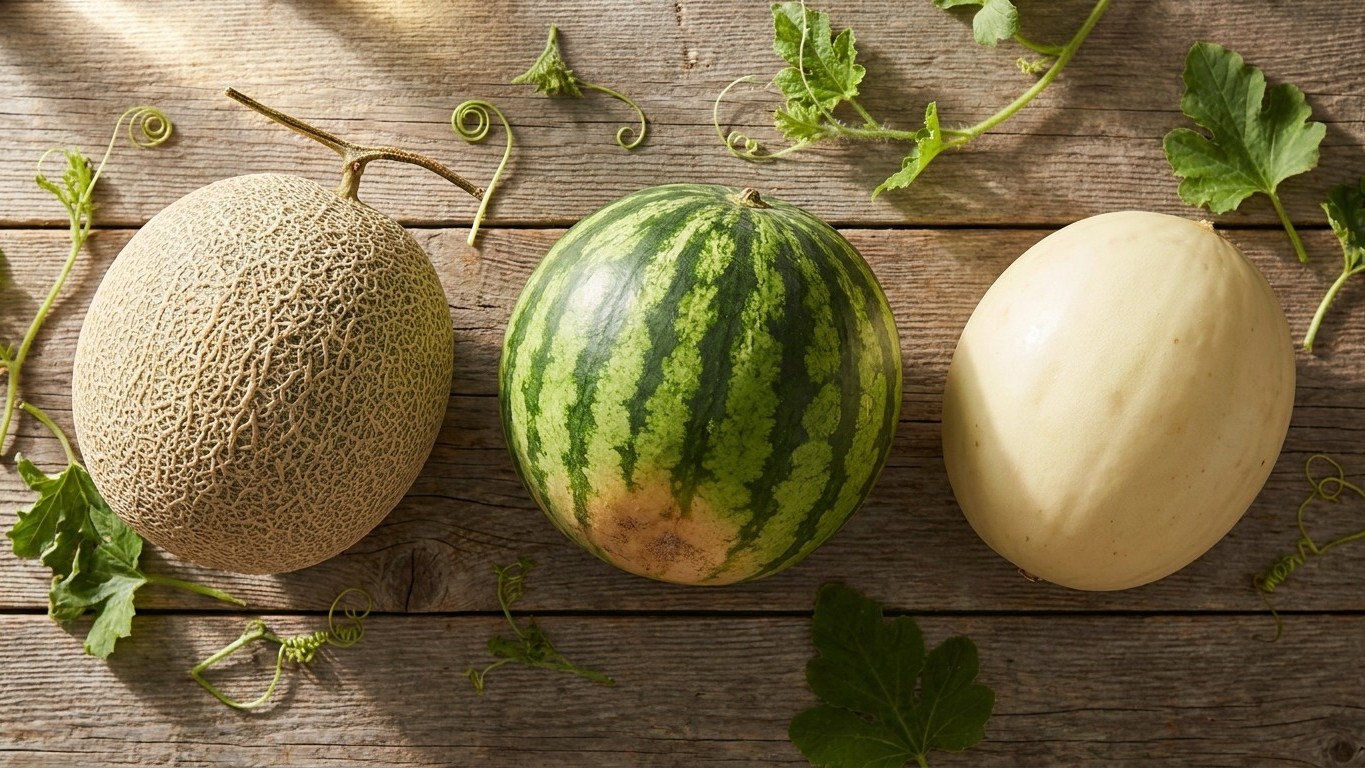

A muskmelon tells you it’s ready by letting go of the vine. A watermelon never will, so you check the spot where it rests on the ground and the tendril curling near the stem. A honeydew stays put too, but its skin turns from matte to a soft, waxy sheen. Three types, three different signals, one shared fact: none of them sweetens after you cut it loose.
What is actually going on

The thing to understand here is that sugar arrives from the leaves until the stem parts, so picking is the moment sweetness stops for good. A melon plant is running sugar down its vine into the fruit for as long as that connection stays intact. Cut the stem, or let the fruit separate on its own, and the pipeline closes. Whatever sugar is in the flesh at that instant is what you get. Nothing that happens after, on a counter or a windowsill, adds a gram of it.
This is where a lot of confusion sets in. A melon left out for a few days after harvest does change. The flesh softens, the aroma gets stronger, the color of the rind can shift a shade. Those changes look like ripening, and people describe them that way, but they are not the same process. Softening is just the fruit’s cell walls breaking down. It happens whether the melon was picked sweet or picked bland. A melon harvested too early will get softer and mushier over the following days without ever tasting like it should have. That is the single most misunderstood fact in melon growing, and it is worth saying plainly: a melon does not ripen after picking, it softens.
Different types signal their peak sugar moment in different ways because they are built differently at the stem. Netted, aromatic types (the cantaloupe-style muskmelons) develop what growers call an abscission layer, a ring of cells at the point where stem meets fruit that weakens on schedule and eventually lets the fruit detach with almost no force. That is the mechanical basis for the “slip” test gardeners rely on. Watermelons and the smooth-skinned winter types (honeydew, casaba, crenshaw) never form that weak layer. Their stems stay tightly attached even at full ripeness, sometimes past it, which is why growers of those types have to read the fruit itself instead of the stem.
None of this is about a fixed number of days. Heat, water, and light all speed up or slow down the sugar-loading process, so the same seed grown in two different backyards can hit peak ripeness on two different schedules even in the same season. That variability is normal, and it is the reason experienced growers check fruit rather than count days on a calendar. For the varieties actually trialled and recommended in your area, your state’s Cooperative Extension office keeps that data current, and it is worth a call before you assume a number you read somewhere applies to your yard.
In the garden
What each type tells you
The signal that matters changes by type, and mixing them up is the fastest way to end up with a bland melon or a rotten one still hanging on the vine.
| Melon type | Real ripeness signal | What it means when the signal is missing or misread |
|---|---|---|
| Netted muskmelon (cantaloupe-type) | Full slip: the stem separates from the fruit with a gentle lift, no cutting needed. Background color under the netting shifts from green to tan or gold, and the blossom end develops a sweet smell. | Netting color alone, without the slip, means the fruit is still attached and still under-ripe. Picking at “half slip” (some resistance still felt) gives inconsistent sugar and is a common source of disappointment. |
| Watermelon | The tendril closest to the fruit stem dries out and turns brown. The ground spot, where the melon rests on soil, changes from white to a creamy yellow. The rind loses its glossy shine and looks duller. | Thumping alone is unreliable because the sound reflects rind thickness and shape, not sugar content. Relying on it without checking the tendril and ground spot leads to a lot of guessing. |
| Honeydew and other smooth-skin types (casaba, crenshaw, canary) | Skin texture changes from fuzzy or matte to smooth and slightly waxy. Overall color deepens toward cream or gold. The blossom end gives slightly under gentle thumb pressure. | Because these types never slip from the vine, waiting for a stem separation never happens naturally. Left too long “waiting for the slip,” the fruit overripens or splits on the vine instead. |
When the signal is wrong
Every one of these cues can mislead you if you read it alone. A muskmelon can develop tan netting color under stress, drought or heat, before the stem is actually ready to release, so color without slip is not enough. A watermelon’s ground spot can turn yellow prematurely if the fruit sits on a warm rock or mulch rather than bare soil, which is why growers check the tendril too. A honeydew’s skin can look waxy from a coating of natural bloom rather than true ripeness, especially in humid weather. The fix in every case is the same: check more than one signal before you cut, and note what actually happens when you slice one open. That feedback, more than anything printed here, teaches you your own garden’s timing.
What it depends on where you are
Everything above describes the mechanism, and the mechanism is the same everywhere melons grow. What is not the same is how fast a plant gets there. Season length, summer heat, and summer rainfall all change how quickly sugar loads into the fruit and how reliable each visual signal turns out to be.
A long, hot, dry summer pushes sugar development faster and tends to make the classic cues (slip, tendril browning, ground spot color) show up cleanly and close together. A short or cool season stretches the whole process out, and fruit can sit at “almost there” for what feels like a long stretch before finally finishing. Heavy rain in the final stretch before harvest is its own complication: a sudden soaking after a dry spell can cause fruit to take up water fast, sometimes fast enough to split the rind, and it dilutes sugar even in fruit that looks otherwise ready. Growers in humid, rain-heavy regions watch the ground spot and tendril more carefully for exactly this reason, because a fruit that looks color-ready can still taste watery if it swelled with rain in its last few days.
None of this is guesswork you have to do alone. Your state’s Cooperative Extension office tracks which types perform reliably in local conditions and can tell you what an average season looks like where you garden. The Cooperative Extension System, coordinated through USDA NIFA, is the standard place to start, and pairing that local guidance with the state-specific growing pages elsewhere in this guide will get you closer to a harvest date than any general rule can.
The mistake that costs the most
The single costliest error is picking too early out of impatience or fear, and then expecting the melon to finish the job on the counter. It usually happens for an understandable reason: a raccoon has been sniffing around, or the fruit looks close enough, or the gardener simply wants to taste something after months of waiting. So it gets cut a few days ahead of the real signal, on the assumption that a little more time indoors will bring it the rest of the way.
It will not. The fruit will soften, the smell will get stronger, and it will look more “ripe” to the eye, but the sugar content is locked in at the moment the stem parted or was cut. That softer, more fragrant melon on the counter is not sweeter than it was the day it was picked. It is just closer to spoiling. This is true across every type discussed above, netted or smooth-skinned, slip-forming or not.
The fix is patience paired with better reading, not earlier picking. If pests are the worry, protect the fruit where it sits (netting, a cage, or moving mulch away from direct ground contact) rather than harvesting ahead of schedule. If the uncertainty is the real problem, check two signals instead of one before deciding, since a single cue misreads more often than a pair does. And keep a simple note from season to season of when each type actually hit its true signal in your own garden. That personal record, built over two or three seasons, ends up more accurate for your yard than any general guideline, including this one.