
Root-knot nematodes stay active in Florida for most of the year because the state rarely gets a hard freeze deep enough to kill them off in the soil. Peak damage shows up during the warm months, roughly March through November, when soil temperatures sit in the 70s and 80s Fahrenheit and the pests move fastest through sandy ground. Stopping them comes down to three things: knowing your soil type, rotating what you plant, and testing before you commit to a crop or a new flower bed.
Florida’s Root-Knot Nematode Season: No Real Off-Time

In states with cold winters, freezing soil temperatures push nematode populations into a kind of dormancy that thins out their numbers year after year. Florida doesn’t offer that reset. Soil temperatures in most of the state rarely drop below 55°F even in January, and root-knot nematodes (genus Meloidogyne) can keep feeding and reproducing whenever the soil stays above roughly 60°F. That means a gardener in Ocala or Fort Myers might see gall damage on tomato roots in February just as easily as in August.
The activity does slow during cooler stretches. Reproduction rates drop, and above-ground symptoms become less dramatic when plants aren’t under summer heat stress. But the eggs and juveniles survive in the root zone, waiting for warmer soil and a host plant to wake back up. South Florida, with its longer growing season and milder winter lows, sees more generations per year than the Panhandle, where a handful of nights below 40°F can slow things down without eliminating the population.
Why Sandy Soil Makes Florida Ground Zero
More than half of Florida’s land area sits on sandy or sandy-loam soil, and that texture is close to ideal for root-knot nematodes. Sand particles are large and loosely packed, which gives these microscopic worms room to move through the soil profile in search of roots. Clay-heavy soils in other regions physically slow nematodes down; Florida’s sand does the opposite.
Sandy soil also drains fast and holds less organic matter, which limits the natural predators and competing microbes that would otherwise keep nematode populations in check. That combination, warm soil temperatures plus loose, low-organic-matter sand, explains why Florida shows up so consistently in University of Florida extension research as one of the higher-pressure regions in the country for this pest. The UF/IFAS Nematode Assay Laboratory processes soil samples from homeowners and growers across the state specifically because the risk here is high enough to warrant routine testing before planting susceptible crops.
Certain pockets are worse than others. Vegetable fields and home gardens built on former citrus or pasture land often carry legacy populations, since root-knot nematodes can persist in soil for years without a host, surviving as eggs until a new root system gives them something to attack.
Spotting the Damage Before It’s Too Late
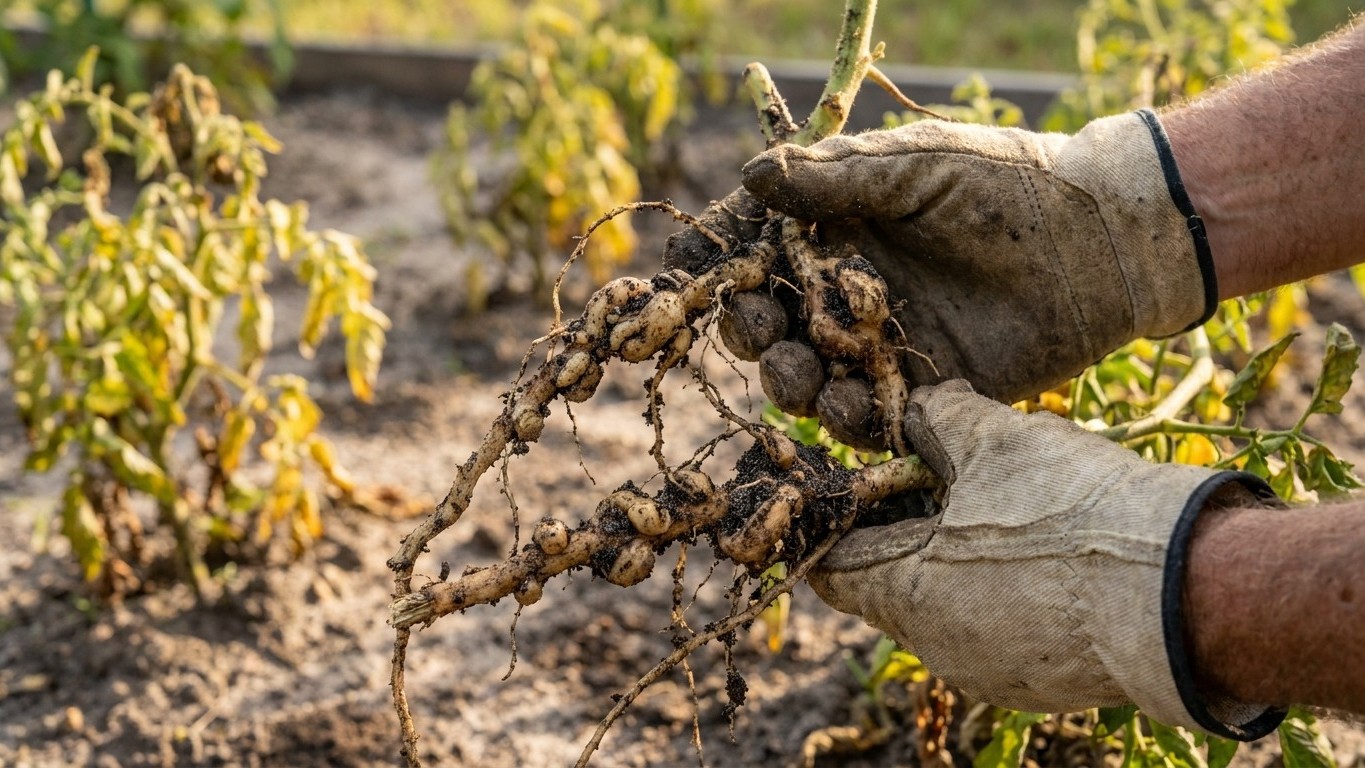
The telltale sign is underground, not above it, which is exactly why so many gardeners miss the early warning. Pull up a struggling plant and check the roots. Healthy roots look thin and branching; infected ones show swollen knots or galls ranging from pinhead-sized to marble-sized, depending on how long the infestation has been building.
Above ground, the symptoms mimic a dozen other problems, which makes root-knot nematode damage frustratingly easy to misdiagnose as a fertility or watering issue. Watch for:
- Stunted, uneven growth compared to plants of the same age and variety
- Yellowing leaves that don’t respond to added nitrogen
- Wilting during the heat of the day even when soil moisture looks adequate
- Poor yield on tomatoes, peppers, okra, squash, and other warm-season vegetables
- Patchy, thinning turfgrass in lawns, especially on St. Augustine grass grown on sandy sites
Tomatoes and okra tend to show the most obvious galling because they’re highly susceptible hosts. Root vegetables like carrots come out misshapen or forked, which ruins the harvest even when the plant itself looked fine all season. Ornamentals aren’t immune either; hibiscus, gardenias, and many bedding plants can carry infestations without dying outright, just underperforming year after year in a way that’s easy to blame on the wrong thing.
Confirming It’s Really Nematodes
Digging up roots and checking for galls is the fastest home diagnostic, but it’s not foolproof, since some nematode species and other soil pests cause similar symptoms without visible galling. A soil sample sent to a university diagnostic lab, taken from the root zone of a struggling plant, gives a confirmed species identification. That distinction matters because control strategies differ somewhat depending on whether you’re dealing with Meloidogyne incognita, M. javanica, or M. arenaria, the three species most common in Florida soils.
What Actually Stops Them
There’s no single product that wipes out root-knot nematodes for good in Florida conditions. Effective control almost always comes from stacking several tactics, and the order you apply them matters as much as the tactics themselves.
Crop rotation is the cheapest and most accessible tool for home gardeners. Switching a bed from tomatoes to a resistant crop, or leaving it fallow with regular tilling to expose eggs to sunlight and drying, breaks the reproduction cycle. The catch is that root-knot nematodes have an unusually wide host range, feeding on more than 2,000 plant species, so rotation only works if the replacement crop is genuinely resistant rather than just a different vegetable that happens to be equally susceptible.
Resistant varieties make a real difference in vegetable gardens. Many modern tomato cultivars carry the “N” gene for nematode resistance, listed on seed packets and plant tags. Cowpeas, some pepper varieties, and certain sweet potato cultivars also carry documented resistance. Checking labels before buying transplants saves a season of frustration.
Soil solarization works well in Florida precisely because of the intense summer sun. Covering bare, moist soil with clear plastic for four to six weeks during peak summer heat raises soil temperatures high enough to kill a large share of nematode eggs and juveniles in the top foot of soil. It’s labor-light but time-intensive, and it only works on beds that can sit empty during the hottest stretch of the year.
Cover crops offer a biological angle. French marigolds and certain sunn hemp varieties release compounds from their roots that suppress root-knot nematode populations, and growing a full season of either before switching to a susceptible vegetable can meaningfully lower egg counts in the soil. This approach takes patience, since the benefit builds over one to two full growing cycles rather than showing up overnight.
Organic matter helps indirectly. Compost, aged manure, and mulch don’t kill nematodes directly, but they encourage populations of nematode-trapping fungi and predatory microorganisms that Florida’s low-organic sandy soils otherwise lack. Building organic matter over several seasons is a slow fix, but it’s one of the few strategies that improves the whole soil ecosystem rather than targeting the pest in isolation.
Chemical nematicides exist for larger-scale agricultural use, but most are restricted-use products requiring licensing, and home garden options are limited compared to what commercial growers can access. For most homeowners, the combination of resistant varieties, rotation, and solarization covers the bulk of practical control without needing to reach for a pesticide label at all.
One detail that surprises a lot of Florida gardeners: soil testing before planting is often more useful than treating after symptoms appear, since by the time galls show up on a mature plant, that season’s harvest is already compromised. A pre-season sample, especially in a bed with a history of poor vegetable performance, gives enough lead time to choose a resistant variety or plan a solarization window instead of guessing after the damage is done.