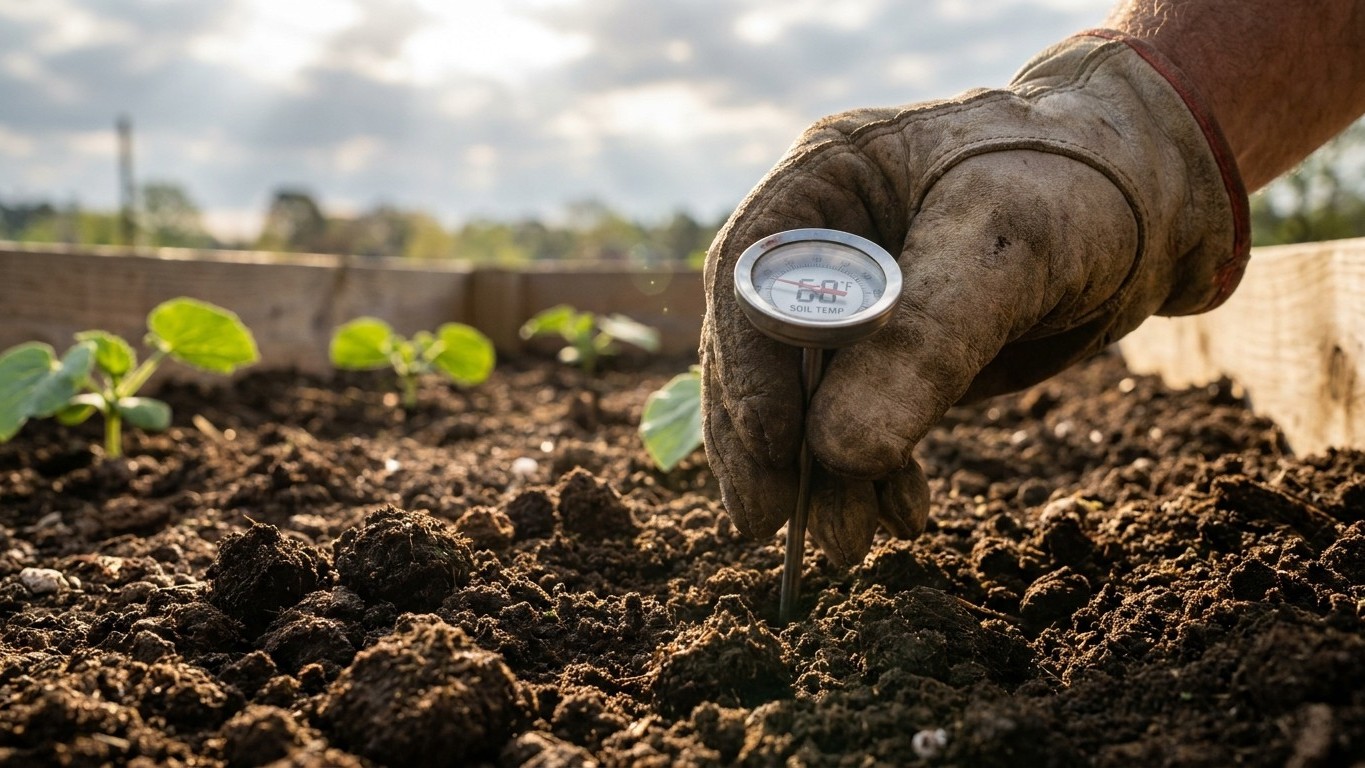

Melons need warm soil more than a calendar date, and in Kentucky that soil typically comes ready between mid-April and early May, depending on where in the state a garden sits. The growing window itself runs long, roughly seven months between frosts, which gives melon growers real flexibility on timing, succession sowing, and variety choice.
When the soil is warm enough in Kentucky

The question every Kentucky gardener asks in spring isn’t really “when’s the last frost” but “when can I trust the ground.” Those are related, but they’re not the same thing, and melons care about the second one far more than the first.
According to NOAA’s 1991-2020 Climate Normals, the last spring frost at the reference station in this data (Louisville, station USW00093821) falls in a window of March 24 to April 4. That’s a 30 to 70 percent probability band, not a guarantee, and it’s worth reading exactly that way: it’s the range where the odds of a freeze swing from unlikely to still plausible. A frost date tells you when the air stops threatening. It doesn’t tell you when the soil is warm enough for melon roots to do anything useful.
Soil warms slower than air, sometimes by two to three weeks, because the ground has to shed months of stored winter cold before it holds heat overnight. Melon seed sitting in soil below the mid-60s Fahrenheit will often just rot rather than germinate, and transplants set into cold ground tend to stall for weeks even if they survive. That lag is why experienced growers in this region wait until well after the frost date clears before they put melons in the ground, whether by seed or transplant.
One caution matters here: NWS Louisville has noted that this particular station, being urban, tends to run later in spring and earlier in fall than the surrounding rural county. A garden outside the city, especially in a low-lying or rural spot, should expect a tighter window than the station figures suggest, meaning frost risk lingering a bit longer into spring and arriving a bit sooner in fall.
Rather than guessing at a fixed date, most Kentucky gardeners take two readings before planting melons: a soil thermometer check in the row itself, and a look at the ten-day forecast for any lingering cold nights. If both cooperate, the ground is ready regardless of what the calendar says.
Warming the soil faster
Black plastic mulch laid over the bed a week or two before planting is the standard practice for pulling soil temperature up faster in this climate, since it captures solar heat directly at root level instead of waiting on air temperature alone. Raised beds and mounded rows help for the same reason: more surface exposed to sun, faster warmup, better drainage after spring rain.
How long the season lasts here
Kentucky’s frost-free window runs from that spring range of March 24 to April 4 out to the first fall frost, which NOAA’s same 1991-2020 Normals place between November 2 and November 12 at the reference station. Doing the subtraction across both ends of the range gives a season of roughly 212 to 233 days between frosts, depending on which edge of each band a given year lands on.
That’s a long window by melon standards. Most melon types need somewhere in the neighborhood of 70 to 100 days from planting to harvest, so even the shorter end of Kentucky’s frost-free season leaves a wide margin. Practically, that margin changes two decisions.
First, it makes a second sowing worth considering. A gardener who starts an early planting in May has enough season left, even by the conservative 212-day estimate, to put in a second round in June or early July and still bring it to harvest well before the first fall frost. This isn’t universal advice, cool damp stretches in a given year change the math, but the calendar itself doesn’t rule it out here the way it would in a shorter northern season.
Second, the length of the season lowers the stakes on the transplant-versus-direct-seed question. In a tight season, transplants are almost mandatory because every week counts. In Kentucky’s longer window, direct seeding is a realistic option too, since there’s enough time left even if germination is slow or a first attempt needs replanting after a cold snap. Transplants still get a head start and can help dodge early-season pest pressure, but they’re a choice here rather than a necessity.
Anyone thinking through a second planting should check the site’s succession sowing guide, which lays out timing intervals and what to watch for when staggering plantings across a single season.
Heat and water in Kentucky

Melons ripen on accumulated heat, not on days passing. That distinction matters in Kentucky, because the summer heat load here is real but not extreme, and the rainfall pattern shifts the real work from timing onto irrigation.
NOAA’s Climate Normals put the reference station (Louisville) at 37.2 days a year reaching 90°F or above. That’s a solid stretch of genuine heat, enough to push melon vines through their fruiting stage at a reasonable pace, but it’s not the kind of desert-summer heat load that turns irrigation into a daily emergency. It’s heat that rewards a warm bed and full sun exposure without demanding constant shade management at the root zone.
Rainfall is the more interesting number. Summer rain across June, July, and August totals about 12.0 inches at the same reference station, out of 48.3 inches for the year. Broken down by month, June averages 4.27 inches, July 4.05 inches, and August, the driest of the three, drops to 3.71 inches.
| Month | Average rainfall |
|---|---|
| June | 4.27 in. |
| July | 4.05 in. |
| August | 3.71 in. |
That pattern, roughly an inch a week easing off toward late summer, means natural rainfall alone can carry a melon crop through the early vine stage most years. But August, the month when fruit is sizing up and sugar is developing, is also the driest month and often coincides with the year’s heaviest run of 90-degree days. That overlap is where irrigation stops being optional. A dry, hot final stretch without supplemental water tends to produce smaller fruit and duller flavor, since the plant can’t move enough moisture to support both vine and fruit.
These are normals for one reference station over 1991-2020, not a forecast for any single yard. Soil type changes how far that rain goes, clay holds moisture for days after a storm, sandy soil lets it through within hours, so a rain gauge and a finger in the soil tell a grower more about their own plot than the regional average ever will.
Which melons suit Kentucky
Kentucky’s combination of a long season, moderate but real summer heat, and humid air with regular rain points toward a specific set of priorities, more than toward any single melon type.
The long frost-free window, over 200 days at minimum, means a short-season type isn’t strictly necessary the way it would be farther north. That opens the door to midseason and later melon types that need more accumulated warmth to finish, since there’s time to spare even in a cooler year. Growers short on space or wanting an earlier harvest can still lean toward faster-maturing types without giving anything up.
Heat load, at 37.2 days above 90°F, favors melons over other warm-season vines that struggle once temperatures climb, but it’s not so extreme that shade cloth or heavy root protection becomes standard practice here the way it might in the Deep South or Southwest.
Humidity is the real deciding factor. Kentucky’s summer rainfall, arriving as regular showers rather than a long dry stretch, keeps foliage damp longer than in drier climates, which raises pressure from powdery mildew and other fungal disease. That single fact should shape variety selection more than heat or season length does: types bred or selected for disease resistance, particularly to mildew, hold up better through a Kentucky summer than types chosen purely for size or sweetness.
Variety trials run by state extension services test real cultivars against real local disease pressure, soil, and weather in a given year, and that data changes as new varieties come to market. A name picked without that local trial history is a guess dressed up as advice. The University of Kentucky’s Cooperative Extension Service publishes current variety recommendations built on exactly that kind of local testing, and that’s the source worth checking before buying seed.
Soil preparation, airflow between plants, and consistent watering through August will do more for a Kentucky melon crop than any single variety choice, but pairing good practice with a variety selected for this region’s disease pressure is what turns a decent harvest into a reliable one.