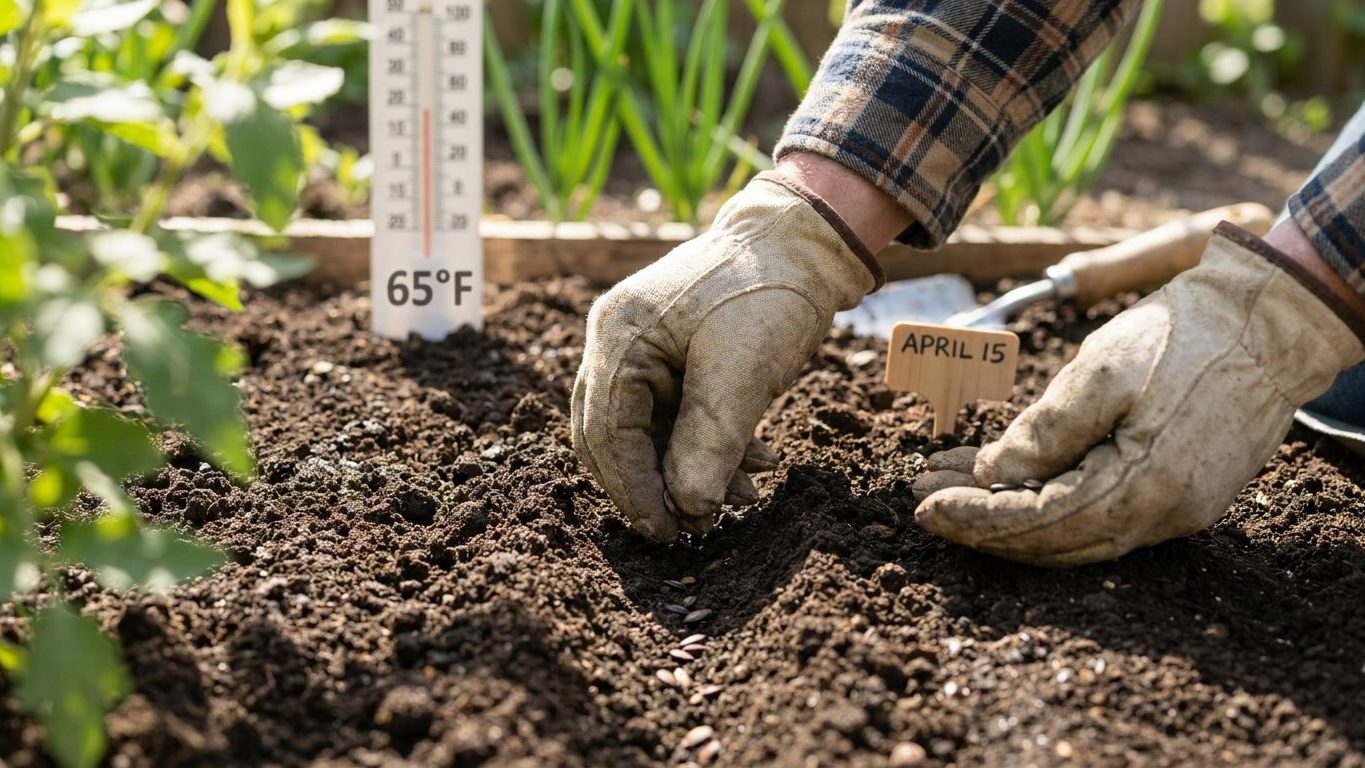

Plant melon seeds or transplants in Georgia once the soil has warmed well past the last frost, generally from late March into April depending on where in the state you garden. That window comes straight from the freeze probabilities recorded at Atlanta’s reference station, but melons care more about soil heat than about the calendar square you circle.
The short answer for Georgia
The last spring frost at the Atlanta reference station (USW00013874) falls somewhere between March 11 and March 29, based on NOAA’s 1991-2020 Climate Normals. That’s not one date, it’s a 30 to 70 percent probability band for a 32F freeze, which means even after March 29 there’s still a real chance of a cold snap in a given year. Melon seed sown into soil that’s still shedding that risk usually just sits there and rots before it germinates, so most Georgia gardeners wait a couple of weeks past this window before direct-seeding.
The other end of the season matters just as much. First fall frost at the same station lands between November 13 and December 1. Melons need roughly three months of uninterrupted warm growth from seed to harvest, so counting backward from that November window tells you how late a planting can realistically go and still finish before the vines get cut down by cold. Push a sowing into June and you’re gambling on a fall that arrives on the late edge of that band rather than the early one.
Both of these dates carry a caution worth repeating: Atlanta’s airport is an urban heat island. The frost dates measured there run milder than what a garden in the north Georgia mountains will see, and milder than the true edge case in some cooler valleys. A coastal or south Georgia garden, on the other hand, tends to run warmer than the reference station suggests, meaning the real frost-free window there opens earlier and closes later than the numbers above.
So the short answer is this: treat late March into April as the practical start for most of the state, treat early November as the outer edge for finishing a crop, and adjust both directions in either direction as you move north or south, higher or lower in elevation, which the next section explains in more detail.
What will not work here
Three things reliably fail with melons in Georgia, and each one traces back directly to the state’s own climate numbers rather than to melon-growing in general.
Sowing too early is the most common mistake. Because the last frost date sits in a 30 to 70 percent probability band, a warm stretch in early March convinces a lot of gardeners the danger has passed. It hasn’t, not statistically. Melon seed planted into soil that’s still cold germinates slowly if at all, and the seedlings that do emerge often get knocked back hard by a frost that lands on the late side of that band. Waiting past the window, rather than planting at the earliest hint of warmth, is the safer bet.
Heat load is the second failure point, and Georgia carries a lot of it. The Atlanta reference station averages 35.8 days a year at or above 90F. That’s not an average summer temperature, it’s a measure of how many days push plants into real heat stress, and it drives water demand hard. A melon patch watered on a fixed weekly schedule through a stretch of 90-degree days is very likely underwatered, especially once August arrives, which is the driest month of summer at just 4.3 inches of rain against June’s 4.54 and July’s 4.75. Gardeners who set up an irrigation routine in a wetter June and never revisit it are the ones whose vines wilt hard come August.
The third failure is a disease problem born from Georgia’s rainfall pattern rather than its total amount. Summer rain here arrives close to 13.6 inches across June, July and August, but a lot of that falls as thunderstorm bursts rather than steady soaking rain, especially against the heat load noted above. Combine that humidity with melon plants spaced too close together, and powdery mildew and other foliar diseases move through a planting fast. Wider spacing and airflow between vines matter more in a state with this rainfall rhythm than they would somewhere drier.
Slow-maturing melon types are the last casualty. A variety bred for a long, mild growing season can outrun the gap between the spring and fall frost windows in the cooler parts of the state, leaving vines still setting fruit when the first hard freeze arrives.
What changes across Georgia
Georgia is not one growing season wearing one label. The USDA Plant Hardiness Zone Map puts the state anywhere from zone 6a up to 9b, a spread wide enough that a single statewide planting date is close to meaningless for anyone gardening at either edge of it. Zone 6a shows up in the north Georgia mountains; zone 9b shows up along the far southern coastal plain. That’s a difference of several USDA zones inside one state’s borders, built on the average annual extreme minimum temperature, which is the one variable the hardiness zone system actually measures.
What that spread means in practice: a gardener in the mountains is working with a frost-free season that opens later in spring and closes earlier in fall than the Atlanta reference numbers suggest, since north Georgia and higher elevations freeze several weeks earlier come autumn. A gardener on the coastal plain gets the opposite deal, milder and longer at both ends, closer to the far side of that November 13 to December 1 fall frost band or later still.
| Region | Relative hardiness zone | Practical shift from the Atlanta reference dates |
|---|---|---|
| North Georgia mountains | Toward 6a-7a | Spring planting later, fall frost arrives earlier |
| Central Georgia / Atlanta area | Roughly 7b-8a | Closest to the reference station dates as given |
| South Georgia / coastal plain | Toward 8b-9b | Spring planting earlier, fall frost arrives later |
Elevation, distance from the coast, even a slope that pools cold air can move a property a full zone away from what a regional label suggests. The USDA’s map is built for that kind of lookup: find the specific zone for a specific address rather than borrowing the state-wide range.
Where to check this for your own county
Everything above is a state-level picture, built from one reference station and one statewide hardiness range. A county in the Georgia mountains and a county on the coastal plain are both technically “Georgia,” but they don’t share a planting calendar.
The University of Georgia Cooperative Extension is the source built for that narrower job, and it’s free to use: extension.uga.edu. Two things are worth looking for once there. First, the local planting calendar for the specific county, which accounts for the elevation and frost patterns that a statewide range can’t. Second, the variety trial results for melons specifically grown and evaluated in that county or region, since UGA extension agents track which cultivars actually perform well against local disease pressure and local heat, not just which ones are popular nationally.
A county-level recommendation from an extension agent who has watched melons grow in that exact soil and climate for years will beat a state-level generalization every time. What it can’t do is replace a local agent who knows whether the clay in a specific county holds water three days after a storm or three hours, or whether a particular melon variety struggled with mildew in that county last summer.
Some gardeners also time melons by the Moon: when to plant watermelon and cantaloupe by the moon, as almanac tradition rather than fact.
Checking this against your own garden
Every date here is built from decades of averages at one weather station. A gardener’s own plot, checked directly, outranks all of it, and three simple observations do the checking without needing any equipment beyond a hand and a pair of eyes.
Soil warmth by feel is the first and most useful check. Push a hand a couple inches into the planting bed on a morning after several sunny days. If it still feels cold to the touch, the ground hasn’t caught up to the calendar yet, regardless of what the frost-date window suggests, and melon seed sown into it will likely stall rather than sprout.
The first flush of male flowers is the second signal. Melon vines produce male flowers before female ones, often days or weeks ahead, and a healthy early flush suggests the plant considers conditions favorable enough to start reproducing. A vine that’s slow to flower at all, well past when neighboring gardens are flowering, is signaling that something in that specific spot, shade, poor drainage, compacted soil, is holding it back regardless of the regional averages.
The first true leaves matter too, the leaves that emerge after the initial seed leaves and actually look like miniature melon foliage. Their color and size say a lot: pale, small true leaves point to a nutrient or light problem specific to that bed, while sturdy, deep-green ones confirm the spot is working as expected. None of these three checks require a thermometer or a soil probe, just attention paid at the right moments, and together they tell a gardener more about their own particular patch of ground than any statewide frost date ever will.