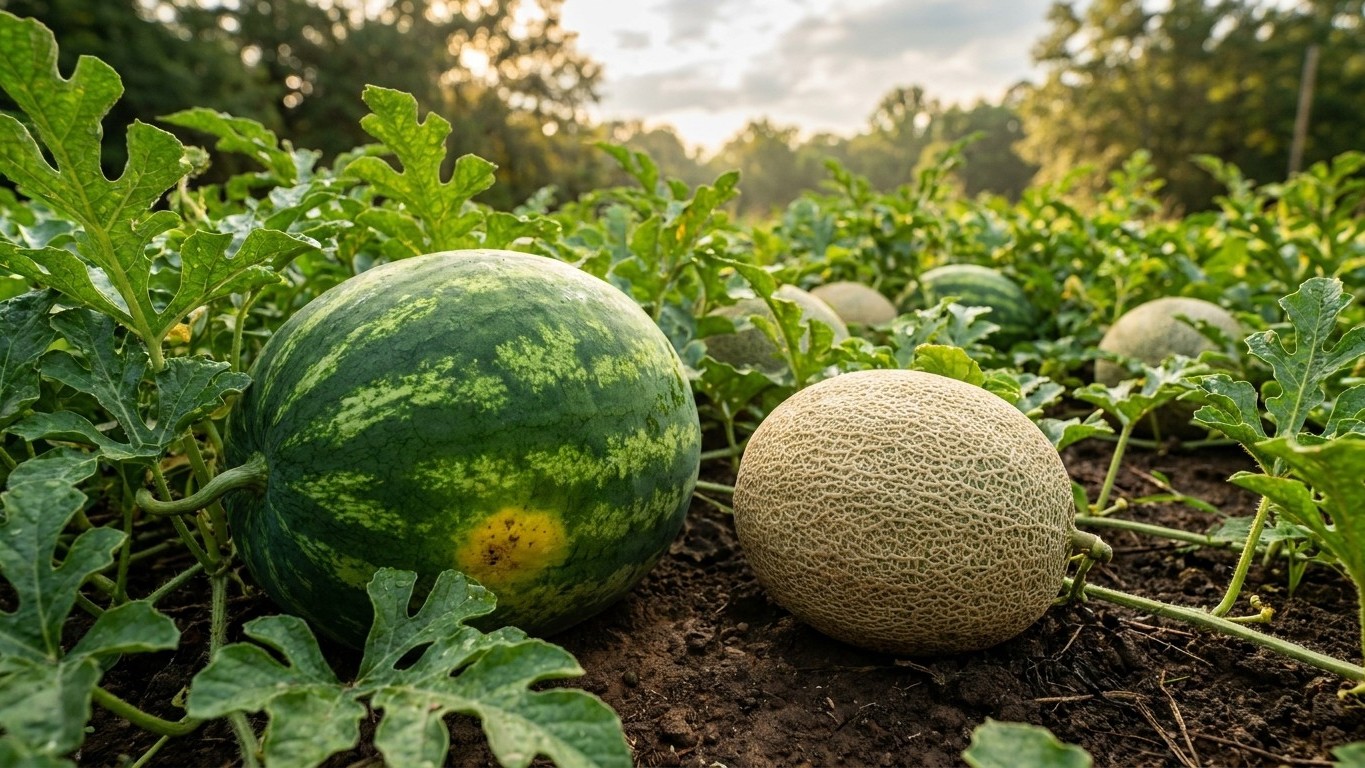

Georgia’s long, hot growing season favors heat-loving melons above all else: watermelon performs best statewide, cantaloupe works well with disease-resistant cultivars, and honeydew struggles against the state’s humid summers. The type that wins here is decided less by frost dates than by heat load and moisture.
The short answer for Georgia
Start with the frame Georgia actually gives a melon grower. The frost-free window at the reference station runs from a last spring frost of March 11 to March 29 out to a first fall frost of November 13 to December 1. Stretch that out and you get somewhere between roughly 230 and 265 days without a killing freeze. That is a wide margin. Almost no melon variety, fast or slow, runs out of season in Georgia the way it would in New England or the upper Midwest. So season length is not the variable that should drive the decision here.
Heat is. The reference station averages 35.8 days a year at or above 90F, and that number is the real filter for choosing a melon type. Watermelon handles that kind of heat load without blinking, which is part of why it is grown commercially across the state’s coastal plain and why home gardeners from the mountains to the Okefenokee fringe get a reliable crop from it. Cantaloupe (also called muskmelon) tolerates the heat reasonably well too, but it is thinner-skinned and more prone to stress-related cracking and blossom drop when daytime highs sit in the mid-90s for stretches at a time.
Then there is moisture. Summer rainfall averages about 13.6 inches across June, July and August, split fairly evenly month to month (4.54, 4.75 and 4.3 inches respectively), with August as the driest of the three. That is not a drought pattern, and it is not a desert-dry summer. It is a humid one. Humidity paired with heat is exactly the combination that breeds fungal pressure, powdery mildew, downy mildew, and fusarium wilt in particular, and melons vary a lot in how well they shrug that off.
Put those two facts together and the type-level answer looks like this: watermelon is the safest bet almost anywhere in the state, because it tolerates both the heat and the humidity better than its cousins. Cantaloupe is a solid second choice if you commit to disease-resistant cultivars and give plants room to dry out between rains. Honeydew and other low-humidity dessert melons are the hardest sell in Georgia, not because the season is too short, but because the air is too wet for too much of the summer.
What will not work here

The melons that fail in Georgia rarely fail from cold. They fail from the state’s own combination of wet air and sustained heat, and it is worth being specific about how.
Honeydew and the drier-climate muskmelon types are bred for places like California’s Central Valley, where summer humidity is a fraction of what Georgia sees. Drop those varieties into a Georgia July, with roughly 4.75 inches of rain falling on top of stretches of 90-plus-degree heat, and the leaf canopy stays damp longer after every rain or dew event. That damp canopy is where powdery mildew and downy mildew take hold. A gardener who has grown honeydew successfully in a drier state and expects the same result in Georgia is usually disappointed by midsummer, watching leaves yellow and collapse well before the fruit sizes up.
Tight spacing compounds the same problem regardless of variety. Melon vines planted close together, the way a gardener might space them in a drier climate to save room, trap humid air inside the canopy in Georgia and slow down the drying time after every rain. In a summer that delivers rain fairly evenly across June, July and August rather than in one dry stretch, that trapped moisture adds up to weeks of extra fungal pressure over the course of a season.
Watering on a fixed weekly schedule is another quiet failure point. With 35.8 days a year reaching 90F or hotter, a melon patch on sandy soil can dry out within a day or two of a rain event, especially in August, the driest of the three summer months at 4.3 inches. A grower who waters once a week regardless of soil type and weather is either underwatering during a hot dry stretch or overwatering right after a storm, and either mistake shows up as split fruit, blossom drop, or root stress.
Finally, the slowest-maturing melon varieties, the ones bred for a short, cool growing window elsewhere, are not really suited to Georgia’s heat profile even though the season here is long enough on paper. They tend to stall out and produce poorly flavored fruit when nighttime temperatures stay high for weeks on end, which is common in a state averaging over a month of 90-degree days.
What changes across Georgia
Georgia is not one growing zone, and treating it like one is where a lot of statewide advice goes wrong. The USDA Plant Hardiness Zone Map, built on the average annual extreme minimum temperature, places Georgia anywhere from zone 6a up to zone 9b. That is one of the widest spreads of any state in the eastern half of the country, and it matters directly for melon timing.
A zone 6a pocket in the north Georgia mountains behaves nothing like a zone 9b spot near the coast. The frost dates cited earlier for the reference station describe a milder, urbanized location; north Georgia and the higher elevations freeze several weeks earlier in the fall and stay colder several weeks longer into spring, which shortens the effective window for a melon crop to mature before cool nights slow it down. The coastal plain, by contrast, runs milder on both ends, giving growers there extra weeks of margin on either side of the main season.
That spread means there is no single planting date, and no single “safe” melon type, that applies evenly from Dahlonega to Valdosta. A gardener in the mountains working with a shorter, cooler season has less room for error with a slow-maturing cantaloupe than someone on the coastal plain does. A gardener in the far south, working with more heat days and a longer window, has more flexibility to experiment with a wider range of melon types, including some of the less heat-tolerant ones, because the season gives them a bigger cushion.
The range itself, 6a to 9b, is the reason a Georgia-wide recommendation has to stay general at the type level and cannot substitute for a local check.
Where to check this for your own county
The University of Georgia Cooperative Extension is the right next stop, at extension.uga.edu. This state page has laid out the reasoning behind why watermelon tends to outperform other melon types in Georgia’s heat and humidity, and why the hardiness zone spans such a wide range. What it cannot give a reader is a planting date or variety list tuned to one specific county, and that is exactly what the county extension office exists to provide.
Two things are worth pulling up once there. First, the county-level planting calendar, which will reflect the actual frost timing for that specific location rather than the reference-station dates. A county office in the mountains publishes different dates than one on the coastal plain, and that difference can run several weeks in either direction. Second, the list of melon varieties that county agents have actually trialed or recommended locally, since disease pressure, soil type, and even the exact strains of powdery mildew or fusarium present can vary county to county within the same state.
A county recommendation beats a state one every time, for a simple reason: it is built on conditions closer to the actual garden. A county extension agent works from what has actually grown well, or failed, in that county’s fields and demonstration plots. When the two disagree, the county-level answer is the one to trust.
Checking this against your own garden
None of the dates or averages above beat what a gardener can see and feel in their own patch of soil, and three observations in particular are worth tracking every spring.
Soil warmth by feel is the first. Melon seed germinates poorly in cold soil regardless of what the calendar says, and a gardener who sinks a hand into the planting bed and finds it still cool and damp, even after the average last frost date has passed, is looking at a microclimate running behind the regional pattern, whether from shade, low ground, or heavy clay that holds cold longer than the surrounding area.
The first flush of male flowers is the second signal. Melon vines put out male blooms before female ones, and a healthy early flush of males tells a gardener the plant has settled in and is building toward fruit set. A vine that flowers weeks later than expected, or not at all during a stretch of cool or overcast weather, is signaling that local conditions, not the regional average, are setting the pace this season.
The first true leaves rounding out past the seed leaves are the third. That stage marks the point where a seedling has shifted from living off stored seed energy to actively photosynthesizing on its own, and how quickly it gets there says something about how much heat and sun the specific bed is actually delivering, compared to a neighbor’s plot a few hundred yards away with different drainage or sun exposure. Between soil feel, flower timing, and leaf development, a gardener builds a more accurate read on their own ground than any statewide date range can offer.