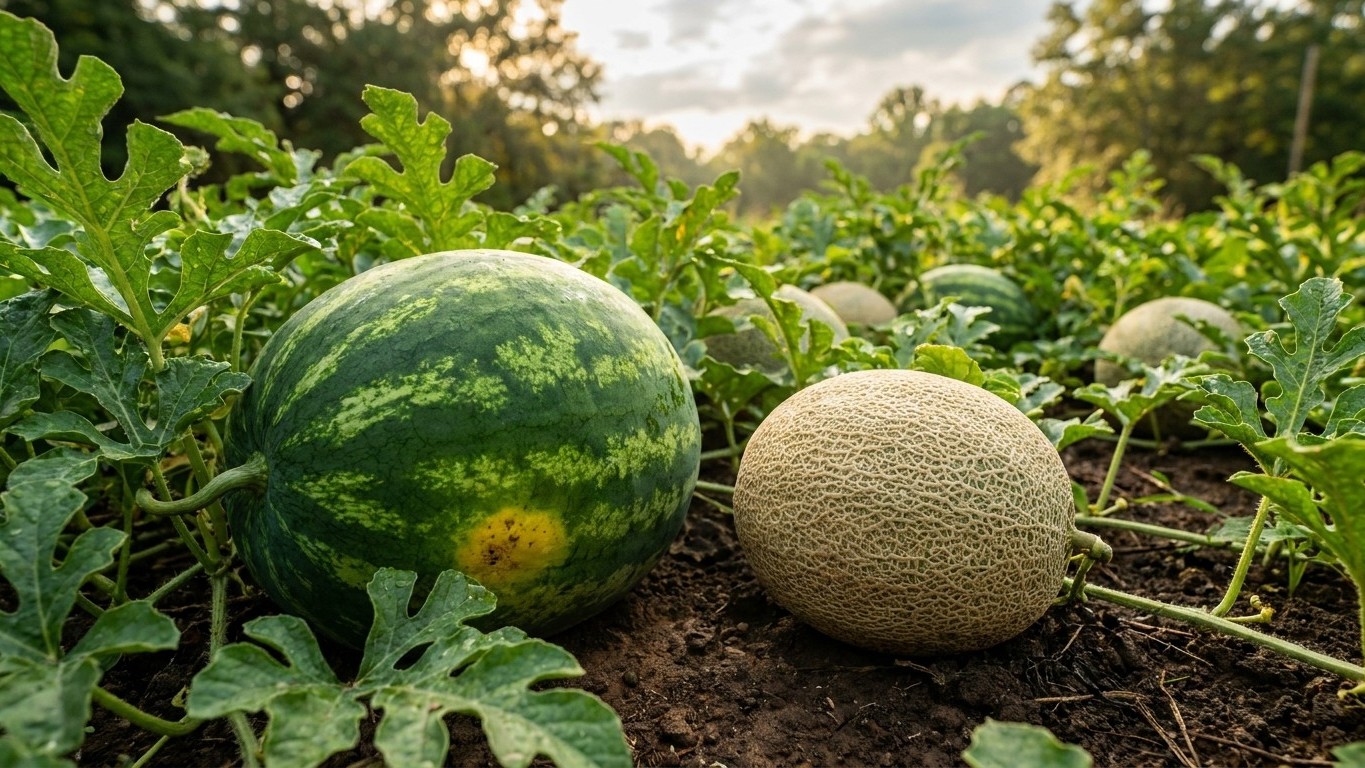

Short-season muskmelon and cantaloupe types, bred to ripen in 70 to 85 days, are the safest bet for New Brunswick gardens. Watermelons and long-season honeydews need heat this province rarely delivers, and a cool, damp summer punishes anything planted for a hotter climate.
The short answer for New Brunswick
Start with the two dates that frame the whole growing season here. The mean last spring frost at the Moncton reference station falls on May 23, and the mean first fall frost lands on October 2. Subtract one from the other and you get roughly 132 days between them. That sounds generous for melons, most of which list 70 to 100 days to maturity on their packets. But a mean date is not a safety line. Environment and Climate Change Canada’s own normals mean frost arrives later than May 23 in one spring out of two, and earlier than October 2 in one fall out of two. Treat 132 days as the best-case midpoint, not a guarantee, and plan for something shorter.
The bigger constraint is heat, not calendar days. The Moncton normals record zero days a year reaching 90°F. Melons don’t just need a frost-free window, they need sustained warmth to push sugar into the fruit and finish sizing it. A variety that “fits” on paper inside a 100-day window can still stall in a New Brunswick July and August that never spike the way a Georgia or even a southern Ontario summer does.
That’s why the decision here is about type first, variety second. Short-season cantaloupe and muskmelon selections bred for northern climates, typically listed at 70 to 85 days, are the group most likely to mature before the mean fall frost and without relying on 90°F days that basically never come. Honeydew types generally need more sustained heat to sweeten properly and are a marginal choice at best. Full-size slicing watermelons, often 85 to 100+ days and bred for hot-summer regions, are the poorest match for this province’s normals.
| Melon type | Typical days to maturity | Fit for New Brunswick’s normals |
|---|---|---|
| Short-season cantaloupe/muskmelon | 70-85 days | Best match for the mean frost-to-frost window |
| Standard muskmelon (longer types) | 85-95 days | Tight even in a mean-length season; needs row cover or plastic mulch to gain heat |
| Honeydew | 85-100 days | Marginal; sugar development lags without 90°F days |
| Full-size watermelon | 85-100+ days | Poor fit; the heat this fruit needs isn’t in the normals |
Season-extension tools matter more here than variety hunting. Black plastic mulch and floating row covers can add real heat units in a province that averages zero days above 90°F, and they’re often what separates a ripened cantaloupe from a vine full of green fruit in late September.
What will not work here

Long-season watermelon varieties are the clearest failure point. A fruit that needs 90 to 100-plus days, and that ripens by accumulating heat rather than just calendar time, runs into a province where the reference station records zero days at or above 90°F in an average year. Even in a season where frost holds off past the October 2 mean, the heat simply isn’t there to finish the fruit. Vines can look healthy, set flowers, even hold small fruit, and still fail to ripen before the first fall frost ends the season.
Standard-length muskmelons, the 85 to 95-day types bred with a longer, hotter summer in mind, sit in the same danger zone. On a mean-to-mean calculation they might squeeze into the roughly 132-day window, but that math assumes both frost dates behave, and normals put real odds against that in any given year. Add a cool, cloudy stretch in August, common in a Maritime summer, and a variety timed to the edge of the calendar simply runs out of days.
Disease pressure is the other failure mode, and it comes from the rainfall pattern rather than drought. Summer rain here averages about 10.5 inches across June, July and August, spread fairly evenly month to month (3.73 inches in June, 3.63 in July, 3.18 in August). That’s not a dry summer needing constant irrigation. It’s a consistently damp one, and melons planted at tight spacing with poor airflow, or grown on the ground without any lift off wet soil, are prone to powdery and downy mildew in exactly that kind of season. A vine that would shrug off the same rainfall in a drier, hotter climate can mildew out here well before the fruit finishes.
Weekly deep watering, the advice that works in a hot, dry summer, isn’t the right frame for New Brunswick. The rain totals here already supply a meaningful share of what melons need across the season; the real risk is standing moisture and humid air around the foliage, not a shortfall in the soil. Gardeners chasing a watering schedule built for a hotter, drier province are solving the wrong problem.
What changes across New Brunswick
New Brunswick is not one climate. The hardiness zone figure available for this territory, 5a on the Canadian system, is measured for the reference city named in the source, not for the whole province. Natural Resources Canada builds that rating from seven climate variables, not one, and it does not convert to a USDA zone the way American gardeners might expect. It’s a starting reference point, not a province-wide fact.
Given that, there is no single answer to how much colder or milder conditions get across the province. What can be said plainly is the direction of the shift: gardeners farther north, or at higher elevation inland, should expect a shorter frost-free window than the Moncton normals used throughout this page, meaning both a later effective start and an earlier effective end to the melon season. Milder pockets along the Fundy coast or in sheltered southern valleys may see conditions closer to, or slightly better than, the Moncton figures. Neither assumption should replace a direct check.
The tool for that check is Natural Resources Canada’s own hardiness zone map by municipality, the same source behind the 5a figure cited here. It lets a reader look up the zone assigned to their own municipality rather than borrowing Moncton’s. That single step does more to sharpen this page’s advice than any variety list could, because it tells a reader whether they’re gaining days on the Moncton window or losing them.
This page won’t guess which side of that line a given reader falls on. That’s a municipality-level question, and the map answers it far than a provincial averages page ever could.
Where to check this for your own county
The most useful next step is a direct one: check the federal agriculture department’s site at agriculture.canada.ca/en. It’s the link used here because it’s independently verified as working; New Brunswick’s own provincial department site currently blocks the kind of automated check that would confirm its address stays live, so the federal resource is the safer citation even though the provincial department is the more locally focused agency for day-to-day gardening questions.
What to look for once there, or on the provincial department’s own site if a reader finds it directly: a planting calendar built around local frost data rather than the Moncton-only figures used on this page, and any list of melon or cucurbit varieties that have actually been trialled in New Brunswick conditions. Provincial and county-level extension work exists precisely because a single reference station can’t capture every microclimate in a province, and trial results from a specific county carry more weight than a general seasonal calculation.
Be clear-eyed about what this page is and isn’t. It’s built from provincial-level normals at one reference station, useful for understanding the general shape of a New Brunswick melon season, but it is not a substitute for a county-specific recommendation. If a local extension resource lists a shorter or longer planting window than the mean dates used here, that local figure should win. It’s drawn from more specific ground truth than a single station’s 1981-2010 average.
Checking this against your own garden
None of the dates on this page beat a direct read of a reader’s own soil and plants, and three observations do most of the work.
Soil warmth by feel is the first and most basic check. Melon seed germinates poorly in cold soil regardless of what the calendar says, so pushing a finger a few inches into the planting bed and feeling for real warmth, not just thawed ground, tells a reader more about their own patch than the May 23 mean ever will. A south-facing bed against a wall can run warm weeks ahead of an open, low-lying spot even in the same yard.
The first flush of male flowers is the second signal. Melon vines typically produce male blossoms before female ones, and a strong early flush shows the plant has moved past establishment and into active growth, a rough proxy for how much accumulated warmth it’s already banked that season.
The appearance of the first true leaves, the second set that emerges after the initial seed leaves, marks the point where a seedling is genuinely growing rather than just surviving on stored energy. Slow, stalled true-leaf development in a bed that should be warm enough by the province’s normals is often the clearest sign that a specific corner of a yard runs cooler than the reference station this whole page is built on.