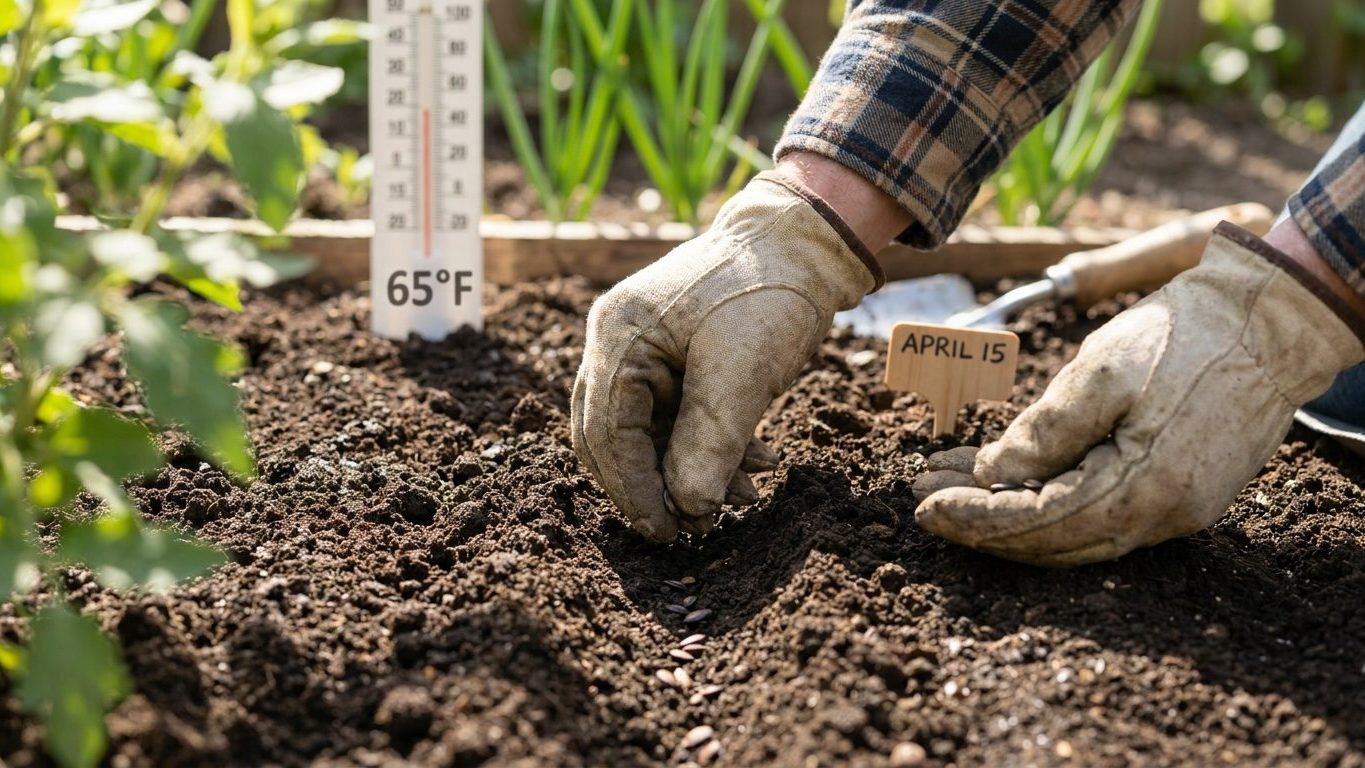

The safe window for planting melons in the North Carolina Piedmont runs from early April, once the last spring frost has cleared, through late October, before the first fall freeze arrives. That gives roughly seven warm months to work with in the Charlotte area, but the actual planting date depends on where in the state your garden sits, and on reading your own soil rather than a single calendar date.
The short answer for North Carolina
The frost dates that matter here aren’t fixed calendar days, they’re a probability band. NOAA’s 1991-2020 climate normals for the Charlotte reference station put the last spring freeze at 32F somewhere between March 23 and April 5, meaning that’s the stretch where the odds of frost drop from likely to unlikely. Plant melons before March 23 and you’re gambling on a freeze that still has better than even odds of showing up. Wait until after April 5 and that risk has largely passed. The same logic runs in reverse in fall: the first freeze normally lands between October 30 and November 8, so that window marks rising risk rather than a hard stop.
Stretch those two dates out and the frost-free season in the Piedmont runs close to seven months. Melons don’t need all of it, but they need most of it. Muskmelon and cantaloupe types typically want somewhere around 80 to 90 warm days from transplant to first harvest, watermelon a bit longer. A season bookended by early April and late October leaves comfortable room for that, plus a buffer for a cool spring or an early cold snap.
The other number that shapes the answer is heat, not frost. Charlotte averages 35 days a year at 90F or above. That’s the fuel melons actually run on, vines stall in cool, cloudy stretches and take off once soil and air both warm up in May and June. So the short answer for this part of the state is: direct-seed or transplant after the frost-risk window closes in early April, expect the crop to size up through the hottest weeks of summer, and plan to have fruit off the vine well before the fall frost risk starts climbing at the end of October.
What will not work here

Rushing the calendar is the most common failure. Melon seed sits in cold soil and simply rots rather than germinates, and a transplant set out while the region still sits inside that March 23 to April 5 freeze-risk band can be knocked flat by a late cold snap that arrives right on schedule, statistically speaking. Treating early April as an automatic green light everywhere in the state is the second version of the same mistake, more on that in the next section.
A weekly watering habit is the other quiet failure. Summer rainfall around Charlotte averages about 12.1 inches across June, July and August, which sounds like plenty, but July, the month melon vines are usually setting and sizing fruit, is the driest of the three at 3.74 inches. Pair that with 35 days a year at 90F or hotter and the math turns against a once-a-week hose schedule. Heat drives evaporation fast, and a lot of that summer rain arrives as a short, hard thunderstorm that runs off the surface rather than soaking down to the root zone. On sandy soil that water is gone within a day; on heavier clay it lingers longer but still doesn’t stretch to cover a July dry spell under 90-degree heat. Gardens that water on a fixed schedule instead of checking soil moisture tend to lose fruit to blossom-end problems or undersized melons right when the crop should be peaking.
Crowding plants is the third trap, and it’s a humidity problem more than a space problem. The Piedmont’s rainfall total, 43.6 inches a year, keeps the air damp enough that powdery mildew and other foliar diseases move fast through melon foliage once the canopy closes in. Tight spacing that might get away with it in a drier climate tends to backfire here, especially in a wet summer.
What changes across North Carolina
North Carolina isn’t one growing zone, it’s several stacked side by side. The USDA Plant Hardiness Zone Map places the state anywhere from 5b to 8b, a spread built on average extreme winter minimum temperatures, and that’s a wide enough range that no single planting date works for the whole state. Charlotte, the Piedmont reference point behind the frost dates above, sits toward the milder middle of that range.
Head west into the Blue Ridge Mountains and the elevation changes the equation. Spring arrives weeks later up there, and the frost-free window compresses on both ends: last frost lingers further into spring, first frost arrives earlier in fall. A grower at altitude working off the Piedmont’s early-April planting date is very likely planting into ground that hasn’t caught up yet, and risks losing young melon plants to a frost the Charlotte data never anticipated for that spot.
Move the other direction, toward the coastal plain, and the pattern flips. Milder winters there mean the last spring frost typically clears earlier than it does in the Piedmont, and the frost-free season stretches longer on the tail end as well. A coastal grower waiting for the Piedmont’s April window is likely leaving warm growing days on the table.
None of this means the state has one correct answer with two exceptions. It means the honest answer is a spread, not a date, and where exactly a given garden falls inside zones 5b through 8b determines which end of that spread applies. The right move isn’t guessing based on region, it’s checking the USDA hardiness zone map directly for the specific location, since the zone boundaries follow terrain and elevation in ways that don’t always match assumptions about east versus west.
Where to check this for your own county
A garden in the mountains or on the coastal plain needs a different set of dates, and the place to find them is North Carolina State University’s Cooperative Extension.
Two things are worth looking for once there. First, the county-level planting calendar. NC State Extension operates through county offices, and each one publishes guidance tuned to its own frost dates and soil conditions rather than a statewide average. A county recommendation accounts for local elevation and microclimate in a way a single state-level article, including this one, structurally can’t. Second, look for the melon varieties that county extension agents have actually trialled locally. Extension programs run variety trials specific to their region’s disease pressure and season length, and a variety that performs well on the coastal plain isn’t automatically the one recommended for a mountain county or a Piedmont one.
The state-level picture is built from one Piedmont reference station, useful for understanding the pattern but not a substitute for what a county office will say about the specific soil and frost history of a particular address. Where the two disagree, the county source wins, because it’s built on local data.
Checking this against your own garden
Every date above is a normal, an average built from thirty years of records at one weather station. A specific yard can run a week or two either side of that average in any given spring, and the plants themselves usually show it before a calendar does.
Soil warmth by feel is the first check. Push a hand a few inches into the planting bed in early spring. Cold and damp to the touch, even well past the calendar’s frost-clear date, means the ground hasn’t caught up yet, and melon seed sitting in it will likely stall or rot rather than sprout.
The first flush of male flowers is the second signal. Melon vines produce male blossoms before female ones, usually opening a couple of weeks ahead. Their appearance is the plant confirming it’s registered enough sustained warmth to start reproducing, a more reliable cue for that particular vine than any date on a chart.
The first true leaves, the ones that emerge after the initial seed leaves and actually look like melon foliage, are the third marker. Slow, stunted true-leaf growth after germination usually points to soil that’s still cooler than it looks, or to a stretch of overcast days holding back the heat units the plant needs. A garden that reads these three signs is working from better information than any regional average, including the one in this article.
Some gardeners also time melons by the Moon: when to plant watermelon and cantaloupe by the moon, as almanac tradition rather than fact.