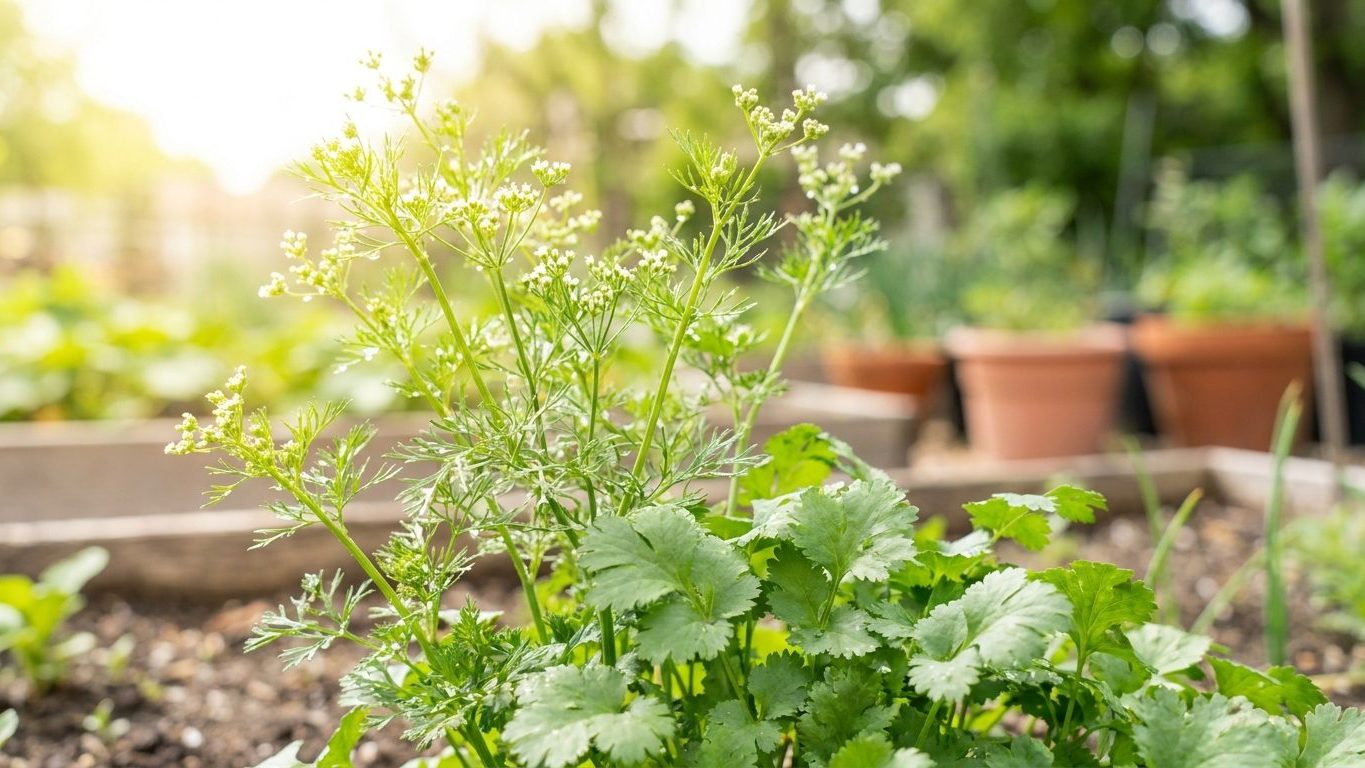

Cilantro bolts because two triggers hit at once: rising heat and lengthening daylight. Most gardeners blame the sun alone and move their plants to shade, then wonder why the leaves still turn feathery and bitter within weeks. Day length is the trigger a shady spot can’t fix, and that’s the piece of the puzzle most advice skips.
What is actually going on

Cilantro (Coriandrum sativum) is a cool-season annual that treats flowering as a race against time, not a reaction to discomfort. The plant reads day length through its leaves, and once daylight stretches past a certain point in spring, it starts building a flower stalk regardless of how cool the air still feels. Heat speeds that process up, but it doesn’t start it. That’s why a cilantro plant tucked into afternoon shade in May can still bolt right on schedule, just a few days behind its sun-drenched neighbor.
This is different from basil or parsley, which bolt mostly in response to heat and stress and can be coaxed into a longer leaf-producing life with enough shade and water. Cilantro’s clock is partly photoperiodic, meaning it’s counting daylight hours the way a bulb counts winter cold. Once the internal signal fires, the plant redirects its energy from leaf production to a central stalk, and the leaves that remain change shape, becoming thin and lacy compared to the broad, rounded leaves of young plants. That’s the flavor complaint people make when they say bolted cilantro “tastes soapy” or “tastes like nothing.” The leaf chemistry shifts along with the leaf shape.
What most guides leave out is that bolting isn’t a failure state. It’s the plant switching from one useful phase to another. A bolted cilantro plant produces small white flower clusters, then round seed pods that dry to a golden brown. Those seeds are coriander, the same plant’s second identity, and they’re perfectly usable in the kitchen even though the leaf harvest is over. Some seed suppliers sell strains bred to hold their leaf stage a little longer under warm conditions, sold generally as slow-bolt types rather than under a single trademarked name, and they buy a gardener maybe an extra week or two, not a season.
The practical upshot: timing and succession matter more than variety selection, and variety selection matters more than site selection. A grower who understands that the plant is running a clock, not just reacting to a thermometer, stops fighting the wrong battle.
In the garden
Because bolting is baked into the plant’s calendar, the real skill in growing cilantro is staggering plantings so something is always in its young leafy stage. Below is how that plays out, along with what tends to go wrong at each step.
| Approach | Timing logic | What happens if it’s mistimed |
|---|---|---|
| Single spring sowing | Sow as soon as soil can be worked, expecting one long harvest | Harvest window closes fast once day length increases; gardener is left with bare bed by early summer and no backup crop started |
| Succession sowing | New seeds every two to three weeks from early spring into early summer | Skipping a sowing window creates a gap in harvest later, since each planting has its own short leaf-producing stage |
| Fall sowing | Seed again as summer heat breaks and day length shortens | Sowing too early into late-summer heat causes fast bolting just like spring; waiting too long risks frost cutting the harvest short |
| Letting a bolted plant finish | Leave spent plants in place once flowering starts, rather than pulling them | Pulling too soon wastes a coriander seed harvest that costs nothing extra to let happen |
Succession sowing is the backbone of this. A single packet of seed sown once in April gives a grower a harvest window measured in weeks, not months, because every plant in that bed hits the same daylight trigger on roughly the same schedule. Sowing a small new row every couple of weeks means that when one batch bolts, the next batch is just reaching harvestable size. It’s less a technique than a mindset shift: treat cilantro like a crop you plant in installments, the way you’d stagger salad greens, rather than a perennial-style herb you plant once and revisit all season.
Once a planting does bolt, the seed heads are worth watching rather than discarding. The flower clusters turn to round green pods, then to tan, papery seed capsules. Left on the plant until they’re dry and starting to split, those seeds can be collected for coriander use in cooking, and a portion can be saved to start the next sowing, which keeps the whole cycle self-sufficient after the first year. Cutting a bolting plant down too early, before the pods dry, sacrifices that seed harvest for no real gain, since the leaves are already past their prime anyway.
Site selection still matters, just less than timing. A spot that gets morning sun and afternoon shade buys a little extra time during the hottest stretch of the sowing calendar, and consistent moisture reduces the stress that pushes plants to bolt faster than their daylight clock alone would dictate. Neither fixes the underlying photoperiod trigger, but both slow it down enough to matter over a two- or three-week harvest window.
What it depends on where you are
The mechanism described above (day length triggering the bolt, heat accelerating it) is the same Everywhere cilantro is grown in the continental United States. What changes by region is how much runway a gardener gets before that mechanism kicks in, and that part is genuinely local.
Season length is the biggest variable. In regions with a long, mild spring, there’s more calendar room to fit in two or three succession sowings before summer day length and heat arrive together. In regions where spring is short and summer heat arrives fast, that window compresses, sometimes to the point where a fall sowing becomes the more reliable harvest than a spring one. Summer rainfall patterns matter too, since consistent moisture reduces bolt-accelerating stress, while a region prone to dry spells during the exact weeks cilantro is trying to establish will see faster, earlier bolting than the calendar alone would predict.
None of that is something a general gardening page can responsibly hand a reader as a specific date or temperature, because the honest answer depends on which state, which microclimate, and even which side of a hill a garden sits on. The shape of the problem is this: shorter, hotter springs mean fewer succession sowings fit before the plant bolts anyway, and longer, milder springs mean more of them do.
Two resources fill that gap better than any national guide can. The state-specific herb pages on this site translate the general mechanism into rough regional timing for the areas readers actually garden in. Beyond that, a local Cooperative Extension office (the university-affiliated service present in every state) tracks average last-frost dates, typical spring warm-up patterns, and locally adapted planting calendars, and its advice is calibrated to a specific county rather than to the country as a whole. For a crop this sensitive to timing, that local calibration is worth more than a broad seasonal guideline.
The mistake that costs the most
The single most expensive mistake with cilantro is treating it as a one-time planting instead of a repeated one. Gardeners who sow a single row in spring, expecting it to behave like parsley or oregano and simply keep producing all season, are set up to lose the crop the moment day length crosses cilantro’s internal threshold, usually well before summer even feels hot.
The fix isn’t a better variety or a shadier spot, though both help at the margins. It’s accepting from the start that any single sowing of cilantro has a short leaf-producing life, and building the harvest around several small, staggered plantings instead of one larger one. A gardener who sows a short row every two to three weeks starting in early spring will have young, leafy cilantro somewhere in the garden almost continuously, even as each individual planting runs through its own quick cycle and bolts on schedule.
This also reframes what counts as wasted effort. A planting that bolts after four or five weeks isn’t a failure if it was one of several staggered sowings timed to overlap. It’s only a failure if it was the only planting made all season, because then its short window was the entire harvest. Letting the bolted plants finish into seed, rather than yanking them the moment flowering starts, turns even the “failed” planting into a coriander seed harvest and a source of seed for next year’s sowing, which is about as close to a consolation prize as a bolting herb offers.