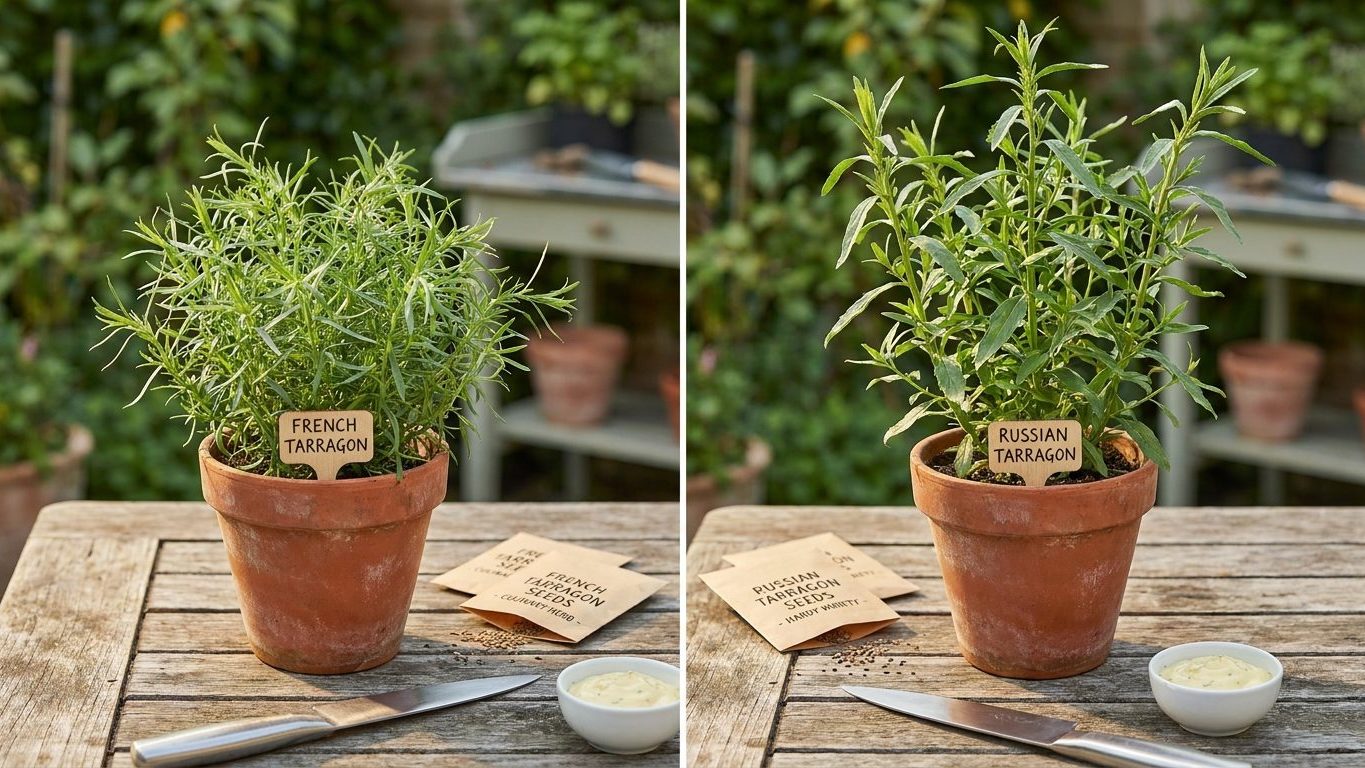

Tarragon seed packets are widely sold, but the plant that grows from them is not the herb cooks reach for. The tarragon that gives béarnaise sauce its anise-like lift, French tarragon, produces almost no viable seed. What sprouts from a seed packet is a different, milder relative. To grow the real thing, you buy a live plant.
What is actually going on

Here is the mechanism worth understanding before you buy anything: tarragon sold in gardens and kitchens is really two separate plants sharing one common name. French tarragon (Artemisia dracunculus var. sativa) is the culinary standard, prized for its smooth, sweet, anise-tinged flavor. It is what recipes mean when they simply say “tarragon.” But French tarragon rarely flowers in a way that sets fertile seed. It is propagated almost exclusively through division of an established plant’s root clump or by rooting stem cuttings, the same way many gardeners multiply mint or rosemary.
Russian tarragon (also classified as Artemisia dracunculus, without the cultivated designation) is the plant that actually grows from seed. It is hardier, grows taller and faster, and will happily set flowers and seed year after year. The problem is flavor. Russian tarragon’s leaves are coarser and its taste is thin, sometimes almost grassy or faintly bitter, with none of the sweet anise note that defines the herb in cooking. Seed companies are not being dishonest when they label a packet “tarragon seed,” since that is a true name for the species. But it is not the plant most home cooks are picturing.
This split explains a recurring pattern: someone plants tarragon from seed, waits for it to fill out, tastes a leaf, and wonders why it doesn’t taste like what they remember from a restaurant dish or a jar of dried herb. The plant grew exactly as advertised. It just wasn’t French tarragon.
Tarragon also carries a long-standing reputation in traditional herbal use, going back centuries in European and Central Asian folk practice. What follows here is about growing and cooking with tarragon, not about any therapeutic use.
The practical takeaway from this mechanism is simple: if a seed packet says “tarragon” with no other qualifier, assume it is the Russian type unless the label specifically states otherwise. Some seed sources do disclose this on the packaging in small print; many do not. Reading the fine print, or simply skipping seed altogether for this one herb, saves a full growing season of disappointment.
In the garden
Because two different plants travel under one name, telling them apart before you buy, and keeping the right one alive afterward, matters more with tarragon than with almost any other kitchen herb.
Spotting the difference before you buy
| Signal | French tarragon | Russian tarragon | What happens if you get it wrong |
|---|---|---|---|
| How it’s sold | Potted plant, division, or rooted cutting | Seed packet or seedling grown from seed | You plant seed expecting the classic flavor and end up with a coarse, bland substitute |
| Leaf feel | Smooth, narrow, slightly glossy | Rougher, sometimes broader | A nursery mislabels a young plant and you don’t notice until it matures |
| Crushed-leaf scent | Sweet, anise-like, fairly strong | Weak, grassy, sometimes bitter | You skip this check at the garden center and buy the wrong pot |
| Flowering and seed | Rarely sets viable seed | Flowers and seeds freely | A plant that seeds itself all over the bed is very likely the wrong type |
| Growth habit | Lower, more compact clump | Taller, more vigorous, spreads faster | A tarragon that took over a bed in one season is probably Russian, not French |
Keeping French tarragon going once you have it
French tarragon wants well-drained soil and a spot with plenty of sun, though it tolerates a little afternoon shade in hotter regions. What kills it faster than almost anything else is wet feet: soil that stays soggy through winter rots the roots outright. Raised beds or containers with generous drainage holes solve this for gardeners on heavy clay.
The plant also declines with age. A clump left undisturbed for several years tends to get woody and produce fewer of the tender young shoots that carry the best flavor. Dividing the root mass every few years, replanting the healthiest sections, and discarding the tired center keeps the planting productive. Skip this step and the harvest quietly gets smaller and tougher each season without an obvious single cause.
Because French tarragon can’t be reliably started from seed, propagation by division or cuttings is also how a gardener replaces a plant that dies over winter or shares it with a neighbor. Rooting a stem cutting in damp potting mix, kept out of direct sun until roots form, is the standard backup method when a whole plant isn’t available to divide.
What it depends on where you are
How well French tarragon settles in, and how it should be treated over winter, depends heavily on regional climate.
Season length matters because tarragon is a perennial that needs a period of dormancy each year but doesn’t want to sit in cold, waterlogged ground. In regions with a shorter growing season and a hard, dry winter, established plants generally handle dormancy well as long as drainage is good. In regions with mild, wet winters, the greater risk is root rot rather than cold damage, which is why raised planting and a well-draining mix matter more there than exact winter temperatures.
Summer conditions swing the other way. In areas with intense summer heat combined with high humidity, French tarragon can struggle and sometimes performs better treated as an annual or grown in a container that can be moved to a cooler, drier spot for part of the season. In regions with hot but dry summers, the plant generally tolerates the heat far better, since its native range includes areas with a similar climate pattern.
None of this can be reduced to a single planting date or hardiness number that applies everywhere in the country. Season length, summer rainfall, humidity, and soil type all interact, and a gardener two states over may be working with a genuinely different set of conditions even at a similar latitude. The most reliable local guidance comes from a state’s Cooperative Extension Service, which tracks how perennial herbs like tarragon actually perform in that specific region, and from the herb-growing guides on this site organized by state, which translate these general patterns into more concrete, local terms.
The mistake that costs the most
The single costliest mistake with this herb is buying a packet of tarragon seed expecting it to grow into the plant used in classic French cooking. It won’t. No amount of good soil, sun, or patience turns Russian tarragon into a substitute for the real thing, because the flavor difference comes from genetics, not growing conditions.
The fix is straightforward: skip the seed rack entirely for this one herb and buy a live plant, either a potted French tarragon from a nursery or a division or rooted cutting from another gardener. When buying in person, crush a small piece of leaf between your fingers before purchasing. A sweet, distinct anise-like fragrance signals the culinary type. A faint, grassy, or bitter smell signals the seed-grown relative, whatever the plant tag claims.
This single check, done at the point of purchase, prevents an entire season of confusion. It also explains why French tarragon tends to cost more and show up less often at big-box garden centers than at smaller nurseries that specialize in herbs: it can’t be mass-propagated from a bin of seed the way basil or thyme can, so every plant on the shelf had to be divided or rooted by hand from an existing one. That extra step in production is exactly what makes the difference in your kitchen worth paying for.