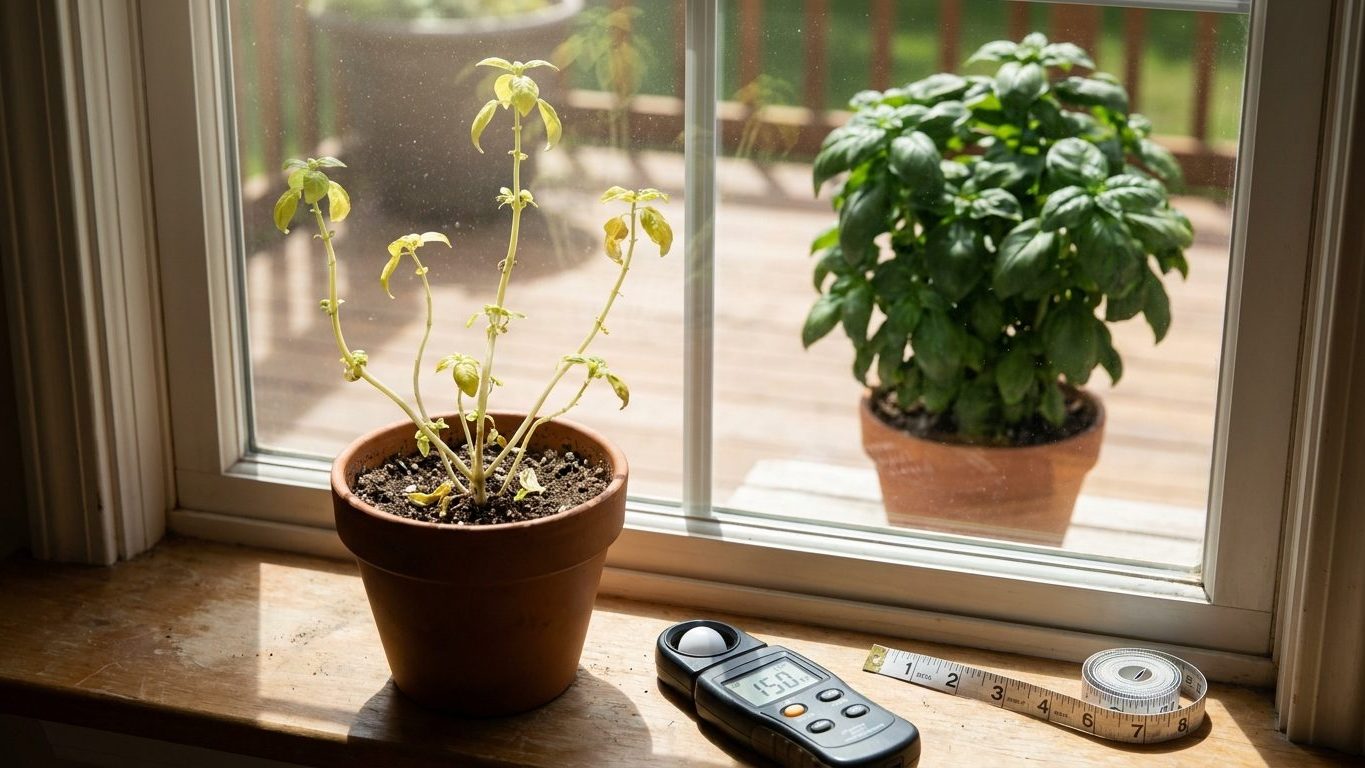

Ask why a windowsill basil turns yellow and leggy within weeks, and the honest answer almost never involves watering habits. It involves light math: a south-facing window in a house delivers a fraction of what that same plant would get outdoors, and no amount of attentive care compensates for that gap on its own.
What is actually going on

The thing to understand here is light intensity, not just light presence. Outdoors on a clear day, a plant sitting in open sun receives somewhere around 10,000 foot-candles of light. Set that same plant behind glass on a windowsill, even a bright one, and the number typically drops to a few hundred. Glass filters out some wavelengths, window frames and roof overhangs shade part of the day, and the angle of the sun changes what actually reaches the leaf surface as the seasons turn. A plant bred to grow in full sun does not simply tolerate that drop, it responds to it, usually by stretching.
That stretching has a name gardeners rarely use correctly: etiolation. The stems elongate, the space between leaves grows longer, and the leaf tissue itself gets thinner and paler because the plant is racing toward whatever light source it can find instead of building sturdy growth. A leggy, floppy herb on a windowsill is not sick in the way a reader might assume. It is starved of a specific resource, and no fertilizer or misting schedule replaces that resource.
Air movement matters more than most kitchens allow for. Outdoors, herbs get constant, gentle air circulation that strengthens stems and discourages the fungal issues that thrive in still, humid pockets of air. A windowsill, especially one crowded with pots, traps humidity around the leaves and barely moves. That stillness is part of why indoor herbs develop powdery mildew and root rot far more often than their garden counterparts, even when the watering routine looks identical on paper.
Temperature swings near glass compound the problem. A windowsill can run several degrees colder than the room at night in winter, and considerably hotter than the room in direct summer sun, because glass transmits temperature extremes efficiently in both directions. Herbs that would ride out a similar swing outdoors, buffered by soil mass and open air, get hit with the full range in a small pot with limited root volume to moderate it.
None of this means indoor herb growing is a lost cause. It means the windowsill is not a scaled-down garden. It is a different growing environment with its own physics, and the herbs that do well indoors are the ones whose natural growth habit happens to tolerate that physics, not the ones a shopper picks because the leaf smells good in the store.
In the garden
Some herbs handle a windowsill’s compromises better than others, largely because of where they evolved. Herbs from woodland or understory backgrounds are used to filtered, indirect light and adapt reasonably well indoors. Herbs from open Mediterranean hillsides, bred by nature for blazing, unfiltered sun, tend to struggle no matter how sunny the window looks to a human eye.
| Herb type | Indoor tolerance | What goes wrong when it fails |
|---|---|---|
| Mint family (mint, lemon balm) | Good, tolerates lower light | Rarely fails from light, more often outgrows its pot and roots turn mushy from too much standing water |
| Chives and parsley | Moderate to good | Growth slows and leaves thin out in low light; often mistaken for a nutrient problem |
| Thyme and oregano | Moderate | Stems stretch and woody growth weakens; plant survives but stops producing usable foliage |
| Basil | Poor to moderate | Rapid legginess, pale leaves, and a much shorter productive life than an outdoor plant |
| Rosemary and bay laurel | Poor | Slow decline over weeks, often blamed on watering when the real cause is insufficient light plus poor air movement |
Supermarket herb pots deserve a separate mention, because they are not grown to become long-term houseplants. Those pots are typically packed with far more seedlings than the container can support long-term, grown in a greenhouse under controlled light for a single harvest cycle, then sold at the exact moment they look their best. Bring one home and set it on a windowsill expecting it to thrive for months, and what usually happens is the seedlings compete for the same limited root space and light, the weaker ones collapse first, and the whole pot declines faster than a single, properly spaced plant would.
The fix, when there is one, is dividing that crowded pot into two or three smaller ones with fresh potting mix and real room for roots to spread, then accepting that even a divided plant is working with the light limitations described above. That single step (splitting an overcrowded starter pot) solves more early indoor herb failures than any watering adjustment does.
What it depends on where you are
How well any of this plays out has almost as much to do with regional daylight patterns as it does with the herb itself. A window in a northern state loses far more usable daylight hours in winter than a window in the Deep South or the Southwest, and that gap widens the further north the house sits. A windowsill that supports a thriving herb pot in October can leave the same plant starving for light by January, not because anything changed indoors, but because the sun’s angle and the day length outside did.
Heating systems complicate the picture further. Homes that run forced-air heat Through the Winter months tend to have drier indoor air than homes in milder climates that need less heating, and dry air stresses herbs that prefer some ambient humidity, mint and parsley among them, faster than a reader might expect. In hot, humid summer climates, the opposite problem shows up: windows facing full afternoon sun can push a sheltered windowsill spot into near-greenhouse heat, which is punishing for herbs that would rather have a cooler, filtered exposure.
None of these variables have a single right answer, because they depend on which direction a window faces, how a specific house is built, and how the local climate behaves in a given year. This site’s state-level herb pages dig into those regional patterns in more detail, and a local Cooperative Extension office (most states run one through a land-grant university) is worth contacting directly for anything specific to a reader’s own county, since extension staff track local frost dates, typical light conditions, and common regional pest pressure far than any general guide can.
The mistake that costs the most
The single costliest habit is treating a weak, leggy plant as a watering problem instead of a light problem. It is an understandable mistake: the plant looks stressed, the instinct is to give it something, and water is the easiest thing to give. But a plant stretching toward a window because it lacks light is not thirsty in the way that instinct assumes, and adding more water to a root system that is already struggling to keep up with weak, thin growth usually pushes the soil toward staying wet longer than the roots can handle.
That extra moisture, sitting in a pot that already has limited air movement around it, is exactly the condition that root rot needs. So the sequence plays out the same way again and again: the plant looks unhappy, the reader waters more, the roots decline, and by the time the leaves show it clearly, the damage is already done below the soil line where nothing was visible.
The better response is to address the light first and let the watering schedule follow the plant’s actual need rather than its appearance. That can mean moving the pot to the brightest available window, rotating it regularly so growth doesn’t lean permanently in one direction, or accepting that a herb the household has struggled with indoors for a season might simply need a spot outdoors, even a shaded porch, for part of the year. Checking the soil with a finger before adding water (not on a fixed schedule, but on what the top inch or two actually feels like) does more to keep a windowsill herb alive than any amount of extra attention paid to fertilizer or leaf appearance.