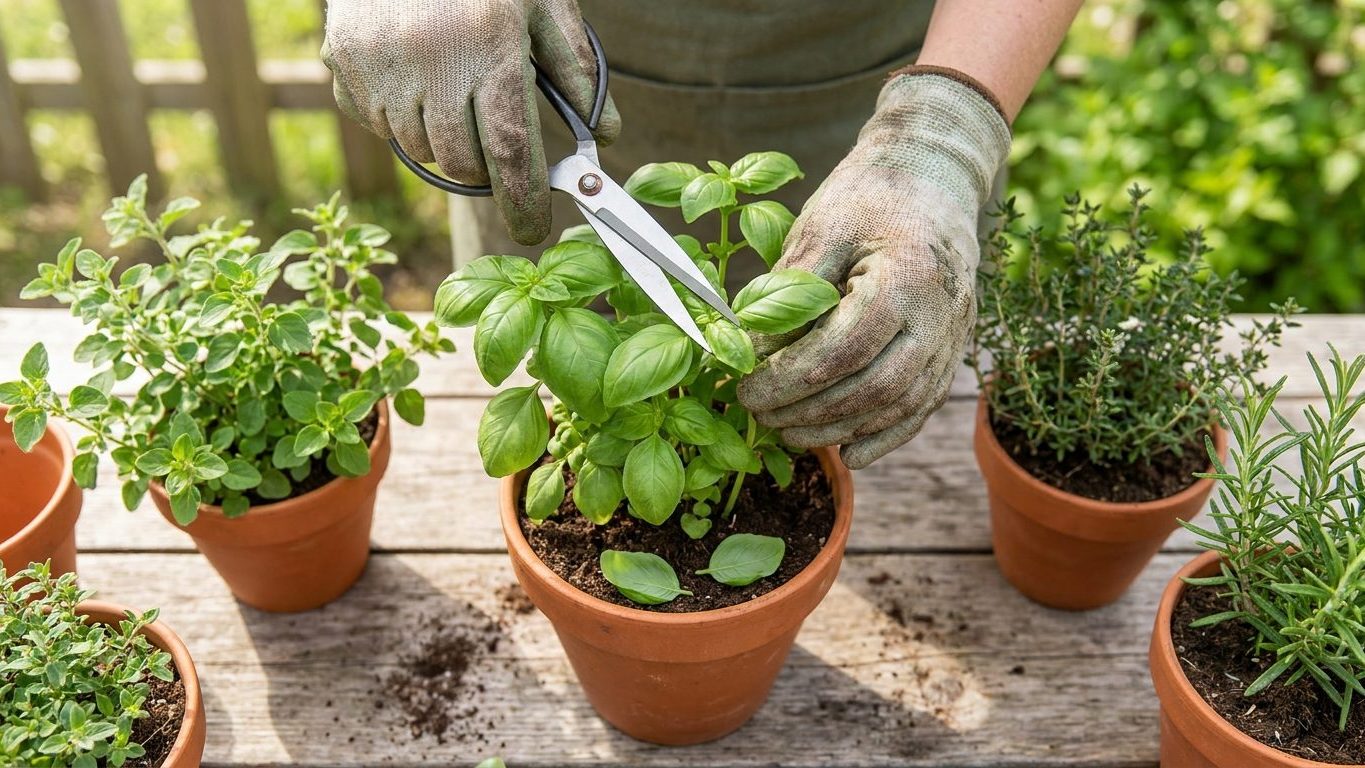

Cutting a herb the right way means the plant sends out two new stems where you took one; cutting it the wrong way means that stem is done for the season. The rule splits by growth habit: soft, leafy herbs regrow from almost anywhere you cut, while woody herbs only regrow from stems that already carry leaves. Get that distinction wrong and the plant stalls out.
What is actually going on

A herb plant grows from buds, and most of those buds sit in the little notch where a leaf meets the stem. When you cut just above a leaf pair, you’re not just removing growth, you’re removing whatever was suppressing the buds at that junction. Within days, two new shoots push out where there used to be one. That’s the entire mechanism behind “cutting so it keeps producing.” It has nothing to do with the herb being special or hardy. It’s basic plant architecture, and it works the same way whether you’re dealing with a pot of basil on a windowsill or a bed of oregano along a fence.
This is why picking single leaves off a stem does almost nothing for future growth. You get that one leaf for the pan, but the stem just keeps growing upward, tall and thin, with no branching. Snip a whole tip off just above a leaf node instead, and the plant is forced to fork. Do that consistently across a plant and you end up with something bushy and productive instead of one long, leggy stalk that flowers early and quits.
The split between soft-stemmed and woody herbs matters because they store their growth potential differently. Soft, tender herbs, the kind that die back completely at the first hard frost, keep active buds all along their green stems, even down near the soil. Cut them hard and they rebuild fast. Woody herbs are different. Their stems harden as the season goes on, and once a section of stem has gone brown and stiff, it typically has no live buds left. New growth on those plants only comes from the still-green, still-leafy wood near the tips. Cut past that point, into bare wood, and that branch is simply finished, no regrowth, no second flush, nothing.
A few herbs in this category, lavender and sage among them, also carry a long-standing medicinal reputation in folk use. This page is about growing and harvesting them for the kitchen and garden, not about evaluating that reputation, so we’ll leave it there and stick to what happens when you make a cut.
In the garden
The practical difference between the two groups comes down to where the scissors go. Soft herbs forgive a lot. Woody herbs don’t forgive much at all. Here’s how the two groups compare and what tends to go wrong with each.
| Herb type | Where to cut | What happens when it goes wrong |
|---|---|---|
| Soft-stemmed herbs (basil, cilantro, dill, parsley, mint) | Just above a leaf pair or node, taking a third to half the stem at a time | Cut too high, near the tip only, and you get one leaf back with no branching; the plant bolts to flower within weeks. Cut too low, near bare soil with no leaves left on the stem, and that particular stem may not recover at all. |
| Woody perennial herbs (rosemary, thyme, sage, oregano, lavender) | Into the current season’s soft, leafy growth only, never into the hardened, bare wood below it | Cut into old wood expecting it to bounce back like basil, and that branch stays bare, sometimes permanently. The plant looks stripped and uneven rather than fuller. |
With soft herbs, the safest habit is to work from the top down, always cutting just above a spot where two leaves meet the stem, and to take a meaningful chunk rather than nibbling single leaves. A basil plant harvested this way branches into a small bush; one harvested leaf-by-leaf from the outside turns into a bare stalk topped with a tuft of leaves, which flowers fast and stops producing new growth soon after.
With woody herbs, the habit that keeps them producing for years is restraint. Look at the stem before you cut it: if it’s still flexible and green or gray-green with leaves along it, that’s fair game. If it’s stiff, brown, and bare at the base, leave it alone entirely, cutting there won’t stimulate anything, it just removes structure the plant was using to support the leafy growth above. This is also why woody herbs tend to get shaped rather than harvested hard in one pass, a little taken from many stems rather than one stem cut to the ground.
Mint sits in an odd spot: technically soft-stemmed and extremely forgiving, it can be cut back hard, almost to the ground, and will usually return, which is one reason it spreads as aggressively as it does in garden beds.
What it depends on where you are
How often you can take a real harvest, and how hard you can cut without stalling the plant, depends heavily on how long the growing season runs, how hot the summer gets, and how much rain or irrigation the plant is getting. A soft herb growing through a long, warm season with steady moisture can be cut back hard every couple of weeks and barely slow down. The same herb in a short, cooler season, or one going through a dry stretch, needs lighter, less frequent cuts, because it simply doesn’t have the resources to rebuild as fast.
Heat changes the calculation too, but not in the direction people expect. Many soft herbs, basil especially, actually push toward flowering faster in high heat, which means more frequent light harvesting is what keeps them from bolting, rather than fewer, heavier ones. Woody Mediterranean herbs like rosemary, thyme, and lavender generally handle heat and dry spells better than soft herbs do, since that’s closer to their native climate, but they slow down hard once a real cold season sets in, and cutting into them right before that slowdown gives them less time to recover before growth stops for the year.
None of this is something a national guide can pin down responsibly. Season length varies by months from one region to another, and summer humidity and rainfall patterns shift the whole equation on top of that. This site’s state-level herb pages get into what that looks like in specific climates, and a local Cooperative Extension office, most states run one, can give a reader a straight answer based on their own soil, elevation, and microclimate. That’s a better source for a firm date or timing recommendation than any general article can be.
The mistake that costs the most
The single costliest mistake is applying the soft-herb rule to a woody herb, cutting a rosemary or a sage plant the same confident way you’d cut basil, straight back into the thick, bare, hardened stems near the base. With basil, that kind of hard cut triggers a flush of new branching. With rosemary, it just leaves a dead stub. The plant doesn’t die outright, usually, but that branch is gone for good, and a rosemary shrub cut this way over a couple of seasons ends up patchy, woody at the center, with all its live growth pushed out to a thin shell at the edges.
The fix isn’t complicated, it’s just a habit of checking before cutting. Before any cut on a woody herb, look for green, flexible stem with leaves on it. That’s the only part that regrows. If the spot you’re about to cut is stiff, dry-looking, and bare, or close to bare, move the cut higher up, into the leafy section, even if that means taking less than you wanted. Over a season, this discipline is what keeps a rosemary or thyme plant dense and full instead of gradually turning into a woody skeleton with a tuft of green on top.
It helps to think of woody herbs as shaping projects rather than as a crop to mow. A little taken from many stems, always within the current season’s leafy growth, keeps the whole plant productive year after year. A single heavy cut into old wood, done once out of habit or in a hurry, can undo several seasons of that shaping in one afternoon, and there’s no pruning cut that brings that wood back.