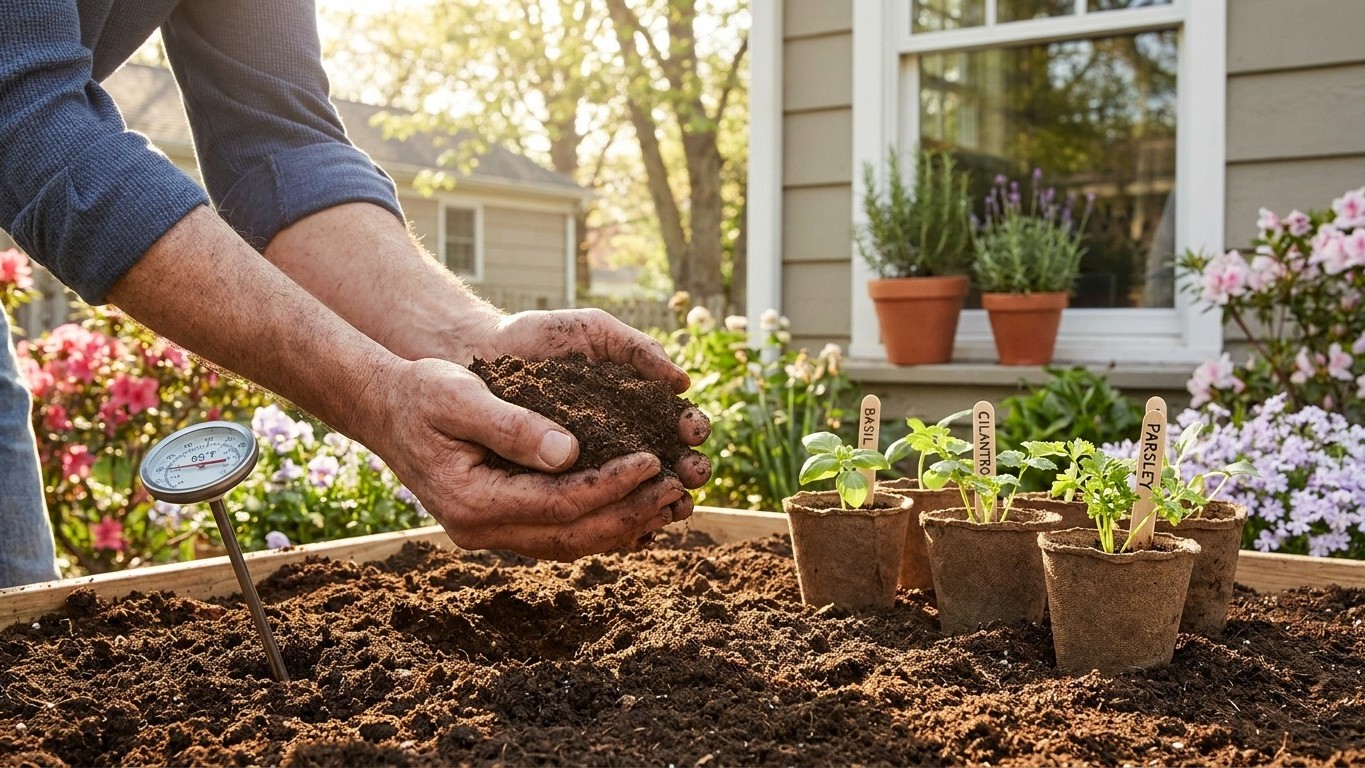

Most culinary herbs go into Alabama ground only once the soil itself has warmed, not merely once frost risk has passed, and that distinction matters more than people think. Once the ground does warm, the season runs long enough here for repeat plantings of the quick annuals, and it’s Alabama’s mild but uneven winters, not its summer heat, that end up deciding which herbs live outdoors as permanent plants and which spend December in a sunny window instead.
When the soil is warm enough in Alabama

The question every Alabama gardener actually asks is “when,” and the honest answer starts with frost, even though frost isn’t really what herbs are waiting on. At Huntsville’s reference weather station (USW00003856), NOAA’s 1991-2020 Climate Normals put the last spring frost somewhere between March 19 and April 3, based on a 30 to 70 percent freeze probability band. That’s a wide window on purpose: a frost date is a probability, not a promise, and treating either end of it as a guaranteed safe day is how a tray of seedlings ends up blackened overnight.
Frost matters to herbs mostly as a stand-in for something slower, soil temperature. Air can clear a frost risk days before the ground underneath has actually warmed enough for herb roots to grow rather than just sit there. Tender warm-climate annuals want soil that’s held real warmth for several days running, which in practice pushes safe planting past the date most people circle on the calendar. Hardier herbs tolerate cooler ground and can go in nearer the frost date itself.
There’s also a geography problem built into that Huntsville figure. It comes from an airport weather station, and airport stations tend to run warmer than a low-lying pasture, a shaded creek bottom, or a ridge a few counties over. Suburban and rural gardens across Alabama typically see their last frost land later than the Huntsville date, sometimes by one to two weeks, more at elevation. Treat March 19 to April 3 as the reference-city figure, not a statewide guarantee, and check your own county’s frost history before committing seedlings to open ground.
None of this depends on a specific herb variety, because soil doesn’t care what’s printed on a seed packet, it cares about degrees. A basic soil thermometer pushed a few inches into the actual bed tells you more than any calendar date can, and it’s the cheapest insurance a spring planting can buy.
How long the season lasts here
Subtract one frost date from the other and Alabama’s growing window comes out to roughly seven to eight months, depending on which edge of each range applies. Using the earliest fall frost, November 2, against the latest spring frost, April 3, gives about seven months. Push both dates to their more generous ends, March 19 in spring and November 16 in fall, and the window opens closer to eight months. Either way, that’s a long stretch by national standards, and it changes what’s worth planning for.
A window that long makes succession sowing genuinely worthwhile rather than a nice idea that never quite pans out. Fast annual herbs, cilantro being the obvious case since it tends to bolt once real heat arrives, can go in more than once. An early planting timed to the spring frost window gets harvested before peak summer heat, and a second sowing in early fall catches the cooler weeks before the season closes for good. Slower annual herbs benefit less from a second round, but even they gain margin: a late frost or a wet week delaying the first planting doesn’t threaten the whole year the way it would in a shorter season.
The season’s length also changes how much transplanting matters versus direct seeding. In a short-season territory, gardeners often start herbs indoors weeks early just to claim every available week outside. Alabama’s growers have more slack, so the choice comes down to convenience and to which herbs resent root disturbance rather than a hard need to bank time. Herbs with taprooted habits, dill and cilantro among the common examples, still resent transplanting regardless of season length, so a long window doesn’t erase the case for direct seeding them; it just means a failed early attempt isn’t the end of the year. For the specifics on timing a second round and spacing it against the first, the site’s succession sowing guide covers it in more detail.
Heat and water in Alabama

Alabama summers have a reputation: long stretches of 90-degree afternoons paired with humidity that keeps foliage damp well past sunrise. That combination matters for herbs mostly through disease pressure rather than the heat itself. Powdery mildew, downy mildew, and fungal leaf spot all move faster through a crowded, humid herb bed than a dry one, and airflow between plants does more real work than extra fertilizer ever will. But heat isn’t the variable that actually reorganizes an Alabama herb garden. Winter is.
The number that matters most sits in the Huntsville climate normals: the coldest month there averages a daily minimum of 33.1°F. That’s not a record low and not a seasonal average, it’s the mean minimum of the coldest month, and it’s the figure that decides which herbs survive an ordinary Alabama winter outdoors. A daily minimum hovering right around freezing means most winter nights dip a little below it, with occasional harder drops, but prolonged hard freezes are the exception near that reference station rather than the rule.
USDA’s Plant Hardiness Zone Map, built from 1991-2020 normals and based on the average annual extreme minimum temperature, places Alabama across zones 7a through 9a. That’s a wide spread for one state, running from cooler pockets in the north to milder conditions closer to the Gulf, and it means a herb that overwinters reliably outdoors near Mobile can still get killed back, or killed outright, in a colder pocket farther north. Alabama isn’t one herb-growing climate, it’s several stacked on top of each other, and a gardener’s own zone within that 7a-9a range matters more than any statewide average.
Which herbs suit Alabama
None of this points toward a single best herb for Alabama, since the honest answer depends on where in that 7a-9a range a garden sits and how much humidity management a gardener is willing to do. It does point toward types worth favoring.
Fast annual herbs, the leafy warm-season kind, fit Alabama’s long frost-free window well and can be sown more than once. Woody Mediterranean-type perennial herbs, evolved on dry, well-drained hillsides, are the group most exposed to Alabama’s mix of humid summers and variable winters: they tend to resent wet feet more than cold, so raised beds, gritty soil, and spacing that lets air move between plants matter here more than in a drier state. In the milder, 8b-to-9a stretch, some of these woody perennials stay in the ground year-round; farther north, toward 7a, the safer approach treats them as container plants that summer outdoors and move indoors before the coldest month sets in, matching the 33.1°F figure discussed above rather than fighting it.
Spreading perennial herbs from cooler climates tend to handle Alabama’s winter range more easily but need their own management, usually containment, since a humid climate with a long season gives them plenty of room to take over a bed. A few herbs carry long-standing medicinal reputations alongside their culinary use; this page doesn’t evaluate those claims one way or the other and treats every herb here strictly as a kitchen-garden plant. Foraging identification, telling a garden herb apart from a wild look-alike, isn’t covered here either, since several dangerous plants resemble common herbs closely enough that no written description is a safe substitute for hands-on expertise.
The specific varieties that actually perform well against Alabama’s humidity and disease pressure change from year to year and get tested locally, which is exactly the work the Alabama Cooperative Extension System does through its regional trials. That’s the resource worth checking before buying seed, because a variety recommendation not backed by local trial data is really just a guess wearing a label.