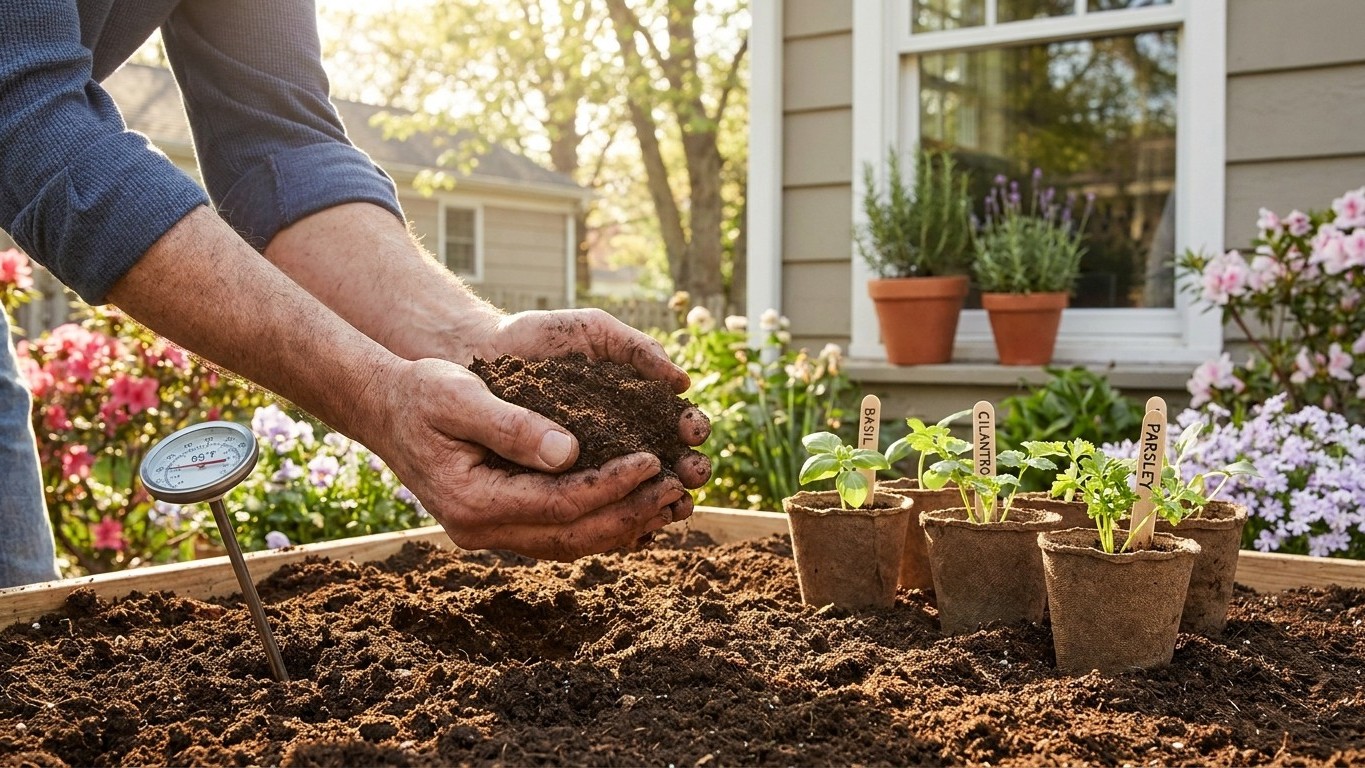

Arkansas gardeners can put most herbs in the ground once the last spring freeze has passed and the soil itself has warmed, generally by early-to-mid April across the state. The growing window that follows runs seven to eight months, long enough for more than one round of quick-growing herbs. Winter cold, not summer heat, decides which herbs stay in the ground year-round and which need a pot.
When the soil is warm enough in Arkansas

The last spring freeze at 32°F, averaged across the 1991-2020 climate record for station USW00013963, falls somewhere between March 12 and March 28. That’s a probability band, not a fixed date: NOAA’s normals put the odds of a freeze after that window at 30 to 70 percent, which means some years break early and some years punish anyone who planted on faith.
That 32°F number describes a hard freeze. A lot of herb damage happens well before temperatures drop that low. At the lighter 36°F threshold, the National Weather Service office in Little Rock lists April 3 as the average date the risk fades, and October 31 as when it returns in fall. Anyone starting basil, or another herb with zero cold tolerance, should plan around the April 3 figure, not the earlier 32°F date. Treat that gap as the built-in safety margin most transplant calendars forget to mention.
Frost dates are useful shorthand, but they’re a proxy for something else entirely: soil temperature. Air can clear the frost threshold on a sunny March afternoon while the ground six inches down is still cold enough to stall germination or rot seed before it sprouts. Warm-season herbs, basil chief among them, don’t care what the calendar says. They care whether the soil around their roots has actually warmed through, which typically trails the last frost date by one to three weeks depending on how wet and shaded the bed is.
This is where herb selection starts to matter more than a single sowing date. Cool-tolerant herbs, parsley, cilantro, dill, can go into the ground while there’s still a real chance of a light frost, since a touch of cold rarely kills them outright and often just slows growth for a few days. Heat-loving herbs need to wait for both the frost risk and the soil lag to clear, which in most years pushes their safe window into mid-to-late April rather than the earlier date on a frost map.
None of this is a promise. A frost date is built from decades of averages, and any single year can land well outside the 30-70 percent band NOAA uses to define it. Gardeners who’ve been burned by a late April cold snap in Arkansas know the feeling. Keep a row cover or old sheet on hand through the first few weeks after transplanting tender herbs, and treat the dates above as the way to bet the odds, not a guarantee.
How long the season lasts here
Run the numbers from both ends of the frost record and Arkansas’s frost-free window stretches roughly 224 to 253 days, depending on where in the March 12-28 and November 7-20 ranges a given year falls. Both figures come from the same NOAA station (USW00013963), so the subtraction holds together. Either way, that’s close to eight months without a freeze in a typical year, one of the longer herb-growing windows among the Territories in this series.
A season that long changes the math on what’s worth planting once versus planting twice. Quick annual herbs, cilantro and dill especially, tend to bolt and go to seed within weeks of hot weather arriving, which means a single spring sowing leaves the bed empty for months. With seven-plus months of frost-free ground to work with, there’s room for a second or even third sowing staggered a few weeks apart, so fresh plants are always coming up as the older ones fade. The site’s succession sowing guide covers the spacing and timing for that approach in more detail.
The length of the season also shifts the transplant-versus-direct-sow decision for slower herbs. Species that take a while to size up, like parsley or a shrubby perennial start, benefit from getting a jump indoors six to eight weeks before the last frost, since even a long season can feel short once summer heat starts pushing bolt-prone herbs toward seed. Anyone transplanting nursery starts into an Arkansas bed in April or May should check the root ball before it goes in the ground. A plant that’s been sitting in a small pot for weeks often has roots circling tight against the container wall, and those need to be loosened or teased apart at planting, or the plant will keep growing in that same cramped circle underground long after the pot is gone.
Where a shorter frost-free window elsewhere might make the first sowing the only realistic shot at a given herb, Arkansas’s stretch gives enough runway that a slow start in April rarely costs the whole season.
Heat and water in Arkansas

Arkansas summers run long and humid, the kind of stretch where mildew shows up on crowded plants faster than most gardeners expect. That reality points to airflow and spacing as real design decisions for an herb bed here, not afterthoughts. But for herbs specifically, summer isn’t actually the variable that reorganizes the whole planting plan. Winter is.
The mean daily minimum temperature during Arkansas’s coldest month sits at 30.9°F, based on NOAA’s 1991-2020 climate normals for the Little Rock reference station. That’s the number that matters for hardiness, not the record low anyone remembers from a bad ice storm, and not the coldest month’s average temperature either. A mean minimum just below freezing means a typical cold-month night dips into the high 20s to low 30s, which is enough to kill an unprotected tender perennial outright and enough to stress even a hardy one if it hasn’t had time to establish.
Layered onto that, the USDA Plant Hardiness Zone Map (2023 edition, built on 1991-2020 normals) places Arkansas across zones 6b to 8a. That’s a wide range for one state, built on a single measure: the average annual extreme minimum temperature. The cooler end, 6b, tends to sit in the higher elevations of the northwest; the warmer end, 8a, tends to run along the southern and Delta lowlands. Little Rock, the reference city behind the coldest-month figure above, lands closer to the middle of that spread. Anyone gardening near the state’s edges should treat their own zone, not the statewide range, as the number that matters for a specific planting decision.
That zone spread is what actually splits the herb list into two categories: plants that can stay in the ground through winter as a permanent fixture, and plants that need a pot they can carry indoors or into a garage before the first hard freeze. A woody perennial herb that shrugs off a mild 8a winter outdoors may need exactly that kind of protection in a colder 6b pocket a few counties away, even though both locations share the same July heat.
Which herbs suit Arkansas
Sort Arkansas herbs by type rather than by name and the choices get simpler. Fast annual herbs, the basil, dill, and cilantro group, fit the long frost-free window well since they can be sown more than once and pulled before summer heat pushes them to bolt. Their main risk here isn’t cold; it’s the humid stretch of midsummer, where crowding and poor airflow invite fungal trouble faster than in a drier climate.
Woody perennial herbs, the rosemary, thyme, sage, and oregano group, are where the hardiness zone split from the last section actually plays out. In the warmer 8a pockets of the state, some of these can survive outdoors year-round with minimal protection. In the cooler 6b areas, the same species often need a container that comes indoors, or at least a heavily mulched, sheltered spot, to make it through a winter where nightly lows regularly sit near that 30.9°F coldest-month average. Rosemary in particular carries a reputation, alongside several other herbs, for a long history of traditional and medicinal use; that reputation isn’t something this page evaluates, and it has no bearing on how the plant handles an Arkansas winter.
Biennial herbs like parsley sit in between: cold-tolerant enough to go in before the last frost and to survive a light freeze, but not built to shrug off a full winter outdoors as reliably as the woody perennials can in the milder parts of the zone range.
What this page won’t do is name a specific variety within any of those groups. Cultivar performance depends on local trial data, disease pressure that shifts county to county, and seed lots that change year to year, none of which belongs in a general climate guide. The University of Arkansas Division of Agriculture’s Cooperative Extension Service runs the variety trials that actually mean something for this territory, county by county, and their current recommendations are the only list worth following when it’s time to pick a specific type off a seed rack.