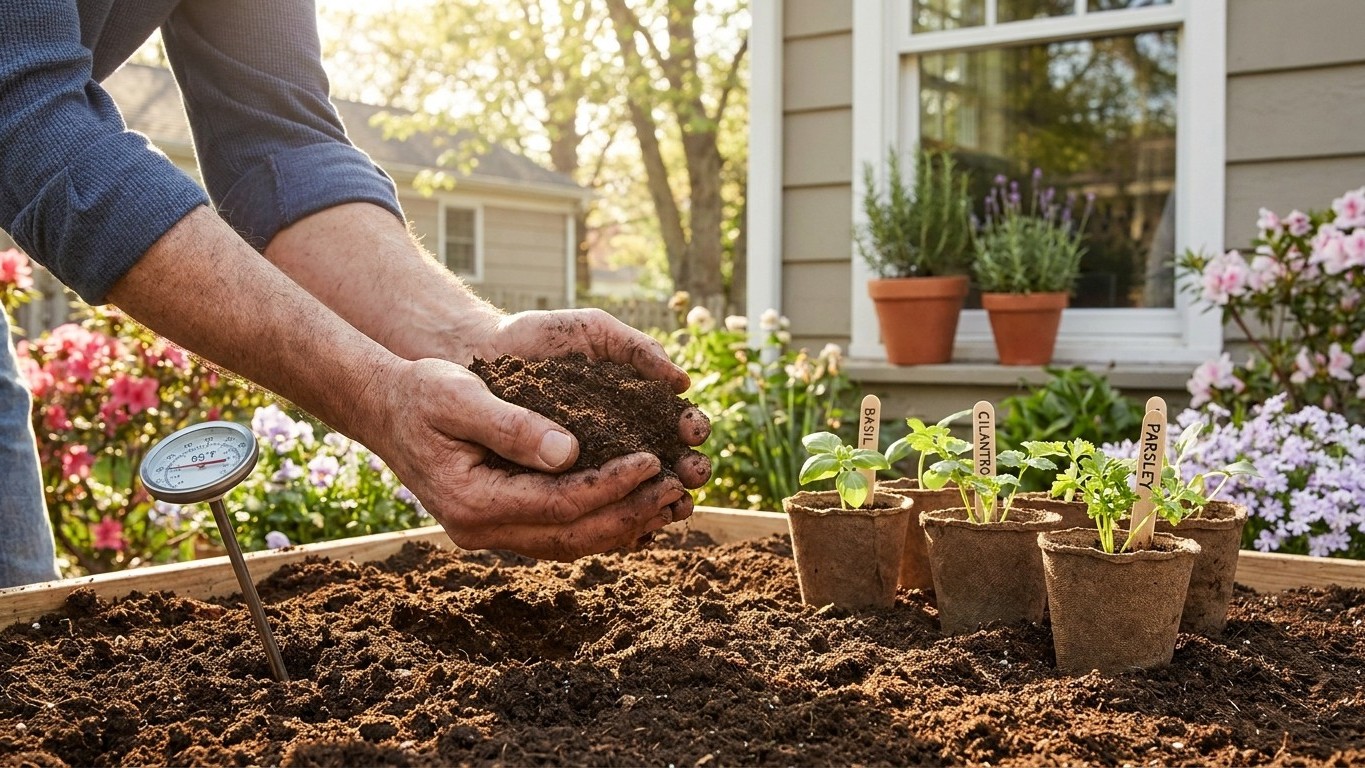

Herbs go into Indiana ground once the soil itself has warmed, which trails the last frost date by a few weeks depending on the herb. Tender types like basil wait longer than hardy perennials like thyme. Winter is the bigger factor here: Indiana’s cold months decide which herbs survive outdoors year-round and which need a pot and a windowsill.
When the soil is warm enough in Indiana

The date everyone wants is the last spring frost, and for the Indianapolis reference station (USW00093819), NOAA’s 1991-2020 Climate Normals put that window between April 9 and April 21. That’s a 30-70% probability band for a 32F freeze, not a single guaranteed day. Purdue Extension adds a detail worth sitting with: even after that published date, there’s still roughly a 10% chance of a freeze event. That’s not a rounding error. It’s a real reason to keep row cover or an old sheet within reach if you’re planting on the early edge of the range.
Frost date is useful, but it’s a proxy for something else: soil temperature. Air can clear 32F on a given morning while the ground six inches down is still cold and slow. Herb seeds and transplants respond to that soil temperature, not the calendar. This is why two gardeners a mile apart, one with heavy clay and one with a raised bed of loose loam, can plant the same herb two weeks apart and both be right for their own dirt.
It also explains why herbs split into two behaviors around this date. Tender annual and short-lived types (the kind grown fresh from seed or transplant each year) wait until frost risk has genuinely passed and soil has caught up, often a week or two past that April 9-21 window for the more cold-sensitive ones. Hardy perennial types tolerate a much earlier start, sometimes going into the ground while there’s still a real chance of a light frost, because their tissue handles it.
Southern Indiana runs earlier than this Indianapolis figure, sometimes by two weeks or more; the northern part of the state runs later by a similar margin in spring and earlier in fall. The Indianapolis dates are a reference point, not a promise for every county.
One more note before moving to types and choices: some herbs carry long-standing reputations tied to traditional or medicinal use. This page doesn’t evaluate those claims one way or another. It sticks to what grows, when, and how it behaves in an Indiana garden.
How long the season lasts here
Subtracting the two frost windows gives the shape of the growing season, and both dates come straight from the same Indianapolis Climate Normals dataset. Last spring frost falls between April 9 and April 21; first fall frost falls between October 21 and October 30. Take the tighter, more conservative pairing (last frost April 21, first fall frost October 21) and the safe growing window runs about 183 days. Take the widest pairing (April 9 to October 30) and it stretches to roughly 204 days. Either way, that’s a season measured in months, not weeks, and it’s enough room to think in more than one planting.
A window this size changes strategy in a specific way: it makes a second sowing worth planning for, not just a hopeful afterthought. Fast-cycling herbs sown in April can be harvested and cleared, with a second round of the same type or a different one going in during early-to-mid summer for a fall harvest before that October frost band arrives. This only works because the gap between spring and fall frost is wide enough to fit two cycles of a quick crop with room to spare. In a shorter-season territory, that math doesn’t work at all, and the first sowing is the only one that matters.
The length of the window also affects whether transplanting versus direct seeding is worth the trouble. With six-plus months of frost-free time, there’s enough slack to start slower herbs indoors, transplant them out once soil has warmed, and still get a full harvest window afterward. A gardener who transplants should check the root ball before it goes into the ground; herbs that have gotten pot-bound indoors transition poorly into a garden bed regardless of how mild the outdoor conditions are.
For the mechanics of timing that second sowing, matching it to when the first crop clears, and choosing which types handle a compressed second cycle, the succession sowing guide on this site walks through the scheduling in more detail than fits here.
Heat and water in Indiana

Indiana summers bring stretches of genuinely hot, humid weather layered over soil that doesn’t dry out as fast as it does farther west, which matters more for herbs than the heat itself does. Humidity sitting on leaves through warm nights is what pushes powdery mildew and other fungal issues onto herbs that would otherwise shrug off the heat. That’s a real management question, but it’s not the one that reorganizes an Indiana herb bed.
Winter is. The coldest month here averages a daily minimum of 20.9F at the Indianapolis reference station, per NOAA’s 1991-2020 Climate Normals. That figure, not the record low and not a seasonal average, is what determines whether a woody perennial herb survives outdoors through winter or needs to come inside. USDA places the state across hardiness zones 5b to 7a, using the Plant Hardiness Zone Map’s 2023 update, which is built on one variable: average annual extreme minimum temperature. That’s a wide range for one state, and it means a herb that overwinters fine in the southern tip might not make it through a winter in the northern counties, even though both fall under the same state-level label.
What that 20.9F figure actually does is split herbs into two working categories for Indiana gardeners. Hardy woody types with genuine cold tolerance can stay in the ground and come back the following spring, treated as permanent fixtures in the bed. Tender woody and soft-stemmed perennial types that read as “perennial” on a seed packet written for a milder region often don’t survive an Indiana winter outdoors at all; here they function as annuals unless they’re grown in a pot and brought indoors before the cold sets in.
That reclassification is the single biggest decision an Indiana herb gardener makes, more consequential than any summer watering schedule. It decides layout: what goes into permanent ground, what goes into a container that can be moved, and what gets replanted from scratch every spring regardless of what the label implies.
Which herbs suit Indiana
Reasoning from this territory’s own numbers narrows the field by type, not by brand or variety. A season running roughly 183 to 204 days rewards herbs that finish quickly enough to allow that second sowing discussed above, or that yield continuously through the summer without needing a full cycle to restart. Humid summers make disease resistance, particularly against fungal leaf issues, a real first-line consideration for any herb kept in the ground through July and August rather than an afterthought. And the 20.9F coldest-month minimum, combined with the 5b-7a hardiness range, is what separates herbs worth planting as permanent perennials from those better treated as container plants moved indoors for winter.
None of that points to naming a specific variety here, and that’s a deliberate choice rather than an omission. Variety trial data, the kind that tells you which specific strains actually perform well against local disease pressure and local winters, comes from university trial gardens, not from a general content page. Purdue Extension runs exactly that kind of testing for Indiana conditions, and its recommendations are built from field trials in this state’s soil and weather, not from a national average.
That’s a meaningfully different kind of information than anything on this page. Purdue Extension can be reached at extension.purdue.edu, and its county offices publish variety-specific guidance updated as new trial results come in. That’s the resource that turns “which type of basil” into “which specific strain has handled Indiana’s humidity and winters in local trials this year,” and it’s worth a call or a visit before committing a garden bed to any perennial herb meant to stay put for years.
The broader pattern holds regardless of which specific plants end up in the ground: short-season types for flexibility, disease-resistant habits for humid summers, and a clear-eyed read on which herbs are genuinely hardy here versus which ones need a pot and a spot indoors once that 20.9F cold sets in.