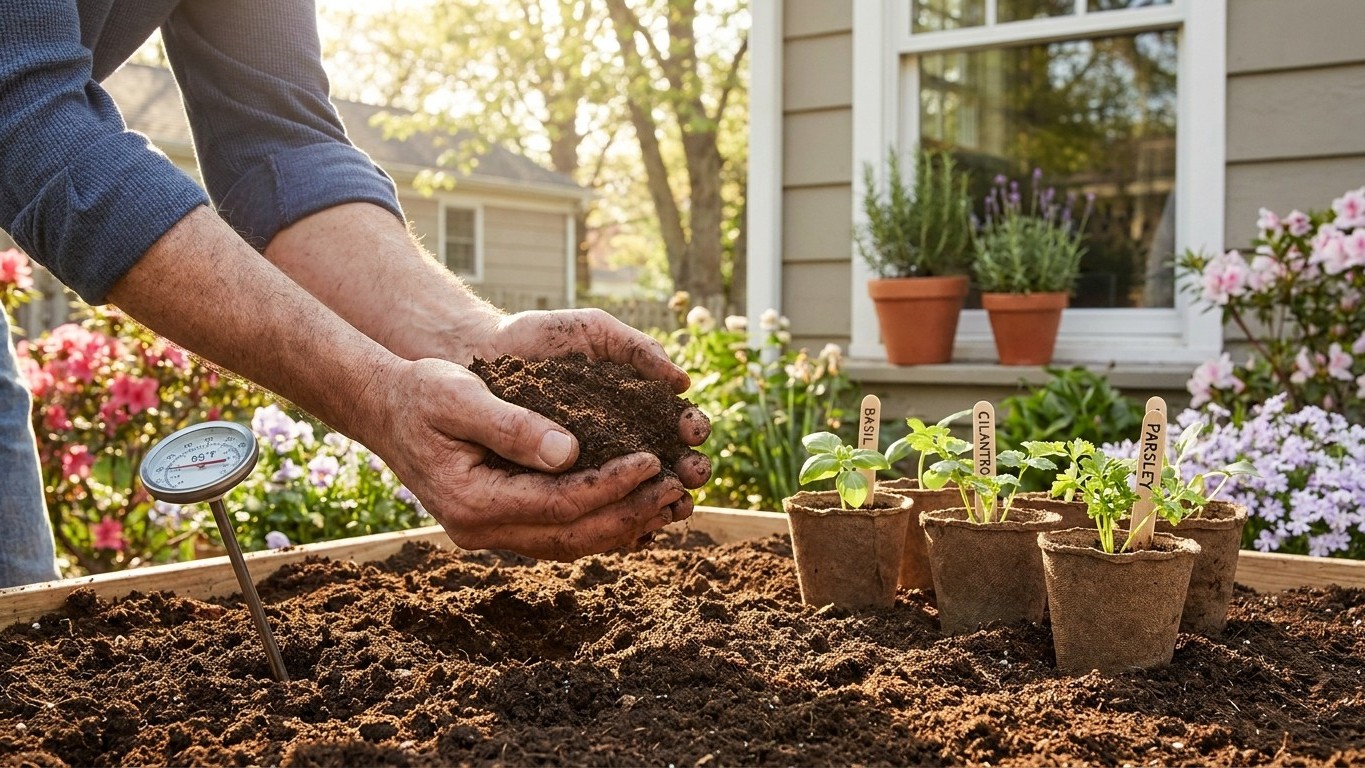

Frost-free planting in Minnesota typically starts between April 17 and April 30, but the real trigger is soil temperature, not the calendar. Because winters here run cold enough to kill most Mediterranean herbs outright, the bigger decision isn’t when to plant, it’s which herbs stay in the ground year after year and which ones live in pots.
When the soil is warm enough in Minnesota

NOAA’s 1991-2020 Climate Normals put the last spring frost for the Minneapolis-St. Paul International Airport station somewhere between April 17 and April 30, based on the 32°F freeze probability band. That’s a 30 to 70 percent chance window, not a fixed date on a calendar. Half the years, frost shows up before or after that stretch. Treat it as a probability, because a garden planned around a promise gets burned the year the promise breaks.
Frost date and planting date aren’t the same thing, either. Basil, for instance, sulks in cold soil even after the air stops freezing. Herbs from warm climates want the ground itself to have warmed, which usually happens one to three weeks after the last frost risk fades. That gap is where a lot of transplants get set out too early and just sit there, stalled, waiting for soil warmth that hasn’t arrived yet.
The Twin Cities sit in the mild southern part of the state. NOAA’s Climate Normals data used here comes from that station specifically. Gardeners in northern Minnesota, up toward the Iron Range or the Arrowhead, are working with a window that runs two to three weeks tighter on both ends. If you’re gardening near Duluth or further north, push your mental planting date back and your fall wrap-up date forward accordingly.
This page sticks to types of herbs rather than named varieties, and for good reason covered further down. Whether you’re starting seed indoors or setting out young plants, the soil-warmth test matters more than the sheet on your kitchen calendar. A simple check: soil that’s still cool to the touch four inches down is soil that isn’t ready, whatever the date says.
How long the season lasts here
Subtracting the two frost windows gives a growing season that runs somewhere between roughly 164 and 189 days, depending on where you land within those probability bands and where in the state you’re gardening. That’s the stretch between the last spring frost (April 17 to April 30) and the first fall frost (October 11 to October 23). Call it five and a half to six months, give or take, and remember both ends are estimates, not guarantees.
That length matters because it decides whether a second round of seeding is realistic. On the long end of the window, closer to 189 days, there’s genuinely room to pull an early crop of a fast annual herb and reseed for a second flush before fall shuts things down. On the short end, closer to 164 days, the first sowing is often the only sowing that has time to mature and be useful before frost ends the run. That’s a meaningfully different planning approach depending on which side of the range your garden falls on.
The shorter the window, the more it also changes how you treat transplants versus direct-seeded herbs. A short season rewards starting seed indoors weeks ahead and setting out plants with an established root system, because every week saved at the front end is a week added to the productive stretch. A longer season gives more slack to direct-seed and skip the indoor start altogether for herbs that don’t transplant well. If you’re weighing whether a second sowing fits your particular stretch of the season, the site’s succession sowing guide walks through how to time that second round against your local frost window.
None of this changes based on how hot or wet the summer gets in between. The frost dates set the outer boundary of what’s possible. Everything that happens inside that boundary, which herbs thrive and which just survive, comes down to a different set of factors entirely.
Heat and water in Minnesota

Minnesota doesn’t rack up long stretches of extreme heat most summers, and for herb growing that’s mostly beside the point anyway. Summers here run warm and often humid rather than scorching, which means the disease pressure that comes with damp air, powdery mildew on basil leaves, botrytis on crowded plantings, tends to matter more than any heat count would. A cool, damp stretch in July does more damage to a dense herb bed than a few hot afternoons ever will, simply because wet foliage that doesn’t dry out fast enough invites fungal problems.
The number that actually organizes the whole herb garden in this state isn’t a summer figure at all. It’s winter. The mean daily minimum temperature in the coldest month, recorded at Minneapolis, comes in at 8.8°F. That’s not the record low for the state and not a single freak cold snap. It’s the average low across the coldest month, which is the figure that determines whether a plant’s roots survive the winter here at all, not whether it merely tolerates one cold night.
Minnesota’s USDA Plant Hardiness Zone rating spans 3a to 5a, built on the average annual extreme minimum temperature, one variable, tracked over time. That’s a wide range for a single state, and it matters where in that range a particular garden sits. A yard in the Twin Cities metro leans toward the milder end of that band; a property further north or in a low-lying frost pocket leans toward the colder, harsher end. Citing the reference city gets you a usable number; assuming the whole state behaves the same way does not.
That cold reality is what reorganizes an herb garden here. Most of the culinary herbs associated with Mediterranean cooking, the ones bred for hot, dry summers and mild winters, simply don’t have the genetics to survive a Minnesota winter in open ground. They’re not built for an 8.8°F average low in the coldest month, let alone the occasional plunge well below that. So the working question for every herb in this climate isn’t “does it like our summer,” it’s “does it come back next spring, or does it need to spend winter somewhere warmer.”
Which herbs suit Minnesota
Split the choice into two piles, and the whole decision gets simpler. One pile is genuinely cold-hardy perennial herbs, the types built to survive an 8.8°F winter average and a Zone 3a to 5a rating without help. Chives, many types of mint, and several hardy strains of thyme and oregano fall into this camp, and they’ll come back on their own year after year once established. The other pile is tender perennial herbs, Mediterranean natives like rosemary and bay, that behave as permanent plants in warmer climates but need to be grown as annuals or brought indoors for the winter here. Treat these two piles differently from the start, and a lot of seasonal disappointment disappears.
Within the annual herbs, a shorter growing season rewards types that mature quickly from seed rather than ones that need a long, slow build. Fast-growing annuals like dill, cilantro, and basil types bred for quicker turnaround make better use of a season that might run as short as 164 days. Given the humidity that shows up in a typical Minnesota summer, disease resistance becomes the first thing worth checking when choosing among types within any of these categories, ahead of flavor intensity or growth habit. A basil that shrugs off downy mildew is worth more here than one bred purely for leaf size.
Airflow matters too, more than heat management does. Spacing plants generously and avoiding dense, shaded plantings does more to prevent fungal trouble in a humid Minnesota summer than any amount of afternoon shade cloth.
Naming a specific variety here would be the wrong move, and refusing to do it is itself part of the answer. Variety trial results shift from year to year and differ by region even within one state, and only University of Minnesota Extension has the locally trialled data to say which specific varieties are actually performing well in this state’s soils and seasons right now. That’s the recommendation worth following, not a generic list assembled without a Minnesota trial behind it.