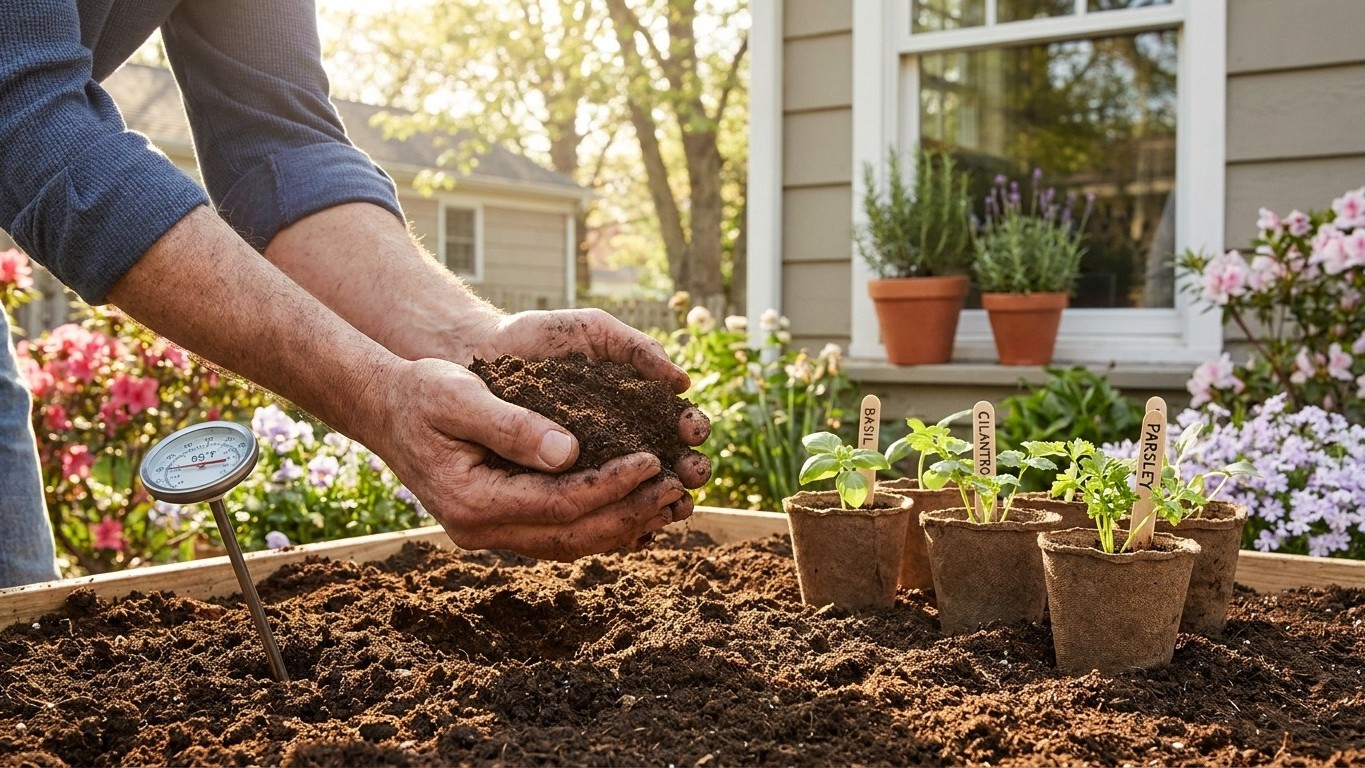

Herbs go into New Brunswick gardens once the soil itself has warmed, typically in the last week of May, and stay productive for roughly four months before fall frost ends the season. Cold-hardy types like chives and parsley tolerate a head start; basil and other tender herbs wait longer. Winter, not summer heat, decides which herbs survive outdoors here year after year.
When the soil is warm enough in New Brunswick

The number gardeners actually want is the last spring frost, and for this region that figure comes from Environment and Climate Change Canada’s Climate Normals (1981-2010), recorded at the MONCTON station: on average, May 23. That date is worth pinning to memory, but it needs a caution attached to it every time. It is a mean, not a guarantee. In roughly half of all years on record, frost has actually arrived later than May 23. Treat it as the midpoint of a window, not a green light.
There’s a second layer under that date, and it matters more for herbs than the frost line itself: soil temperature. Air can clear the frost risk while the ground underneath stays cold and slow to release nutrients. Herbs rooted in cool, wet soil sit and sulk rather than grow, whether or not the calendar says it’s safe. So the practical answer is that soil warms up after the frost risk has passed, not at the same moment as it. Waiting a week or two past the mean frost date, and checking that the ground itself feels warm to the hand a few inches down, does more for young plants than the calendar alone.
It’s also worth remembering that Moncton is one station in a province that is not one climate. Northern New Brunswick and higher, inland districts commonly run weeks behind this figure. A gardener near the Restigouche or in higher elevation country should treat late May as optimistic and push transplanting later.
Species differ in how much of a head start they can handle. Cold-tolerant herbs such as parsley, chives, and cilantro germinate in cool soil and can go in before the mean frost date with some protection. Tender, warmth-loving herbs, basil chief among them, punish an early planting with stunted growth or blackened leaves at the first cool night, so those are better held until soil has had real time to warm. Several herbs known for a traditional medicinal reputation appear in New Brunswick gardens too; this page treats them strictly as culinary and garden plants and does not evaluate any health claim attached to them.
How long the season lasts here
With a mean last spring frost of May 23 and a mean first fall frost of October 2, both drawn from the same Moncton station and the same 1981-2010 normals, the arithmetic gives a growing window of about 132 days, call it four and a half months. That’s the frost-to-frost span; it says nothing about how fast the soil warms at the start or how quickly light fades at the end, but it’s the honest subtraction the two Canadian normals allow.
A window of that length changes the decisions a gardener makes more than it might seem. It’s long enough for one full run of most culinary herbs from transplant to harvest, with room to spare on either end for hardening off and a late cutting. It is not, generally, long enough to justify a full second sowing of slower herbs the way a six-month season farther south would. Quick, cut-and-come-again types such as cilantro or dill can sometimes support a second round if the first is started early under cover, but treating that as a plan rather than a bonus sets up disappointment.
Because the window is moderate rather than generous, starting many herbs indoors and transplanting seedlings out, instead of direct-seeding everything once the soil warms, buys back real weeks of harvest. That’s especially true for slower herbs like rosemary types or thyme types, where a transplant already has a developed root system by the time it meets outdoor soil. Checking that a seedling isn’t rootbound before it goes in the ground matters more here than in a longer season, since there’s less time in reserve to recover from transplant shock.
Readers planning exactly when to start a second round, or wondering which herbs tolerate a staggered planting at all, will find the mechanics laid out in our succession sowing guide, which applies the same frost-window logic to timing decisions across the season.
Heat and water in New Brunswick

For most of the United States, the summer heat count is the number that decides an herb bed’s fate. New Brunswick flips that. The Maritime province sits under a maritime-influenced climate where summers run cooler and damper than inland regions at the same latitude, and the more decisive figure for herbs here is a winter one: the mean daily minimum of the coldest month, which at Moncton runs to 6.9°F, paired with a Canadian hardiness zone rating of 5a for the reference city in these facts.
That pairing needs its own caution. The Canadian zone system is not the USDA system used elsewhere on this site, and Natural Resources Canada is explicit that there is no simple conversion between the two: they’re built from different sets of climate variables, and a single Canadian zone can span numerous USDA zones. So 5a here should be read on its own terms, as a description of what survives outdoors through a Moncton winter, not translated into a US zone number.
What that combination of a cold winter minimum and a cool, humid growing season means in practice is that summer heat stress, sunscald, wilting, bolting from high temperatures, is rarely the problem it is farther south. The problem instead tends to be moisture sitting on foliage through a cool, overcast stretch: slower ripening, slower drying after rain, and a higher risk of fungal issues on herbs planted too close together or in poorly drained soil. Airflow between plants and well-drained beds do more for herb health in this territory than shade cloth or extra watering ever would.
The winter minimum is also the number that separates herbs that can live outdoors as permanent plants here from herbs that have to be treated as containers brought indoors before the cold sets in. A woody perennial herb rated for winters colder than 6.9°F stands a real chance in the ground; one that isn’t, survives only as a potted plant moved to a porch, garage, or windowsill for the coldest months. That single distinction, more than any summer heat consideration, is what organizes a New Brunswick herb bed.
Which herbs suit New Brunswick
Given a roughly 132-day window, a cool damp summer, and a winter minimum near 7°F, the herbs that do well here sort naturally into a few groups rather than a list of specific names.
| Herb type | Season fit | Winter behavior in zone 5a |
|---|---|---|
| Fast, cool-tolerant annuals (cilantro, dill types, parsley types) | Can start early, sometimes support a second sowing | Annual regardless of zone; replanted yearly |
| Warmth-loving annuals (basil types) | Need soil fully warmed before transplant; full season use | Annual; killed by first fall frost |
| Hardy perennial herbs (chives, some mint types) | Establish in one season, return on their own | Generally survive a Moncton winter in the ground |
| Tender woody perennials (rosemary types, some thyme types) | Grow well through the summer window | Often need to be containerized and moved indoors for winter |
A short growing window rewards the fastest-establishing types, since there’s little slack to recover from a slow start. The humid, cool summer makes disease resistance, more than heat tolerance, the trait worth prioritizing when choosing among varieties of the same herb. And the cold winter minimum decides, herb by herb, whether it belongs in the permanent garden bed or in a pot destined for a windowsill come October.
This page deliberately stops at the type level and does not name specific cultivars. Variety trials, the kind that tell a gardener which strain of a given herb actually shrugs off local humidity or survives a Moncton winter outdoors, are done at the provincial and regional level, not on a general information page. The right next step is the federal agriculture department’s site, which links through to the provincial resources running those local trials; recommendations built on data from a gardener’s own region carry weight that a generic list never can.