
Yukon herb gardeners get a clear answer: yes, herbs grow here, but the territory’s short frost-free stretch and Canadian hardiness zone 1b turn most familiar kitchen herbs into annuals, container plants, or both. The soil that decides sowing dates, the cold that decides what survives winter, and the season length that decides whether a second planting is worth trying all come from Whitehorse’s own climate station, not from Yukon as a single, uniform climate.
When the soil is warm enough in Yukon
Why frost date isn’t a starting gun
June 5. That’s the average last spring frost recorded at Whitehorse A, according to Environment and Climate Change Canada’s 1981-2010 climate normals. It’s tempting to treat that date as a green light for planting basil, cilantro, or dill outdoors. It isn’t one.
A frost date is a mean, not a guarantee. In one year out of two, the last frost at this station falls later than June 5, sometimes well later. Treat the date as the midpoint of a window, not a safe line to plant against.
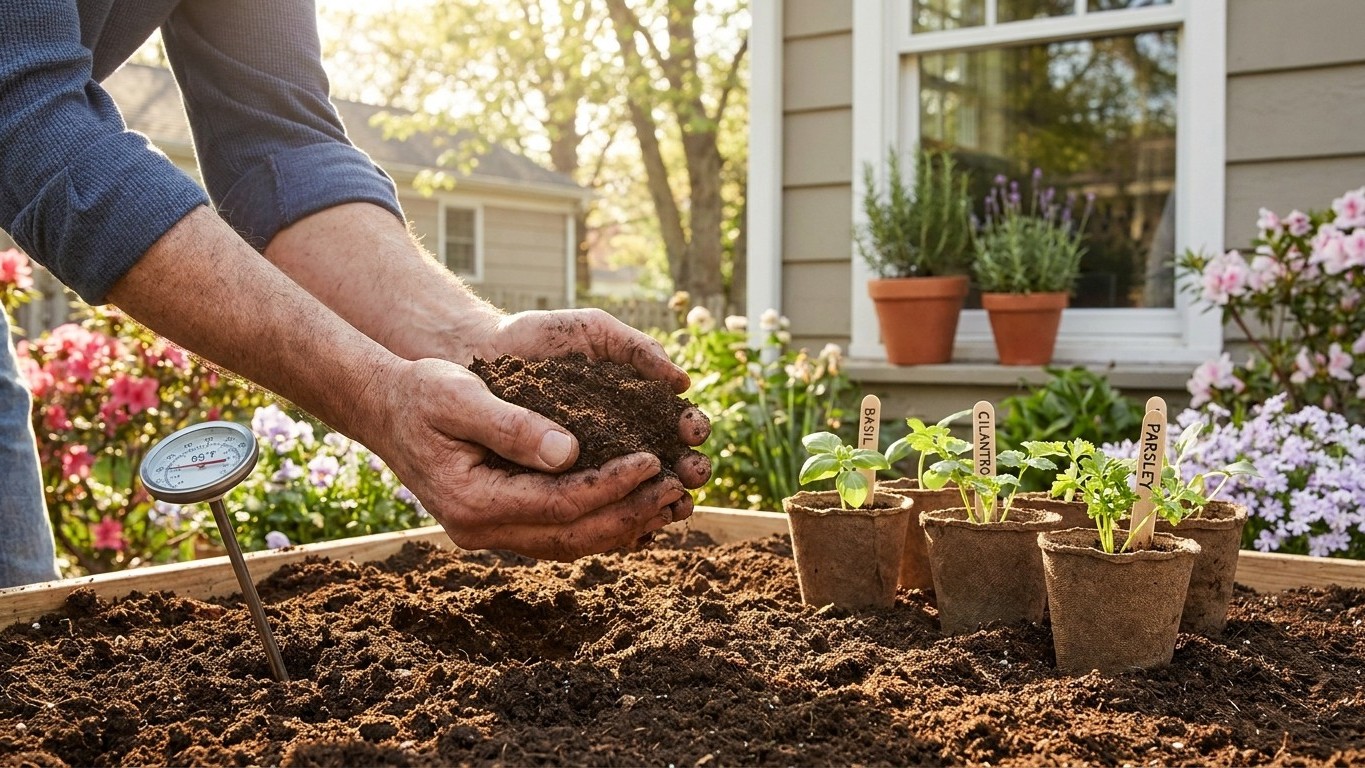
There’s a second problem with using frost as the planting signal at all: it measures air temperature, not soil temperature, and herbs germinate and root according to the soil, not the calendar. Ground that thawed weeks earlier can still sit cold and wet through early June at this latitude, especially in shaded beds or heavy clay. Warm-season herb types, the tender annuals like basil and most cilantro, stall or rot if seeded or transplanted into soil that hasn’t caught up with the air.
Watching the soil, not just the calendar
The practical fix is to wait past the frost date itself and check the ground: soil that feels cool to the wrist a few inches down is still too cold for tender herb seedlings, whatever the thermometer on the porch says. Hardier annual types, such as parsley and dill, tolerate a cooler start and can go in closer to the frost date than basil can.
Whitehorse A is one station. Yukon covers a vast area, and communities north of Whitehorse, or at higher elevation, typically lag behind this date by days to weeks. Gardeners outside the immediate Whitehorse area should treat June 5 as an optimistic starting point, not a working forecast for their own yard.
None of this is about which herb has a reputation for treating this or that condition; it’s strictly about timing seed and transplant to soil that can support root growth. Some herbs common in home kitchens carry long-standing medicinal reputations, but this page doesn’t evaluate those claims one way or the other. The only question here is when the dirt is ready.
How long the season lasts here
Doing the math
Subtract June 5 from August 25, the average first fall frost also recorded at Whitehorse A, and the frost-free window comes out to roughly 81 days. That’s the growing season Yukon herb gardeners are working with, at least at this reference station, and it’s short compared to almost anywhere else covered in this herb-by-territory series.
Eighty-one days changes what’s realistic. It doesn’t rule out a second sowing entirely, but it makes the decision tight: an herb that needs even a few weeks to reach usable size before the first sowing can be harvested leaves little room for a repeat planting before fall frost risk returns. Compare that to a territory with a five- or six-month window, where staggering plantings every few weeks is routine and low-risk.
What 81 days allows and what it doesn’t
In practice, the first sowing is the season for most herb types here, rather than the opening move in a longer sequence. Herbs that establish and mature quickly, the early types, are worth prioritizing for that reason alone: they have the best shot at producing something before frost returns, and they’re also the only realistic candidates for a modest second sowing squeezed in during the warmest weeks.
The short window also changes how much benefit transplanting offers over direct seeding. With more growing days to spare, gardeners elsewhere can afford to start seedlings indoors, then check root development before setting plants out, accepting some transplant shock as the price of a head start. With only 81 frost-free days, that head start matters more, but so does getting the transplant right: rootbound or damaged starts lose time this climate can’t give back.
Readers wanting the mechanics of staggering plantings inside a short window, how far apart to space sowings, and which herb types tolerate a late-summer restart, should see this site’s succession sowing guide, which covers the technique in more depth than a single territory page can.
Heat and water in Yukon
No meaningful heat count for this territory
Some territories in this series lean on a count of days above 90°F and a summer rainfall total to explain what herbs go through in July and August. Yukon doesn’t offer a comparable heat count worth citing: at this latitude, days that hot are rare enough that the figure isn’t a meaningful description of a typical summer, and no such reference number appears in the records used for this page. The same caution applies to a specific summer rainfall total; rather than estimate one, this page won’t put a number to it.
What that absence tells you matters more than a number would. Yukon summers run cool and often damp rather than hot and dry, and for herb gardeners that flips the usual seasonal worry. Where a hot, humid territory pushes cilantro to bolt early and forces gardeners to plan for afternoon shade, a cool, short Yukon summer brings a different set of problems: slow ripening, sluggish growth in overcast stretches, and fungal issues like powdery mildew or gray mold that thrive on cool, damp foliage that doesn’t dry off quickly between rain or dew. Airflow around plants and morning sun exposure matter here for disease control, not for protecting herbs from scorching heat.
The number that actually matters: winter
The figure that organizes a Yukon herb bed is a winter one. The coldest month at the Whitehorse reference station averages a daily minimum of -2.6°F, and the territory sits in Canadian hardiness zone 1b, based on Natural Resources Canada’s 1991-2020 normals for the reference city. That’s the Canadian system, built on seven climate variables, and it does not convert to a USDA zone the way many US gardeners expect; Natural Resources Canada itself notes there’s no simple conversion between the two scales.
| Metric | Value | What it decides |
|---|---|---|
| Coldest month, mean daily minimum | -2.6°F | Whether roots and woody stems survive winter outdoors |
| Canadian hardiness zone | 1b | Which herb types can be planted as permanent perennials at all |
At zone 1b, almost no herb typically grown as an outdoor perennial elsewhere in North America is reliably hardy through a Yukon winter without protection. That single fact reorganizes the whole herb bed: perennial herb types either come indoors for winter as container plants, get treated as annuals and replanted each spring, or get skipped in favor of species genuinely rated for extreme cold. Summer heat isn’t the limiting factor in this territory. Winter is.
Which herbs suit Yukon
Types that fit a short, cool, humid season
With an 81-day frost-free window and a winter that rules out most outdoor perennials, the herbs that make sense in Yukon fall into a short list of practical types rather than particular products.
- Fast-maturing annual types: many basils, cilantro, dill, and other quick leafy herbs suited to reaching usable size inside a short window
- Disease-resistant, airflow-friendly types: selections bred with resistance to powdery mildew and other fungal pressure common in cool, damp summers
- Portable perennial types: chives, mint, oregano, thyme, and similar species grown as container plants rather than permanent bed residents
Fast-maturing annual types come first, and they’re worth prioritizing precisely because they have the best odds of reaching usable size inside this territory’s short window. Slower annual and biennial types carry more risk of running out of season before they’re worth cutting. Cool, damp summers make disease resistance the next filter, ahead of flavor or growth habit; open, upright types tend to shed moisture faster than dense, sprawling ones, which matters when foliage stays damp for long stretches.
Why this page won’t name a variety
Perennial herb types are usually sold as hardy outdoor perennials in warmer parts of North America, but Canadian zone 1b puts nearly all of them outside their reliable outdoor range in Yukon. The practical version of these herbs here is a container plant: grown outdoors through the frost-free window, then moved indoors or into an unheated but frost-protected space before the coldest month arrives. Treating a “perennial” herb as a portable container plant, rather than a permanent bed resident, is often the difference between having it next spring and starting over from seed.
This page deliberately stops short of naming specific varieties. The categories above are useful, but which named variety within each type actually performs well is a local trial question, tested against Yukon’s particular combination of short season, cool summer, and severe winter. Agriculture and Agri-Food Canada, at agriculture.canada.ca, is the federal starting point for that kind of regionally tested guidance. A variety recommendation that hasn’t been trialled against this territory’s specific numbers isn’t worth much more than a guess, and this page would rather point readers to where the real local data lives than pretend to have it.