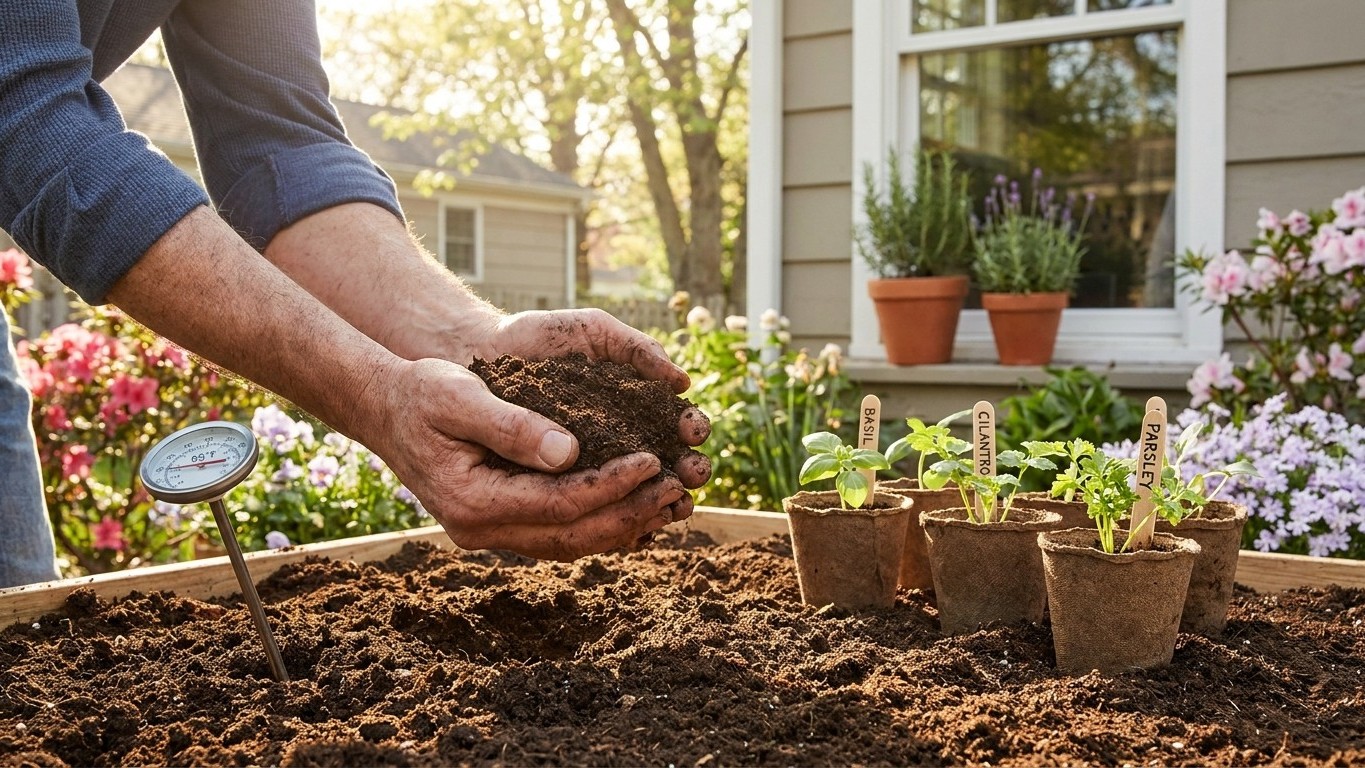

Most herbs can go into Ontario ground once the frost risk has genuinely passed, which lands closer to mid or late May than the calendar average suggests. The reference point is Canadian hardiness zone 7a, but that number is less useful for spring planting than for one bigger decision: which herbs Ontario winters allow to live outdoors year-round, and which need a pot and a windowsill from October on.
When the soil is warm enough in Ontario

The average last spring frost at Toronto Lester B. Pearson International Airport, per Environment and Climate Change Canada’s 1981-2010 Climate Normals, falls on April 30. That figure matters, but not the way most gardeners use it. It is a mean date, not a safety line: in one year out of two, frost arrives after April 30, sometimes well after. Treat it as the midpoint of a window, not a promise the ground is safe.
Frost is also a proxy for something else entirely. Herbs don’t respond to frost risk itself, they respond to soil temperature. Basil, in particular, sulks and yellows in cold soil even on a frost-free night, because its roots stall below roughly 50°F. So the real question isn’t “has the last frost passed,” it’s “has the soil actually warmed through,” and that second milestone typically trails the frost date by one to two weeks in a clay-heavy or poorly drained Ontario garden bed. Sandy, south-facing beds warm faster; low, shaded, or heavy soils lag.
What this means for different herb types
Hardy perennial herbs from the Mediterranean hill country, along with biennials like parsley, tolerate a cooler start and can go in around the frost date itself, or even a little before under cover. Tender annual herbs from warmer origins want to wait until the soil has fully turned over, not just until the thermometer avoided a frost overnight. Gardeners who rush a warm-soil herb into cold ground usually don’t lose the plant outright, but they lose weeks of growth waiting for it to recover, which on a short Ontario season is a real cost.
None of this changes by province-wide decree. The April 30 figure comes from one station near Toronto’s airport. Gardeners in northern Ontario, in the Muskoka uplands, or along the Ottawa Valley routinely see their last frost run two to four weeks later than that Toronto reading, simply because elevation and latitude both push frost risk later. A provincial average is a starting reference, not a local forecast, and this page cannot substitute for watching your own soil and your own thermometer that particular spring.
How long the season lasts here
Between the average last spring frost of April 30 and the average first fall frost of October 16, both from the same Toronto Pearson station and the same 1981-2010 Normals, Ontario’s frost-free window runs about 169 days. That’s a genuinely workable season for herbs, longer than many people assume for a Canadian province, though again it’s an average built from two averages, and either end can shift by weeks depending on the actual year and the actual district.
What a window of that length allows is choice. It’s long enough to sow a fast annual herb like cilantro or dill in spring, let it bolt or finish in the summer heat, then sow a second round in July for a fall harvest before the October frost closes things out. That’s a real second sowing, not a stretch, and it’s the kind of decision the succession sowing guide on this site walks through crop by crop, including which herbs tolerate a mid-season restart and which don’t bother.
Where the window gets tight
A 169-day average also changes how much transplant fussiness is worth tolerating. Herbs with a taproot, dill and cilantro among them, resent having their roots disturbed at transplant and often bolt or stall afterward. On a long season, that setback is recoverable; there’s time to wait it out. On a shortened season, whether from a late local frost, a colder microclimate, or simply a bad spring, the same setback can eat into the only real harvest window the plant gets. That’s the practical argument for direct-sowing taprooted herbs in Ontario rather than starting them indoors and transplanting, even though transplanting is the more forgiving method for basil, thyme, or oregano.
It’s worth remembering the window is a provincial average built from a single Toronto-area station. A gardener in a colder inland district, or one gardening at higher elevation, should treat 169 days as an upper estimate for their own conditions, not a guarantee, and plan the second sowing with a buffer rather than cutting it against October 16 exactly.
Heat and water in Ontario

For most vegetable crops, the summer heat count and the rainfall total decide the season. For herbs, particularly the woody perennial kinds, that’s usually the wrong question to ask about Ontario. The number that actually reorganizes the whole herb bed is winter, not summer: Toronto’s reference station sits in Canadian hardiness zone 7a, with a coldest-month mean daily minimum of 13.6°F, according to ECCC’s 1981-2010 Normals.
That single figure, 13.6°F as an average nightly low in the depth of winter, is the line that separates herbs that can live outdoors in Ontario all year from herbs that can’t survive an Ontario winter at all without help. Some perennial herbs handle that cold reliably in the ground. Others, particularly herbs bred from warmer Mediterranean or subtropical origins, will not survive a typical Ontario winter outdoors, no matter how well they performed all summer. For those, the choice in this province isn’t “annual or perennial,” it’s “permanent garden plant or container that comes indoors before the first hard frost.”
Why this matters more than a hot afternoon
A gardener moving from a warmer US state to Ontario will often plan around summer stress: shade cloth, extra watering, mulch against heat. Those aren’t wasted efforts, but they’re solving the smaller problem. The bigger one arrives in November, when a herb that shrugged off every August afternoon quietly dies at the roots because nobody planned for the 13.6°F average low, let alone the colder nights that regularly dip below that mean. Frost blankets and mulch help marginally hardy herbs survive a borderline winter, but they don’t rescue a plant that’s genuinely outside its hardiness range.
It’s also worth flagging what the Canadian zone number is not. Zone 7a here is built on Natural Resources Canada’s own seven-variable model, and it does not convert to a USDA zone the way a temperature reading might suggest. NRCan is explicit that a single Canadian zone can overlap several different USDA zones depending on which of the seven variables drives the difference. Anyone cross-referencing a herb’s USDA hardiness rating against this province’s zone 7a should treat that comparison as informal at best, not as a like-for-like number.
Which herbs suit Ontario
None of this page names a specific variety, and that’s a deliberate choice, not an oversight. Cultivar performance depends on trials run in local soil and local weather, and the only body positioned to publish that kind of tested, province-specific recommendation is Ontario’s own agricultural extension network, reachable through the province’s agriculture and food services. A blog naming a specific basil or rosemary strain without that local trial data is guessing, and guessing with a plant that has to survive a Zone 7a winter or a 169-day season isn’t a small risk.
What can be said by type follows directly from the three earlier sections. The frost-window math favors annual herb types that finish quickly and tolerate a second sowing after a July restart, since the season is long enough to support that but not endless. The winter question sorts perennial herb types into two honest categories: those hardy enough for Ontario’s coldest-month average to leave alone in the ground, and those that need to spend the winter as a container plant brought indoors before the first fall frost risk sets in around mid-October.
Reading the humidity signal
Ontario summers, especially in the Toronto corridor and the Golden Horseshoe, run humid enough that fungal pressure on herb foliage is a real and recurring issue, more than heat stress itself. Woody Mediterranean-type herbs, the ones that evolved for dry, airy hillsides, generally want more airflow and drier footing in an Ontario bed than their reputation suggests, which usually means wider spacing and a raised or well-drained spot rather than a low, damp corner of the yard. Leafier annual types tend to tolerate the humidity better but bolt faster in a warm, wet stretch, which is one more argument for planning that second, later sowing rather than counting on one planting to carry the whole season.
The species-level decision, then, comes down to three filters worth applying in order: does this herb’s type survive a 13.6°F average winter low outdoors, does it fit inside a roughly 169-day window with room for a restart if needed, and does it tolerate Ontario’s humid summer air without constant mildew management. A herb that clears all three is worth planting directly. One that fails the winter filter isn’t a bad choice, it just belongs in a pot with a plan for November, not in a permanent bed.