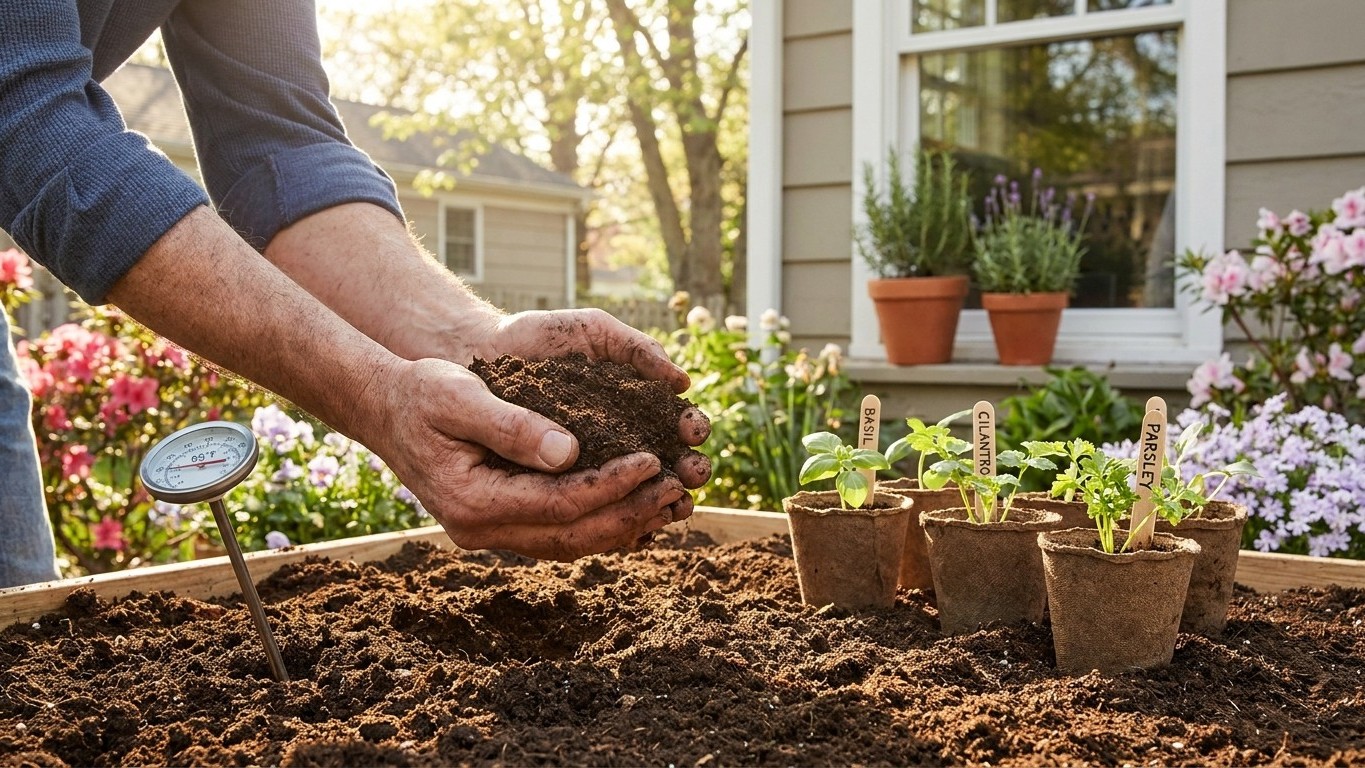

Herbs grow across nearly all of Tennessee, but the state spans two full USDA hardiness zones, from the cool ridges of the Cumberland Plateau to the warmer valleys near Memphis. The practical answer: plant tender herbs after mid-April, expect a growing window of roughly seven months, and treat winter cold, not summer heat, as the factor that decides which herbs stay in the ground year-round.
When the soil is warm enough in Tennessee

The question every gardener actually wants answered is not “when does frost end” but “when can I put a basil seedling in the ground without losing it.” Those are related but not identical, and the gap between them trips up a lot of first-time herb growers.
For the reference station used by NOAA (USW00013897), the last spring frost falls between March 31 and April 12, based on the 1991-2020 Climate Normals and their 30-70% freeze probability band. That is a probability window, not a guarantee. A frost date tells you when the odds of a damaging freeze drop to a manageable level; it does not promise a frost-free morning on any specific day, and a late cold snap outside that window is not unheard of.
Here is the part that matters more than the date itself: tender herbs like basil, cilantro, and most tropical or Mediterranean types are not actually waiting for the air to warm. They are waiting for the soil to warm, and soil temperature lags behind air temperature by days to a couple of weeks depending on how wet and shaded the ground is. So even once the frost risk has passed in early to mid-April, it is worth checking that the soil itself has climbed into a range where roots will actually grow rather than just sit and sulk. Planting into cold, wet soil is one of the most common reasons a healthy-looking herb seedling stalls for weeks.
Geography inside Tennessee complicates this further. The frost window above comes from a single reference station, and the state’s elevation change is significant. East Tennessee and the Cumberland Plateau sit higher and cooler than the Nashville basin, and both frost dates there tend to run later in spring. A gardener in Sevierville or on the Plateau should treat the early end of that April window with real skepticism and lean toward the later dates, or even a bit past them, before setting out anything frost-sensitive.
Hardy herbs don’t need to wait at all. Types like chives, parsley, and most mints tolerate a light frost and can go in several weeks before the last-frost window closes, which is worth remembering if you’re eager to get something growing while the tender herbs wait out the soil.
One more note on scope: some herbs common in home gardens carry a long-standing reputation for medicinal use. This page doesn’t evaluate those claims one way or the other, and it isn’t the place to look for guidance on that front. What follows here is strictly about growing herbs for the kitchen, in a garden bed or a pot.
How long the season lasts here
Put both frost dates from the same NOAA station together and Tennessee’s growing window runs from a last spring frost of March 31 to April 12, out to a first fall frost of October 28 to November 8. Taken at their widest, that’s about 222 days between the earliest possible last frost and the latest possible first frost. Taken conservatively, using the later spring date and the earlier fall date, it’s closer to 199 days. Either way, that’s roughly six and a half to seven months of frost-free growing, which puts Tennessee comfortably in the “long enough for more than one round” category for most annual herbs.
That length changes the math on how you plant. A season this long means a first sowing of something like cilantro or dill, which bolts and fades in hot weather, doesn’t have to be the only sowing of the year. There’s enough calendar left after a spring crop finishes to put in a second round in late summer for a fall harvest, particularly in the warmer parts of Middle and West Tennessee where the fall frost arrives closer to the November end of the range. Gardeners in the cooler eastern and Plateau counties should plan around the earlier end of that fall window and get a second sowing in the ground sooner rather than later.
The season length also affects whether starting from seed indoors is worth the trouble versus buying transplants or direct-sowing. With nearly seven months on the table, slower-germinating herbs like parsley or oregano have time to catch up even from a mid-spring seeding, whereas in a shorter-season territory, skipping straight to a transplant with an established root system would be the safer bet. Here, either approach works, and the choice comes down more to convenience than necessity.
For the specifics of timing a second sowing, spacing it out from the first, and picking which herbs actually reward the effort, this site’s succession sowing guide walks through the calendar in more detail than fits here.
Heat and water in Tennessee

Summers across Middle and West Tennessee run hot and humid, and the higher ground of East Tennessee and the Cumberland Plateau runs noticeably cooler and often wetter in comparison. That contrast matters for herbs mostly through disease pressure rather than heat stress itself: humid air sitting on herb foliage overnight is what invites powdery mildew and other fungal problems on crowded basil or dense mint patches, more than the daytime temperature does.
But for herbs specifically, summer conditions aren’t actually the variable that reorganizes the whole planting plan. Winter is. The figure that matters most here is the mean daily minimum temperature of the coldest month, which for the Nashville reference station sits at 30.1°F, based on NOAA’s 1991-2020 Climate Normals. That’s not the record low and not a monthly average; it’s the typical overnight floor during the coldest stretch of winter, and it’s the number that decides whether a perennial herb survives outdoors or needs to come inside.
Tennessee spans USDA Hardiness Zones 5b to 8a, based on the USDA Plant Hardiness Zone Map’s 2023 update (built on 1991-2020 normals). That’s a wide range for one state, and it reflects the elevation swing between the Plateau and the western lowlands. The zone system itself is built on a single variable, the average annual extreme minimum temperature, so it’s a useful shorthand for winter survival but not a full climate picture. A gardener in the cooler 5b-6a pockets of the eastern highlands is working with a genuinely different winter than one in the 7b-8a stretch near Memphis, even though both are technically “Tennessee.”
What this means in practice: a rosemary plant that overwinters outdoors without a second thought in a warmer Tennessee valley may need a sheltered spot, a heavy mulch, or a trip into a container and indoors for winter in a colder pocket of the state. The same goes for bay laurel and some of the woodier Mediterranean herbs. Zone and coldest-month minimum, not the summer heat count, are the numbers worth checking against your specific county before deciding what stays in the ground past October.
Which herbs suit Tennessee
Given a season stretching roughly seven months and a winter that varies sharply by elevation, the honest way to sort herbs here is by type, not by brand name or specific variety.
Annual, heat-tolerant herbs (basil, summer savory, most annual types) fit the long frost-free window well and can go in as soon as the soil has warmed past the last-frost date. Because humidity runs high across much of the state in summer, giving these plants real airflow, wider spacing than the seed packet might suggest, matters more here than it would in a drier climate. Crowded basil in a humid Tennessee July is an invitation for fungal trouble.
Perennial herbs split along the hardiness line described above. Types that handle cold well, like chives, thyme, sage, and most mints, can be treated as permanent plantings across nearly the whole state, though gardeners at the cooler end of the 5b-6a range should still watch them through a hard winter. Tender perennials, the rosemary and bay laurel types, need a case-by-case decision based on local winter minimums; in the warmer western and Middle Tennessee zones they may overwinter outdoors with protection, while in cooler pockets, treating them as container plants that move indoors for winter is the more reliable path.
Biennial herbs like parsley fit either as a one-season annual harvest or, if the winter is mild enough where you are, a plant that carries over and flowers the following year, though most gardeners here treat it as an annual and replant.
Cool-season herbs such as cilantro do best sown early, since sustained summer heat pushes them to bolt quickly; the long season here just means there’s room to try a second round again in early fall once temperatures ease.
This page won’t recommend specific varieties, and that’s deliberate. Which basil or rosemary selection actually performs well in a given Tennessee county depends on trials run in that region’s real conditions, not on a general description of the state’s climate. The University of Tennessee Institute of Agriculture Extension maintains that kind of locally tested guidance, county by county, and it’s the resource worth checking before buying seed or transplants for anything beyond the most common, forgiving herb types.