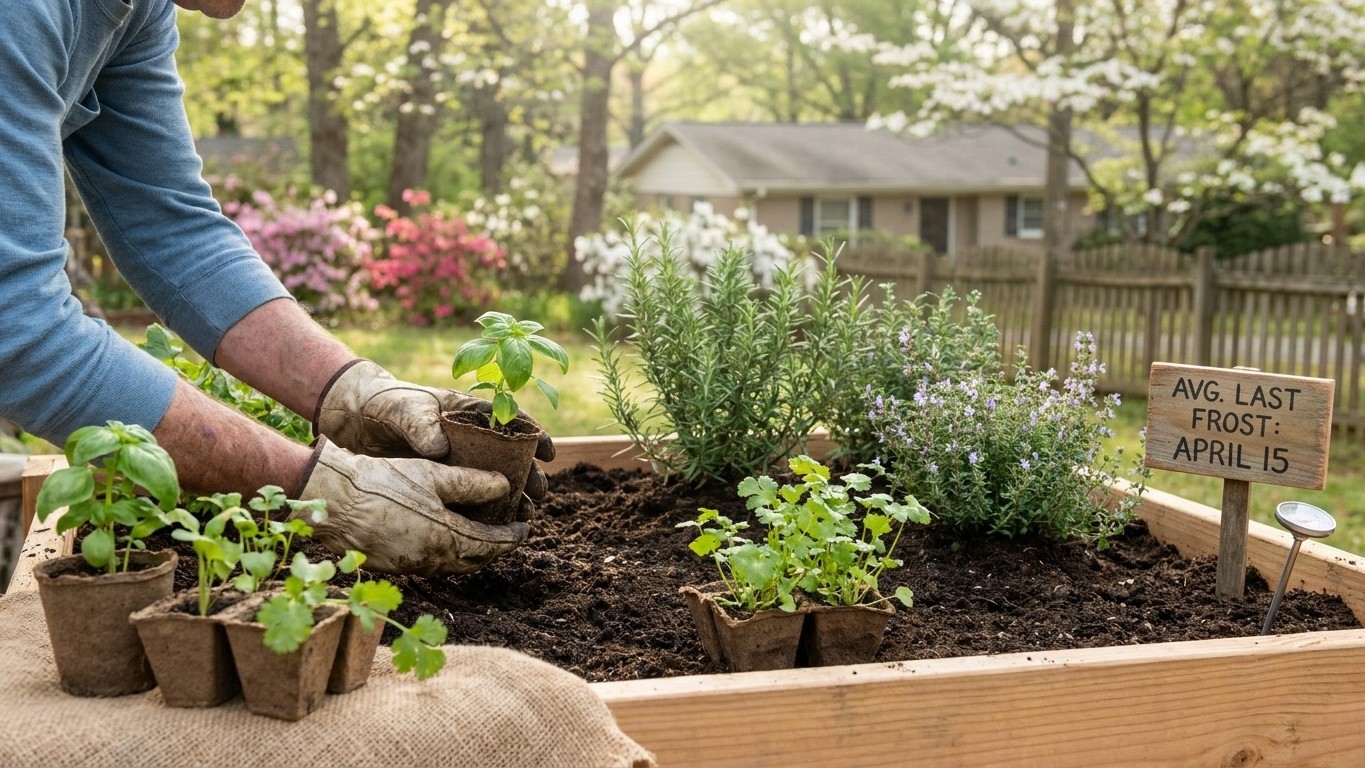

In Anchorage, the safe window for putting herb transplants outside runs from May 3 to May 12 through September 22 to October 1, roughly 143 frost-free days. That window is a probability, not a guarantee, and it shifts for your own yard.
The short answer for Alaska
The dates above come from NOAA’s 1991-2020 Climate Normals for station USW00026451, Anchorage, and they mark the 30-70% freeze probability band for 32°F. That means on May 3, there’s still roughly a 70% chance of a freeze; by May 12, the odds have dropped to about 30%. The same logic runs in reverse for fall: September 22 carries a 30% freeze chance, October 1 closer to 70%. Nobody is handing you a guarantee here, just a shrinking risk curve.
For hardy, cold-tolerant herbs, chives, parsley, and cilantro, you can push transplants out near the early end of that window and accept the occasional frost nip on outer leaves. For anything tender, basil above all, waiting until the back half of the window, closer to May 12, cuts your losses considerably. Basil sulks and blackens at temperatures many other herbs shrug off.
Direct-sown seed is a different calculation. Seeds don’t die from a light frost the way transplants can, but they also won’t germinate in cold soil. Dill, cilantro, and parsley seed can go into the ground a week or two before the last frost date because germination itself takes time, and by the time seedlings emerge, the frost risk has usually already eased. Fast-germinating, cold-tolerant herbs are the ones best suited to squeezing extra days out of a short Alaska season.
On the back end, that September 22 to October 1 window matters more than gardeners in warmer states might expect. It’s not just about a killing frost ending the season, it’s about the light frosts that show up days before dragging down flavor and vigor in tender herbs while barely touching hardy ones. Anchorage’s roughly 143 frost-free days sound short next to a Gulf Coast garden’s 250-plus, but the compensation is daylight. Summer days in south-central Alaska run long, often 18 hours or more of usable light in June, and that extra photosynthesis time pushes many herbs through their life cycle faster than the calendar alone would suggest.
One caution worth repeating: Anchorage is one of the mildest inhabited parts of the state. Treat these dates as the generous end of what Alaska offers, not the statewide default.
What will not work here

A 143-day frost-free season, even stretched by long daylight, defeats slow-maturing herbs outright when they’re grown the way a gardener in a longer-season state would grow them, straight in open ground with no head start. Herbs that need a long, uninterrupted warm stretch to bulk up before they’re useful struggle here unless started indoors well ahead of the outdoor window and then given a sheltered spot once transplanted.
The bigger constraint is winter, not summer. The coldest month in Anchorage averages a daily minimum of 11.0°F, and that’s the mean, not the record low, meaning it happens most winters, not just in a rare cold snap. Any herb marketed as a hardy perennial in a warmer hardiness zone, think rosemary or bay in much of the country, simply won’t survive an Alaska winter outdoors without being brought inside or grown as an annual from scratch each spring. The USDA hardiness zone map lists Alaska spanning 1a through 8a statewide, and even at the mild end of that range, near Anchorage, perennial herbs rated for zone 8 or 9 elsewhere are not making it through an unprotected winter.
Where watering habits fail
Alaska’s short, cool summers don’t punish herbs the way a hot, dry Southwest summer does. Weekly watering schedules built for arid heat will leave containers and raised beds soggy here, since evaporation is slower and rainfall in coastal south-central Alaska is a regular feature of the growing season. Herbs that demand sharp drainage, most Mediterranean natives, are the ones most likely to sulk or rot in a wet, cool summer if the soil doesn’t drain fast.
Close spacing is the other quiet failure point. Cooler air holds humidity near the leaf surface longer than it would in a drier climate, and herbs packed tight the way a catalog photo suggests will hold that dampness against their own foliage, inviting mildew on crowded plantings of anything with soft, dense leaves. Give herbs more air movement between plants here than a general planting guide recommends, and skip the perennial Mediterranean herbs entirely unless you’re prepared to overwinter them indoors.
What changes across Alaska
Alaska is not one climate wearing different scenery. The USDA Hardiness Zone Map lists the state spanning zone 1a all the way to 8a, one of the widest spreads of any state in the country. There is no single answer for “when to plant” that covers a coastal garden near Anchorage and an Interior homestead near Fairbanks in the same sentence, let alone anything farther north.
| Region type | General pattern | What shifts |
|---|---|---|
| Mild coastal (Anchorage reference) | Longer frost-free window, cooler summers | Wet-soil risk for Mediterranean herbs |
| Interior | Shorter frost-free window, more summer heat swing | Faster warm-up but harder, earlier fall frost |
| Northern/high-latitude | Much shorter or marginal outdoor season | Container or greenhouse growing often required |
Move toward the Interior and the frost-free window generally narrows even as summer daytime heat can climb higher than coastal areas ever see. Move north or up in elevation and the growing season can shrink to a fraction of Anchorage’s, sometimes to the point where outdoor herb growing without protection stops being realistic at all.
The right move is checking the USDA Plant Hardiness Zone Map directly for your ZIP code rather than assuming Anchorage’s numbers travel with you across the state.
Where to check this for your own county
Alaska at the state level is described by one reference station. Your county deserves better than a state average, and the University of Alaska Fairbanks Cooperative Extension Service is where that better answer lives.
Once there, look specifically for two things. First, a local planting calendar built for your district office rather than the state as a whole, since extension offices in Alaska cover ground as different as the Kenai Peninsula, the Tanana Valley, and the Southeast panhandle, each with its own frost pattern that this state-level page cannot capture. Second, look for variety trial results or recommended cultivar lists specific to your county’s growing conditions. Extension trials test which herb varieties actually mature and produce reliably under local daylight, soil, and temperature conditions, information no national seed catalog or general planting guide can offer.
A county-level recommendation from your local extension office will beat this state-level page every time it’s available, because it accounts for the exact frost pattern, soil type, and daylight exposure of your district rather than one reference station’s normals. Treat what’s written here as the starting framework, and treat whatever your local extension office publishes as the correction layer on top of it.
If your district office doesn’t have a published calendar yet, calling or emailing them directly is worth the ten minutes. Extension agents in Alaska field exactly this kind of question regularly, and they can often speak to microclimate quirks, a cold pocket at the bottom of a valley, a warm south-facing slope, that no map or dataset captures.
Checking this against your own garden
Every date here is an average built from decades of past weather, and your actual garden this year is not obligated to match it. Three direct observations will tell you more than any calendar.
Soil warmth by feel comes first. Push a finger a few inches into the bed in spring; if it still feels cold and heavy rather than merely cool, seeds and transplants will sit and sulk regardless of what the calendar says, since germination and root growth both stall in cold soil even after air temperatures have warmed.
The first true leaves on direct-sown seedlings are the second signal. Seedlings that push past their initial seed leaves and develop proper, plant-specific foliage quickly are telling you the soil and air conditions actually suit them right now, not just on the date you planted. Slow, stalled true-leaf development after a normal germination period usually means conditions cooled back down after sowing.
The third is early flowering, or bolting, on cool-season herbs like cilantro and dill. A sudden rush to flower well before the plant has bulked up usually signals heat or daylight stress specific to your spot, meaning your microclimate is running warmer or the days are hitting a light threshold sooner than the general Anchorage pattern suggests. Watching for that tells you more about your own yard’s real season than any regional average ever will.
If you follow the almanac, here is when to plant herbs by the moon. It is a tradition, not a proven method.