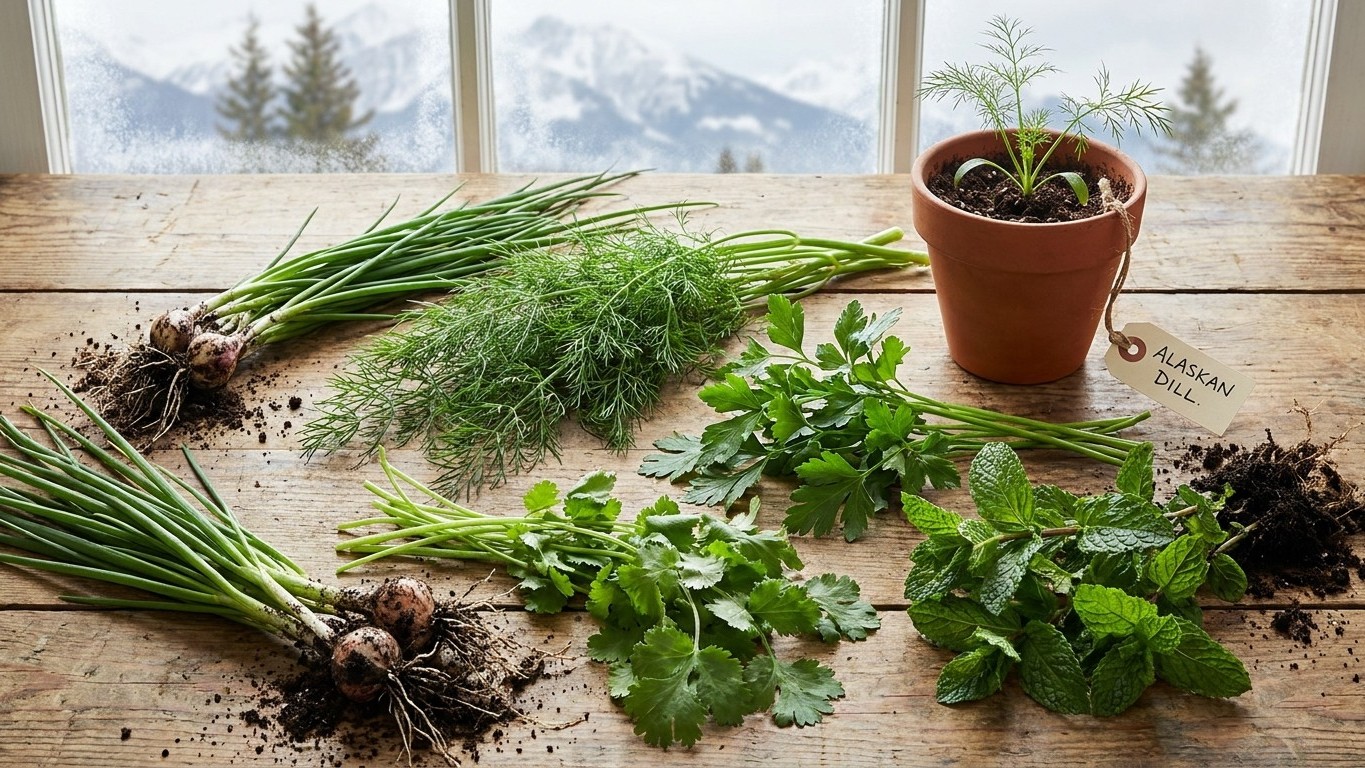

Alberta’s herb list is short and practical: fast annuals like chives, dill, cilantro, and parsley, plus cold-hardy perennials such as thyme, oregano, and sage. The reason comes down to two numbers, a frost-free window that averages 118 days and winters that dip to a mean minimum of 8.2°F. Anything slower or softer than that gets cut from the list before it’s even planted.
The short answer for Alberta
Start with the frost dates for the Calgary Int’l A station, the reference point Environment and Climate Change Canada uses for this part of the province: last spring frost on average May 21, first fall frost on average September 16. That’s a mean gap of about 118 days between them. But a mean is not a promise. In one year out of two, that spring frost lands later than May 21, sometimes weeks later, and the same swing applies at the other end of the season. So the real planning number for herbs isn’t 118 days, it’s “somewhere close to 118 days, in a good year.”
That number decides which herbs make the cut. Herbs that mature from seed in 30 to 60 days, dill, cilantro, chervil, chives, most parsley, fit comfortably inside even a shortened window. They can go straight into the ground once soil has warmed and still deliver a full harvest before the September frost shows up. Thyme, oregano, sage, and summer savory work too, either as fast-establishing perennials or as annuals that don’t need the entire season to be useful.
Herbs that need a head start
Basil is the tricky one. It’s a herb Alberta gardeners want, but it’s also a heat-lover that resents cold soil and won’t forgive a late frost. The way around the short window is to start it indoors four to six weeks before the average last frost and transplant it out only once night temperatures have settled, not on a fixed calendar date. Treated that way, short-season basil varieties can still produce a real harvest before the first fall frost arrives.
Winter survival is the other filter, and it comes from the 8.2°F coldest-month minimum and the Canadian hardiness zone of 4a for the Calgary reference point. That’s cold enough to kill many so-called perennial herbs outright over winter unless they’re grown as annuals or brought indoors. Thyme, chives, oregano, and some sage varieties can survive it with decent snow cover; plenty of others can’t, which leads into the next section.
What will not work here

Rosemary is the herb most gardeners in Alberta want and can’t reliably keep. It needs a long, warm growing season to bulk up and a mild winter to survive outdoors, and this province offers neither. Outside of a container brought indoors for winter, rosemary in Alberta is functionally an annual, and even as an annual it grows slowly enough that a 118-day window barely gives it time to become useful.
Bay laurel fails for the same reason, only worse. It’s a small tree in its native range, used to frost-free winters, and the 8.2°F mean minimum of a Calgary-area January isn’t a rough patch for it, it’s a death sentence. Nobody is overwintering bay outdoors here. French tarragon sits in the same marginal category: it wants a longer, more temperate season to establish real roots, and a zone 4a winter kills off plants that haven’t had two or three years to build reserves.
Lemongrass and other tropical herbs aren’t even a discussion. They need a frost-free season measured in many months, not around 118 days, and they can’t tolerate any frost at all, let alone a winter averaging single-digit lows. If a reader wants that flavor profile here, it’s a container plant that lives on a windowsill, not a garden crop.
| Herb | Why it fails outdoors in Alberta | Better substitute |
|---|---|---|
| Rosemary | Needs long warm season and mild winter; zone 4a winters kill it | Thyme or savory |
| Bay laurel | No frost tolerance; 8.2°F mean low is fatal | Bay leaf grown as indoor container plant |
| French tarragon | Needs multiple mild winters to establish; short season limits root growth | Russian tarragon or dill for anise notes |
| Lemongrass | Tropical; no frost tolerance at all | Lemon balm or lemon thyme |
There’s also a slower, quieter failure mode worth naming: slow-bulking biennials like parsley left in the ground over winter, hoping to get a second-year harvest. In milder zones that works. Here, with a mean coldest-month low of 8.2°F, the roots often don’t make it, so parsley in Alberta is best treated as a reliable one-season annual rather than a two-year project.
What changes across Alberta
Every number above comes from one reference point, the Calgary Int’l A station, and Alberta is not one climate. The Canadian hardiness zone system that puts Calgary at 4a is built on seven separate climate variables, not just a single winter low, and Natural Resources Canada is blunt about the fact that a single Canadian zone like 4a can overlap nine different USDA zone equivalents depending on where you are, from as mild as USDA 7a to as harsh as USDA 3a. Alberta’s own footprint spans a wide slice of that range.
Southern Alberta river valleys and sheltered pockets can run noticeably milder than the Calgary reference figures suggest. Head north toward the Peace River region, or up in elevation toward the foothills and the Rockies, and both the frost-free window and the winter lows get considerably harsher than what’s listed here. A grower in Grande Prairie is not working with the same season as a grower in Lethbridge, even though both are technically in Alberta.
None of the dates or figures in this article should be read as a single provincial answer, because there isn’t one. The only way to know where a specific address falls is to check the official Plant Hardiness Zone map, which lets a reader look up their own municipality rather than borrowing Calgary’s numbers by default: planthardiness.gc.ca. That’s the tool to use before deciding whether tender perennials like sage or oregano stand a real chance of overwintering at a specific location.
Where to check this for your own county
Alberta-wide figures are anchored to one weather station. That’s useful for a first pass, but it’s not a substitute for local, ground-level advice. The place to get that is Alberta’s own agriculture service, reached through alberta.ca/agriculture-and-irrigation. That’s the provincial body responsible for agricultural extension work, and it’s the right starting point for anyone who wants recommendations tuned closer to their own municipality rather than to a single Calgary reference station.
Two things are worth hunting down once there. First, any localized planting or frost-date guidance for a specific region rather than the province as a whole. Frost dates shift by weeks between the foothills, the Peace region, and the southern prairies, and a provincial average smooths over all of that. Second, look for any variety trial information relevant to herbs and vegetables in the local climate zone. Trial data, where it exists, reflects what actually survived and produced in nearby soil and weather, which beats a general recommendation every time.
A county or regional recommendation will always beat a provincial one, for the same reason a house key beats a master key: it’s built to fit one specific lock.
Checking this against your own garden
Every date is an average pulled from decades of weather records at one airport station. A reader’s own soil and sky will always outrank it. Three things to watch, in order, tell more about a specific yard than any calendar figure.
First, soil warmth by feel. Push a finger a couple of inches into the bed where herbs are going. If it still feels cold and damp like early spring, seeds like basil and dill will sit and sulk no matter what the calendar says; warm, crumbly soil that’s comfortable to the touch is the better signal to start.
Second, watch for the first true leaves on anything already seeded. The first pair of leaves after germination is just the seed’s stored energy showing itself, and it doesn’t mean much. The second set, the true leaves, means the seedling is actually feeding itself and has decided the conditions are workable.
Third, pay attention to what’s already growing wild or perennial nearby, whether that’s a neighbor’s established chives or self-seeded dill from a previous year. If those are pushing new growth on their own, without any help, that’s a stronger local signal that the ground has genuinely turned than any single date borrowed from an airport weather station miles away.