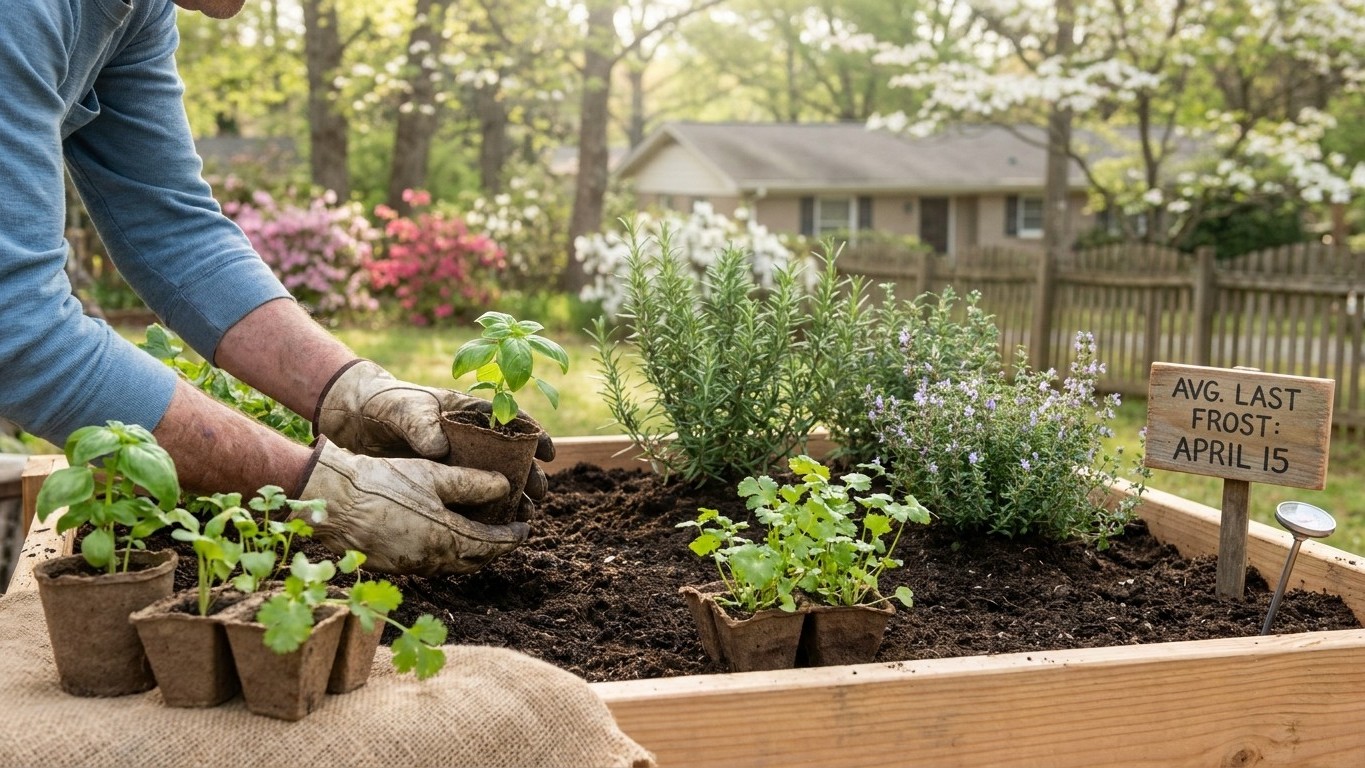

Cool-season herbs like parsley, cilantro, and chives can go into the ground in coastal British Columbia from mid-March onward. Tender basil needs to wait until mid-to-late May. The reason comes down to one number: BC’s average last spring frost is only a midpoint, not a guarantee, so the safe window is later than the date itself suggests.
The short answer for British Columbia
Environment and Climate Change Canada puts the average last spring frost for the Vancouver Int’l A station at March 18, and the average first fall frost at November 10. Those are 1981-2010 normals, and they’re means, not safe dates. Half the years on record saw frost after March 18. That single fact should shape every sowing decision more than the date itself does.
The coldest month’s average daily minimum sits at 33.5°F, just above freezing. Winters here rarely bite hard, which is why the region carries a Canadian hardiness zone of 9a for the reference city (Vancouver), on Natural Resources Canada’s seven-variable scale. That number doesn’t convert to a USDA zone, and it only describes the reference city, not the province, but it does explain why some perennial herbs can overwinter outdoors here with little fuss while the same species would need protection a few hundred miles inland.
What that means for sowing dates, by herb category:
| Herb type | When to plant near the coast | Why |
|---|---|---|
| Frost-tolerant (parsley, cilantro, chives, dill) | Mid-March to early April | Tolerates a light frost close to the March 18 mean |
| Half-hardy perennials (thyme, sage, oregano) | Late March as transplants | Established roots shrug off a late cold snap |
| Tender annuals (basil) | Mid-to-late May | Needs soil consistently above 60°F, which the mean frost date doesn’t guarantee |
Basil is the clearest test case. Sow it right on March 18 and you’re betting on the half of years that run mild. Wait until the soil has actually warmed, closer to May, and the bet disappears.
What will not work here

The failure people run into most on the coast isn’t cold, it’s wet. A coldest-month minimum of 33.5°F means the ground rarely freezes solid, but marine air keeps soil damp well into spring and keeps clay-heavy beds saturated through winter. Mediterranean herbs that need to dry out between waterings, rosemary and lavender in particular, don’t die from frost here. They die from crowns and roots sitting in cold, wet soil for months on end. If a rosemary plant survives its first winter only to rot out in its second, the cause is almost always drainage, not temperature.
Basil sown too early is the second common failure, and it traces straight back to the frost-date math above. Because March 18 is a mean, not a floor, gardeners who trust it as a safe planting date lose a share of their basil crop most years. The plant doesn’t need to hit an actual frost to fail either. Chilled soil in the 40s stunts basil roots even without ice forming, so a cool, damp April after an “average” last frost can still wreck a transplant.
Slug pressure is the third factor that trips up new herb gardeners in this climate, and it’s tied to the same humidity that punishes rosemary. Tender seedlings like basil and young cilantro get shredded overnight in wet coastal springs, especially in beds mulched heavily or planted close together for warmth. Wider spacing and morning checks matter more here than in a drier climate, where the same seedlings might sail through untouched.
None of this is a season-length problem. With roughly 237 days between the average frost dates, the coastal growing season is long by Canadian standards. The limiting factor is moisture management, not the calendar, and that’s the piece a generic planting guide tends to miss.
What changes across British Columbia
Reading a single hardiness zone and applying it province-wide is the fastest way to get herb planting wrong in BC. The 9a figure cited above belongs to the reference city used in Natural Resources Canada’s mapping, the mild south coast, not to the province as a whole. British Columbia stretches from temperate coastline to interior plateau to high mountain valleys, and its own plant hardiness mapping shows the difference between those places running many steps apart on Canada’s seven-variable scale. There is no single zone for BC, and there is no single frost date either.
The same logic applies to the frost dates themselves. March 18 and November 10 are readings from a coastal airport station at low elevation, buffered by the Pacific and the Strait of Georgia. Move inland toward the interior valleys, gain elevation into the mountains, or head north toward the central and northern parts of the province, and both frost dates shift, later in spring, earlier in fall, shrinking the usable season considerably.
What that means in practice: a reader gardening away from the immediate south coast should treat every date as an earliest-case scenario for spring and a latest-case scenario for fall. Cool-season herbs that go in mid-March near Vancouver may need to wait into April or later inland. Tender herbs like basil that already wait until mid-to-late May on the coast may need to wait even longer, or get grown under cover, in colder interior or upland districts.
No single zone applies to every yard. Natural Resources Canada’s interactive plant hardiness map does that, using local elevation and climate data down to a fine grid, and it’s the right tool to check before trusting any date.
Where to check this for your own county
British Columbia’s own agriculture ministry is the right next stop, and the address is https://www2.gov.bc.ca/gov/content/industry/agriculture-seafood. The province-level picture is built from one coastal station’s climate normals. That’s useful as a baseline, but it’s not a substitute for information gathered closer to home.
On the ministry’s site, look specifically for two things: any regional or seasonal planting guidance published for BC growers, and any variety trial results or recommendations tied to a particular region or growing district. Provincial agriculture programs in Canada often route detailed, localized advice through regional offices or partner organizations rather than a single central calendar, so it’s worth following links to regional agricultural resources or contacting a local office directly if the general pages don’t cover herbs specifically.
The reasoning is the same one used earlier in this article about hardiness zones: a recommendation built around conditions in one specific district will always beat a provincial average for a reader gardening in that district. A regional or district-level source, where one exists, has the advantage of reflecting local elevation, local frost pockets, and local soil patterns that a province-wide page simply can’t capture.
If a regional planting calendar isn’t published for a specific area, the next best move is checking which herb varieties nearby garden centers and seed suppliers are actually stocking and recommending for that district. Local retailers often adjust their offerings based on what performs reliably in their specific microclimate, which is a rough but genuinely useful proxy for formal trial data.
Checking this against your own garden
Every date in this article is drawn from long-term averages at one weather station. A gardener’s own yard, checked directly, will always give a more accurate read than any of those numbers. Three simple checks do most of the work.
First, feel the soil itself before trusting the calendar. Push a finger a few inches into the bed where herbs will go. If it feels cold and clammy rather than merely cool, tender herbs like basil aren’t ready no matter what the date says. Warm, crumbly soil that’s dried slightly on the surface is the real signal a coastal BC spring is finally catching up to the calendar.
Second, watch what’s already growing nearby. Self-sown dill, cilantro, or parsley from a previous season, or even common weeds breaking dormancy in the same bed, will germinate on their own schedule based on actual local soil temperature. Their appearance is a more honest signal than any published frost date, because they’re responding to the exact microclimate of that yard, not a regional average.
Third, track how a transplant behaves in its first week rather than assuming it’s fine because it survived planting. Basil or other tender herbs that sit static, with pale or purplish leaves and no new growth, are sitting in soil that’s colder than it looks. Herbs that push new leaves within days of transplanting are telling their owner the ground has genuinely warmed, regardless of what the calendar says the date should be.
The Moon calendar is a separate, older custom: see when to plant herbs by the moon, written as tradition rather than fact.