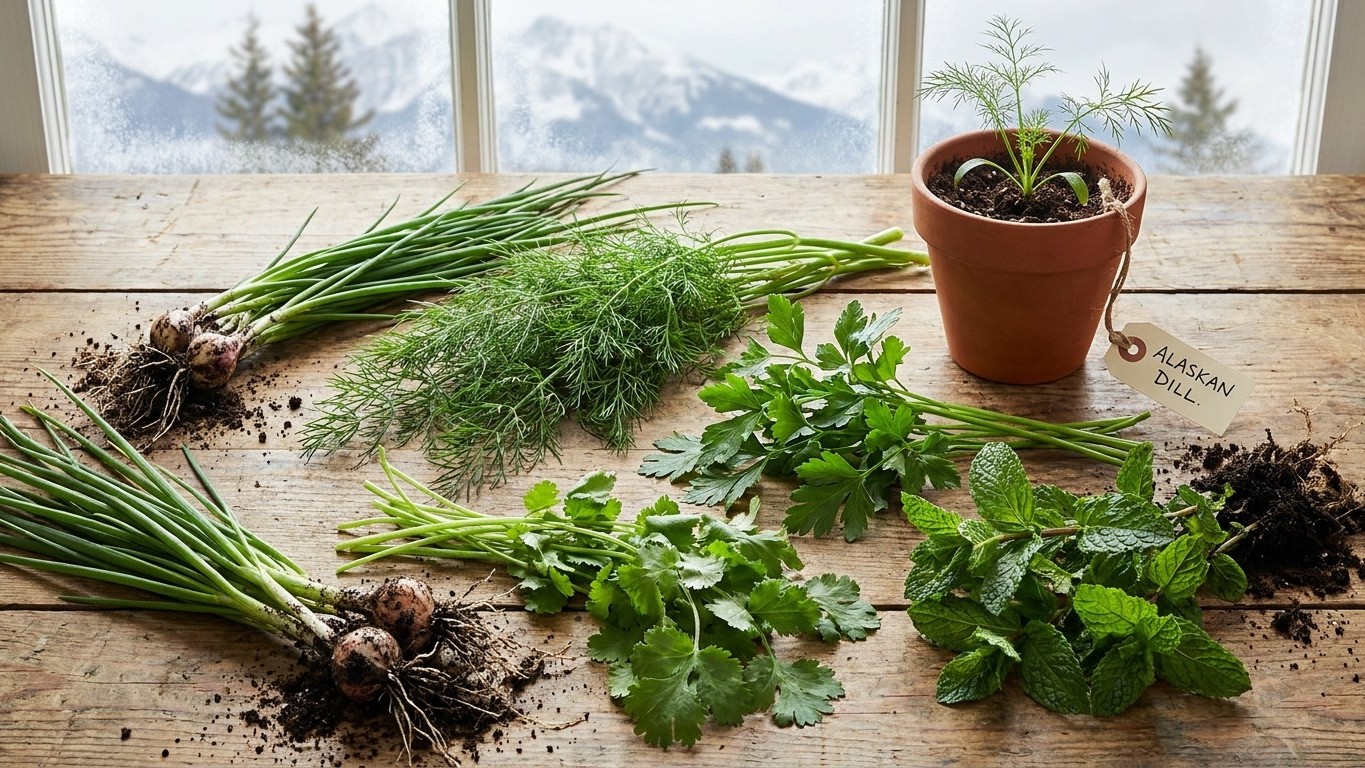

For Colorado’s short, dry, high-altitude growing season, the best bets are cold-hardy perennial herbs like chives, thyme, oregano, sage, and mint, paired with fast-maturing annuals like basil, cilantro, and dill. Slow-growing tropical herbs and anything needing a long, humid summer struggle here.
The short answer for Colorado
Start with the number that actually decides this: the growing season at Denver’s reference station (USW00003017) runs from a last spring frost of May 1 to May 11 through a first fall frost of September 30 to October 12. That’s a window of roughly 142 to 164 days between the two probability bands. It’s a decent season, not a generous one. Enough for most kitchen herbs to go from seed or transplant to harvest, but tight for anything that needs a full 90-plus frost-free days after transplanting just to start producing.
That season length sorts herbs into two workable groups. The first is fast annuals: basil, cilantro, dill, summer savory, and parsley all mature well inside that window, especially if started indoors a few weeks before the last frost date instead of direct-seeded outside. The second is cold-hardy perennials that don’t need to be replanted every year and that can shrug off a Colorado winter once established: chives, thyme, oregano, sage, tarragon, and most mints. These come back on their own, which matters in a state where the frost-free window is short enough that every week of spring counts.
Winter hardiness is decided by a different number: the average daily minimum of the coldest month, which sits at 18.4°F at the Denver reference station. That’s the figure that determines whether a perennial herb survives here at all, not the record low and not a monthly average. Mint, chives, thyme, oregano, and sage are all rated to handle temperatures well below that, so they come through winter without special protection in most of the state. That single fact, more than any planting date, is what separates a herb garden you plant once from one you replant every spring.
Basil and cilantro don’t factor into that winter calculation at all. They’re annuals here regardless of zone, so the only question is whether the frost-free window is long enough for them to produce before the first fall frost shuts things down. At 142 to 164 days, it is, provided they go in after the last frost date rather than before it. This is the state-level starting point. What actually knocks herbs out of the running is covered next.
What will not work here

Rosemary is the clearest casualty of Colorado’s winter minimums. It’s typically rated hardy only down into the mid-teens to low single digits, and even at the milder end of that range, an average coldest-month minimum of 18.4°F is enough to kill an unprotected plant outdoors over a normal winter, not just an unusually cold one. Gardeners across the state grow it successfully, but almost always in a container that comes indoors for winter or against a south-facing wall with heavy mulch, not as a permanent outdoor perennial the way it behaves in milder climates.
Bay laurel runs into the same wall. It’s a woody Mediterranean shrub that needs winters far gentler than an 18.4°F average coldest-month minimum allows, and it has none of thyme’s or sage’s tolerance for hard freezes. Treat it as a container plant that spends winter inside, not as a bed perennial.
Lemongrass fails for a different reason entirely: season length. It’s a tropical grass that needs a long, hot, humid stretch to bulk up before harvest, and Colorado’s 142-to-164-day window at 5,280 feet simply doesn’t deliver the sustained heat this plant is used to in its native range. Even where the season is technically long enough on the calendar, the nights are too cool for it to put on real growth.
Then there’s the moisture problem, which trips up gardeners who assume herbs are automatically low-maintenance. Chervil and sweet cicely, both cool-climate herbs that expect consistently moist soil and some humidity, tend to bolt or scorch fast in Colorado’s dry air and intense high-altitude sun. A weekly watering schedule that works fine for these herbs in a humid climate leaves them stressed within days here, because low humidity and strong UV at elevation pull moisture out of soil and leaves far faster than gardeners moving from wetter states expect. Shallow-rooted annuals like basil and cilantro run into the same issue during a hot, dry July stretch: skip a watering and they wilt hard, sometimes past the point of bouncing back.
None of this means those herbs are impossible in Colorado. It means they need a workaround, whether that’s a container that moves indoors, afternoon shade, or watering two or three times a week instead of once, rather than being planted and left alone the way a bed of thyme can be.
What changes across Colorado
Colorado’s USDA hardiness zone range, 3b to 7b under the USDA Plant Hardiness Zone Map (2023 edition, based on 1991-2020 normals), is one of the widest spans of any state on this site. That’s a four-and-a-half zone spread inside one set of borders, built on the average annual extreme minimum temperature, and it means there’s no single hardiness answer for “Colorado.” A herb bed that overwinters without a second thought in a milder pocket of the state can die outright a few hundred miles away, or a few thousand feet higher.
Elevation is the biggest driver of that spread. The frost dates and coldest-month figure above come from Denver’s reference station at 5,280 feet on the plains. Mountain towns sitting several thousand feet higher run a noticeably shorter frost-free season and can see frost even in July in some years, which changes the entire calculus for annual herbs like basil that need a solid run of warm nights to produce. A gardener at altitude working from Denver’s May 1 to May 11 last-frost window risks losing a planting to a freeze that Denver won’t see for another month, if at all that year.
The Western Slope differs again, with its own frost patterns shaped by different terrain and air drainage than either the Front Range or the high mountains. That’s three distinct climate patterns inside one state, which is exactly why a statewide answer can only go so far.
The practical shift for a reader in the north, at higher elevation, or on the Western Slope is to treat the frost dates and hardiness expectations here as a starting reference, not a local forecast, and to push planting later and lean harder on cold-hardy perennials over tender annuals the higher up they garden. Figuring out where a specific address falls on that spectrum means checking the map, not guessing from a regional label.
Where to check this for your own county
Colorado State University Extension is the source built to answer the question this state page can’t: what actually works in one specific county. That’s the nature of a state-level page like this one. It has to average across a 3b-to-7b hardiness spread and three distinct regional climate patterns, which means it’s useful for orientation but not precise enough to be the last word for any single yard.
Two things are worth hunting down on the extension site specifically. The first is a local planting calendar for the county in question, which will reflect the actual frost dates and season length at that elevation rather than the Denver reference figures used here. A county calendar for a mountain town will look meaningfully different from one for a Front Range suburb, even though both fall under the same statewide hardiness range. The second is any list of herb varieties that have been trialled in that county’s conditions, since local extension offices often track which cultivars of basil, thyme, or oregano actually perform well against local pests, soil, and microclimate quirks, information that a statewide roundup like this one has no way to capture.
A county recommendation will always beat a state one on accuracy, simply because it’s working with narrower, more specific data. The extension office exists to tell a reader what their own patch of ground is actually doing, which is the more useful answer once the general picture is understood.
Checking this against your own garden
Every frost date and hardiness figure is a probability built from decades of averages, not a guarantee for any particular spring. A reader’s own observation of their soil and plants will beat any calendar date, because it reflects what’s actually happening in that yard this year, not a long-term average.
Soil warmth by feel is the simplest check. Herb seeds and transplants, especially heat-loving ones like basil, sit and sulk in cold soil no matter what the last-frost date says. If a handful of soil still feels cool and slightly damp rather than crumbly and faintly warm to the touch, it’s telling the gardener the ground hasn’t caught up to the calendar yet, regardless of what the frost probability bands suggest for that week.
The first true leaves on any newly emerged seedling are the next signal worth watching. The initial pair of leaves on a seedling are usually rounded seed leaves; the true leaves that follow, shaped like the mature plant’s foliage, mean the plant has moved past its most fragile stage and is starting real growth. Seeing that first flush of true leaves appear faster or slower than expected is a direct read on how that year’s spring is running compared to the statewide averages.
For perennial herbs like chives and oregano, watching for the first new growth pushing up from the base each spring is the clearest sign that the plant made it through winter and that the coldest-month minimum didn’t do lasting damage. That single observation, more than any hardiness map, confirms whether a particular bed can be trusted to come back on its own next year.