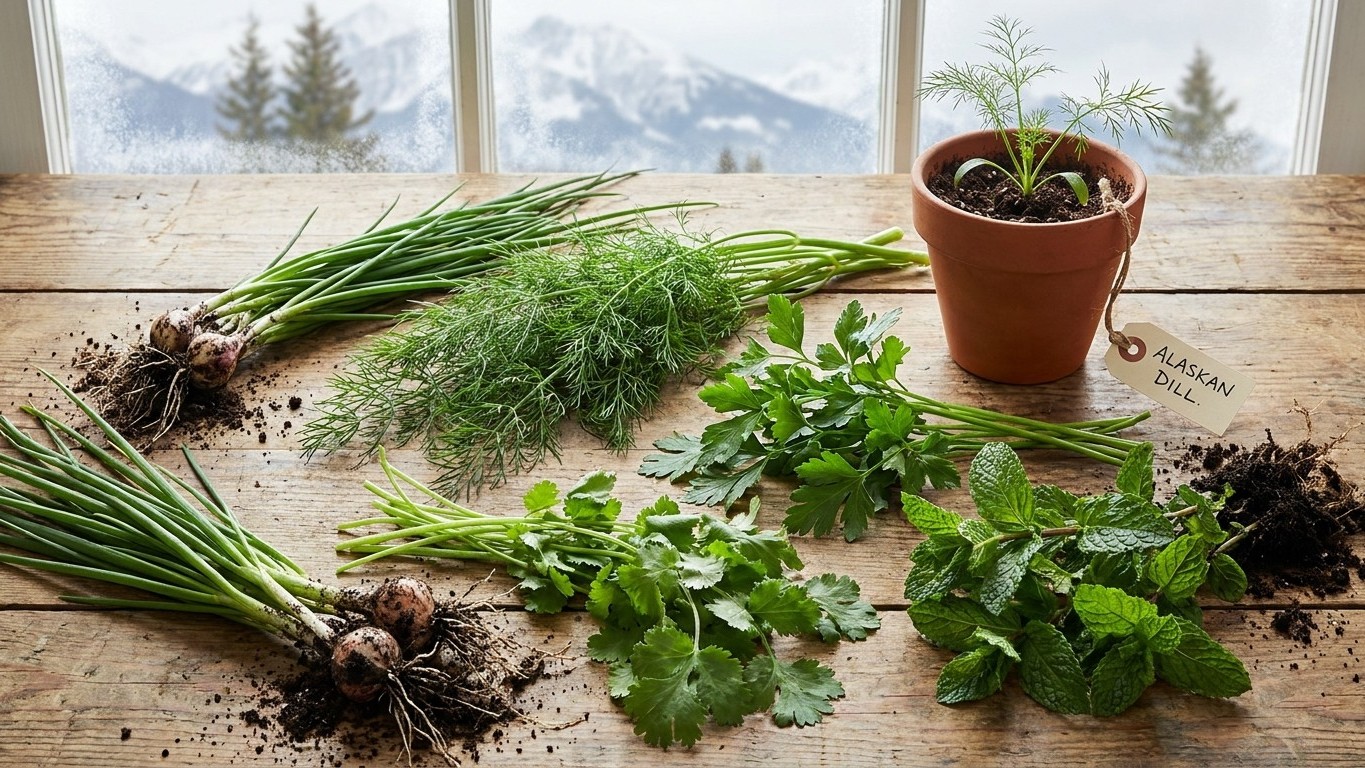

Georgia’s long growing season and mild winters favor heat-tolerant herbs like basil, rosemary, sage, oregano, and thyme, which can produce for seven months or more without missing a beat. Cool-season herbs such as cilantro, dill, and chervil need the shoulder seasons instead, since summer heat pushes them to bolt within weeks of the last frost.
The short answer for Georgia
Start with the math. Using the 30-70% probability band from NOAA’s Atlanta station, the last spring freeze lands somewhere between March 11 and March 29, and the first fall freeze arrives between November 13 and December 1. Even taking the most conservative dates, that leaves roughly 229 frost-free days. Stretch to the earlier spring date and later fall date, and it’s closer to nine months. That’s a season long enough to grow almost anything a home cook would want, twice over in some cases.
That length is what decides the herb list here, more than any single frost date. Woody Mediterranean herbs, basil, rosemary, sage, thyme, oregano, marjoram, all need warmth to build real production, and Georgia gives them enough of it that a single spring planting can keep producing into October or November in the milder parts of the state. Basil in particular rewards the long window: it grows fastest above 70°F, and Georgia summers sit there for months at a stretch.
The coldest month’s average daily minimum sits at 35.6°F, measured at the Atlanta reference station. That’s a mild figure by national standards, and it explains why perennial herbs like rosemary and sage often survive winter outdoors here without much fuss, something a gardener in Minnesota or Vermont couldn’t count on. It doesn’t mean every part of the state shares that number, but it sets the baseline for what “winter” means in the Piedmont.
Cool-season herbs work differently. Cilantro, dill, chervil, and parsley prefer temperatures in the 50s and 60s, and Georgia only offers that range for a handful of weeks each year, once in spring before the heat builds, and again in fall as it fades. The trick with these herbs isn’t finding room in the calendar, it’s timing the planting tight enough to catch that window before summer heat cuts it short. Chives and mint, both more heat-tolerant than their cool-season cousins, bridge the gap and stay productive through most of the season without much complaint.
For a household deciding what to plant first, the type of herb matters more than the variety. Woody, heat-loving perennials are the safe bet for a long, low-maintenance harvest. Tender annuals like basil need the frost dates respected on both ends. Cool-season herbs need to be treated as short, two-season crops rather than summer-long plantings.
What will not work here

French tarragon is the herb most often set up to fail in Georgia gardens. It needs a real winter chill to break dormancy properly and resents humid heat in summer, and Georgia’s mild winter minimum of 35.6°F combined with sticky, humid summers works against it on both ends. Gardeners who want a tarragon flavor generally do better with Mexican mint marigold, sold as a substitute in some southern nurseries, though that’s a different plant entirely and worth treating as such rather than a stand-in with identical needs.
Lavender struggles for a similar reason, but the mechanism is different. It’s not the cold that kills lavender here, it’s the combination of humidity and heavy clay soil common across the Piedmont. Lavender roots need to dry out between waterings, and a summer where afternoon storms roll through every few days on top of clay that drains slowly leaves the roots sitting wet. That’s root rot weather, and no amount of frost tolerance fixes a drainage problem.
Cilantro, dill, and chervil fail here for the opposite reason of a short season, they fail because the cool window closes fast. Once the frost-free window opens in mid-to-late March, temperatures don’t ease into summer, they climb quickly. A cilantro crop seeded right after the last frost date might get three or four weeks of proper leaf growth before the plant reads the rising heat as a signal to flower and set seed. That’s bolting, and it’s not a disease or a mistake, it’s the plant doing exactly what it’s built to do when its temperature cue arrives early.
The humidity problem, not the drought problem
Some regions lose herbs to hot, dry summers and irregular watering. Georgia’s risk runs the other way. Summer humidity here defeats herbs planted too close together far more often than drought does. Oregano, thyme, and sage planted in tight blocks, the way a raised-bed layout often suggests, lose airflow between plants just as humidity peaks in July and August. The result is powdery mildew and root and stem rot showing up on plants that would otherwise be nearly indestructible. Spacing wider than the seed packet suggests, and pruning up the base of woody herbs midseason, does more for these plants in Georgia than any amount of extra watering.
What changes across Georgia
Georgia isn’t one climate, and the USDA hardiness zone range for the state, 6a to 9b, makes that obvious on its own. That’s a four-zone spread, one of the widest of any state east of the Rockies, running from cold mountain hollows in the north to warm coastal plain in the south. A hardiness zone map built on average annual extreme minimum temperatures simply can’t produce one answer for a range that wide.
The frost dates and coldest-month figure cited above come from the Atlanta station, and Atlanta sits in an urban heat island at a mid-range elevation. North Georgia and the mountain counties freeze several weeks earlier in fall and thaw later in spring, which shortens the safe window for tender annuals like basil noticeably compared to what a metro Atlanta gardener sees. Perennial herbs that shrug off winter in Atlanta, rosemary especially, may need a container brought indoors or a sheltered spot against a south-facing wall once you’re up in the higher elevations.
The coastal plain runs the opposite direction, milder in winter and often with a longer frost-free stretch than the state’s average figures suggest. Gardeners there sometimes carry rosemary, bay, and even some tender perennials through winter with no protection at all, something that would be a gamble farther north in the same state.
None of this can be resolved from a state-level page, and it shouldn’t be. The right move for anyone wanting a number specific to their own location is the USDA Plant Hardiness Zone Map itself, which resolves down to zip code level rather than state averages.
Where to check this for your own county
The University of Georgia Cooperative Extension Service is the source that fills in what this page can’t. State-level figures like the ones above are averages built from a single reference station, useful for understanding the pattern but not precise enough to plan a specific garden bed.
Two things are worth looking for once there. First, the county-level planting calendar, which adjusts the frost-date ranges cited here for local elevation and microclimate rather than relying on the Atlanta station alone. Second, the variety trial results for herbs and vegetables specific to that county’s climate, since UGA extension agents run comparison plots that show which cultivars actually held up to local humidity, heat, and pest pressure, not just which ones perform well in general.
A county recommendation beats a state one every time, because it accounts for exactly the kind of variation described in the section above, elevation, distance from the coast, local soil type, none of which shows up in a statewide frost-date range. This page describes Georgia broadly. The extension office describes the specific county a reader is standing in, and that’s the more useful number when it comes time to actually put seed in the ground.
Extension offices also answer questions like soil test results, local pest identification, and specific disease pressure by region, all free services most homeowners never think to use until something goes wrong in the garden.
Checking this against your own garden
Every date in this article is a probability, not a promise, and the most reliable information available to any gardener is what’s happening in their own bed right now. Three signs are worth tracking, and none require anything more than a hand in the dirt and a pair of eyes.
Soil warmth by feel comes first. Basil and other tender annuals germinate poorly in cold soil no matter what the calendar says, so pressing a hand a few inches into the bed and feeling for real warmth, not just air temperature, tells more about transplant timing than any frost date can.
The first true leaves on a seedling matter more than the day it was planted. Cotyledons, the first paired leaves to emerge, don’t indicate much, but the appearance of the first true leaves, the ones that actually look like the mature plant, signals the seedling has moved past its most fragile stage and is drawing real energy from photosynthesis rather than seed reserves.
For herbs prone to bolting in Georgia’s fast-rising spring heat, cilantro especially, watch for the first sign of a central flower stalk starting to elongate above the leafy growth. That’s the plant’s own signal that its cool window has closed for the season, regardless of what the calendar says, and it’s a far more reliable cue than counting days from the last frost.