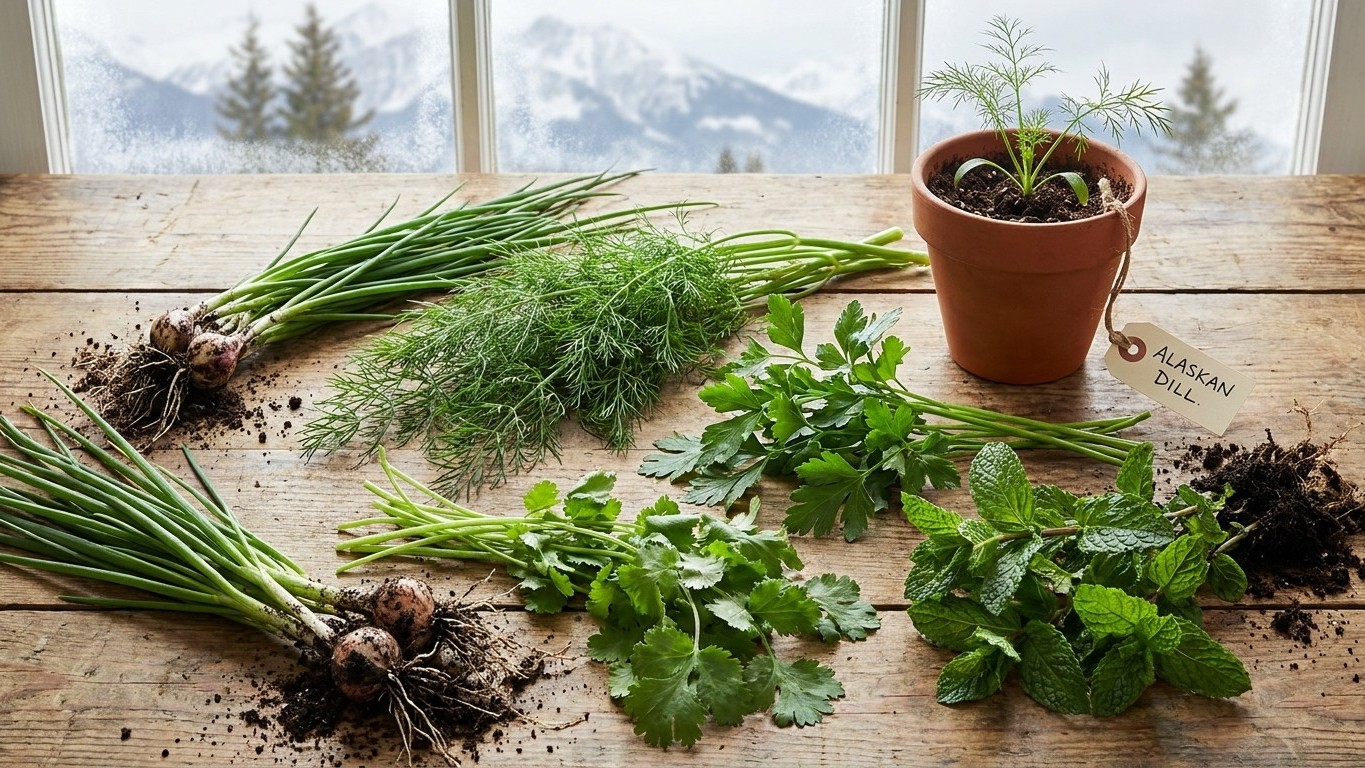

Kentucky’s long, humid growing season favors warm-season annual herbs like basil, dill, and cilantro, while its 6a-7a hardiness range supports hardy perennials such as thyme, oregano, chives, and sage. Rosemary and bay laurel sit at the edge of what survives a Kentucky winter outdoors.
The short answer for Kentucky
Start with the calendar, because it does most of the deciding. The last spring frost across the reference station falls between March 24 and April 4, and the first fall frost arrives November 2 to November 12. That puts the frost-free window somewhere between roughly 212 and 233 days, depending on where those two dates land in a given year. That’s a genuinely long season by national standards, long enough to grow two, sometimes three, successive rounds of a fast annual herb like cilantro if you stagger the sowing.
For warm-season annuals, the decision is easy. Basil, dill, and cilantro all want heat and a frost-free stretch, and Kentucky hands them one of the longer ones east of the Mississippi. Basil in particular rewards the state’s hot, sticky July and August, the same humidity that causes headaches elsewhere in this list.
For woody perennial herbs, the hardiness zone does the talking. Kentucky sits in USDA zone 6a-7a, and the coldest month’s average daily minimum runs 27.8°F at the reference station. That’s cold enough to kill back a lot of soft growth but not brutal enough to threaten the roots of thyme, oregano, sage, or chives, all of which are rated hardy well into zone 5 or lower. Plant these once and, barring an unusually severe winter, they come back on their own.
Rosemary is the herb that splits opinion here, and for good reason. Most rosemary cultivars are only reliably hardy to zone 7b or warmer, which puts a chunk of Kentucky’s own hardiness range below what the plant wants. Treat rosemary as an annual, or grow it in a container you can move indoors or into an unheated garage for winter, rather than betting on it surviving in open ground.
Parsley falls in between. It’s biennial and cool-tolerant enough to handle a Kentucky fall and often limp through winter under a layer of mulch, flowering and going to seed the following spring before you’re ready to pull it.
So the short version, sorted by type: annuals get a long runway and should be planted with confidence; hardy perennials are close to a sure thing; and the Mediterranean natives that need dry winters and mild cold, rosemary and bay laurel chief among them, need either a container strategy or acceptance that they’re a one-season plant here.
What will not work here

The number that trips people up isn’t the cold, it’s the wet heat. Kentucky summers run hot and humid, and that combination is exactly what fungal disease needs to spread through a densely planted herb bed. Basil and oregano planted at the spacing a seed packet suggests for a drier climate will often develop leaf spot or downy mildew here by mid-August, especially in a year with a wet July. Give both more room than the packet says and water at the soil line instead of overhead.
Lavender is the herb most likely to disappoint a Kentucky gardener who’s grown it successfully somewhere drier. Lavender wants sharp drainage and low humidity around its foliage, and much of Kentucky’s clay-heavy soil holds water exactly the way lavender’s roots hate. It’s not that lavender can’t survive a Kentucky winter, plenty of it does. It’s that root rot in a wet spring or a humid August kills more lavender plants here than cold ever does. If you’re set on growing it, raised beds or heavy grit amendment aren’t optional extras, they’re the difference between a plant that lives three years and one that dies its first summer.
French tarragon runs into the same problem from a different angle. It dislikes both heavy clay and high summer humidity, and Kentucky offers both in quantity. Russian tarragon tolerates the conditions better but trades away most of the flavor that makes tarragon worth growing in the first place.
Bay laurel fails here for a colder-climate reason: it’s rated hardy only to about zone 8, well outside even the warmer end of Kentucky’s 6a-7a range. Left outdoors through a Kentucky winter, an in-ground bay laurel will likely die back to the ground or outright die during any cold snap that drops well below that 27.8°F average minimum for the coldest month, since averages don’t rule out a harder freeze in any given year. Container culture, with the pot brought indoors before the first hard frost, is the only realistic option.
Finally, don’t trust the earliest end of that spring frost window if you garden outside a city. NWS Louisville has flagged that its own station reads later in spring and earlier in fall than the rural Jefferson County around it, meaning rural gardens likely face a tighter, not wider, frost-free season than the March 24 to April 4 range suggests. Jumping the gun on tender annuals because a nearby city’s last frost date looked early is a common way to lose a basil crop in a late April cold snap.
What changes across Kentucky
Kentucky isn’t one garden, it’s a state that spans an entire hardiness zone’s worth of difference. The USDA Plant Hardiness Zone Map puts the state at 6a-7a, and that range represents a real gap in average extreme minimum winter temperature, not a rounding difference. A perennial herb bed planted at the colder end of that spread faces a meaningfully harsher winter than one planted at the warmer end, even though both gardeners are, technically, gardening in “Kentucky.”
What that means in practice is that there’s no single answer to “will rosemary survive outdoors here.” In the parts of the state that fall toward 6a, treat rosemary, bay, and any other herb rated for zone 7b or warmer as a container plant or a seasonal annual, full stop. In the parts that fall toward 7a, some gardeners do get rosemary to overwinter outdoors in a sheltered spot, particularly against a south-facing wall that holds a little extra heat, though it’s still not a guaranteed bet.
Elevation plays a role too, independent of the zone map’s broader strokes. Higher ground tends to run colder at night and can hold frost later into spring and earlier into fall than the flatter, lower terrain nearby, which shifts both ends of that frost-free window in a way the statewide dates can’t capture.
None of this is something to guess at from a general sense of “north tends to be colder.” Pull up the USDA Plant Hardiness Zone Map, enter your ZIP code, and see where you actually land inside that 6a-7a range before you decide whether rosemary gets a spot in the ground or a spot in a pot by the back door.
Where to check this for your own county
Everything above is a state-level answer, and a state-level answer is a starting point, not a final one.
The University of Kentucky Cooperative Extension Service, at extension.ca.uky.edu, is the place to go for that county-level detail. Once there, look specifically for two things: your county’s own planting calendar, which will translate the frost-date ranges discussed here into dates tuned to your local station rather than the one used for the state’s broader climate normals, and any herb variety trial results your county office has published or can point you to. Extension offices frequently test which basil cultivars resist downy mildew best in local humidity, or which thyme varieties have proven hardiest through recent county winters, and that kind of ground-truthed data isn’t something a statewide page can offer.
Every county in Kentucky has its own extension office staffed by agents who work with the specific soils and microclimates of that county, and calling or emailing them directly, especially before committing to a perennial herb bed, tends to save more disappointment than any general guide can. Your county office can tell you what’s actually true where your garden sits.
Checking this against your own garden
Calendar dates are averages built from decades of past weather, and your garden this year is under no obligation to match them. Three simple, no-equipment observations will tell you more about your actual microclimate than any date range can.
First, feel the soil itself before sowing warm-season herbs like basil or dill directly outdoors. Push a finger a couple of inches in on a sunny mid-morning; if it feels cool and damp rather than mild, the soil hasn’t caught up to the air temperature yet, and seeds will sit and sulk, or rot, rather than germinate.
Second, watch your established perennial herbs for their first flush of new growth in spring, whether that’s fresh green shoots pushing up through chives or new leaf growth appearing on thyme and oregano. That first flush is the plant itself reporting that the soil and air around it have warmed enough to resume active growth, and it’s a better local signal than a calendar date pulled from a station that might sit in a different microclimate than your yard.
Third, once you’ve direct-sown annual herbs, wait for the first true leaves, the second set that appears after the initial rounded seed leaves, before thinning or transplanting. True leaves mean the seedling has moved past its most fragile stage and is drawing energy from its own root system rather than the seed’s stored reserves, which is the point at which it can handle being moved or thinned without a serious setback.