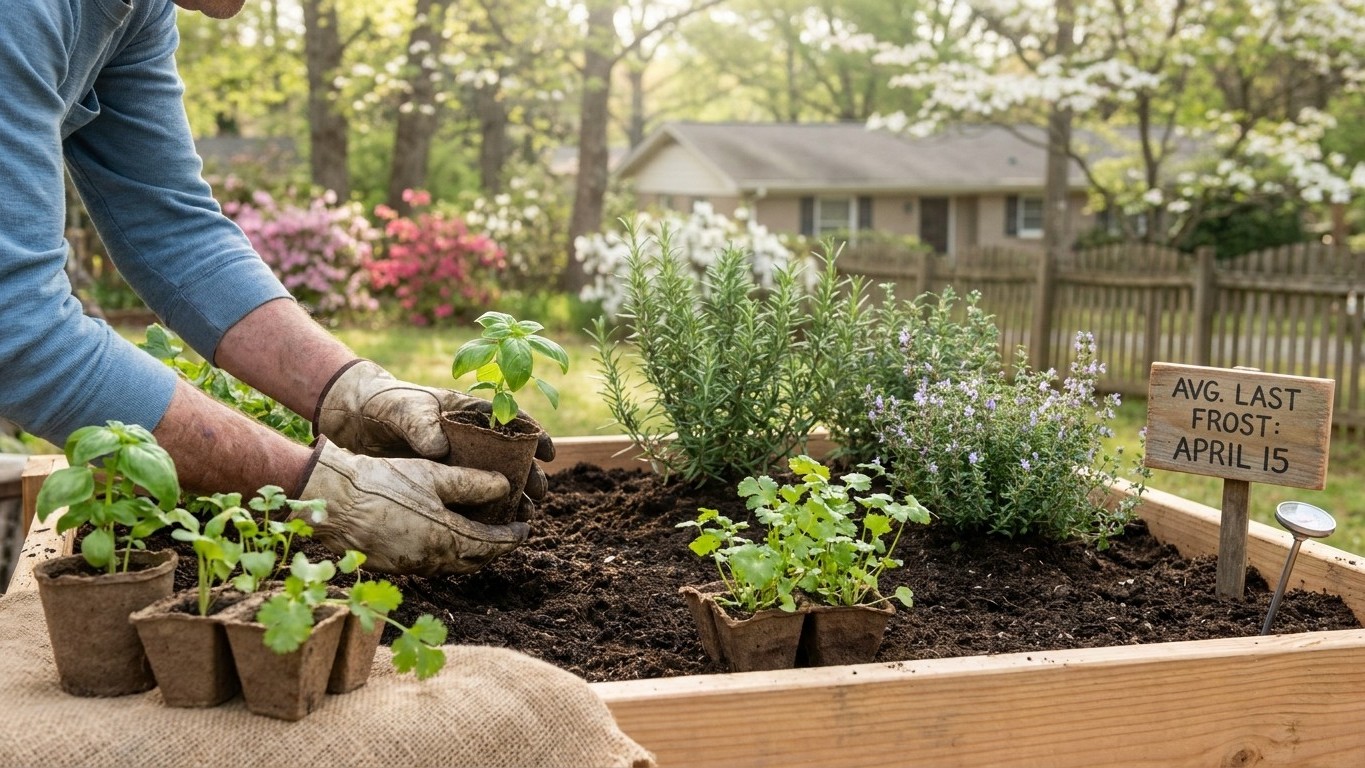

Sow hardy herb seeds outdoors in coastal Maine between late April and early May, once soil has warmed past the last frost window. Tender herbs like basil wait until early June. Inland and northern growers push both dates later, sometimes by several weeks, because the frost data below comes from Portland, the state’s mildest reference point.
The short answer for Maine
The numbers that matter come from NOAA’s 1991-2020 Climate Normals for the Portland reference station: last spring frost falls between April 22 and May 1, first fall frost between October 9 and October 21. Those aren’t guarantees. They mark the 30-70% probability band for a 32F freeze, meaning even at the safest end of that window, roughly three years in ten still bring a frost after May 1 or before October 21. Plant hardy herbs at the early edge and you’re gambling on the calmer years; plant at the late edge and you’re paying an insurance premium in lost growing days.
Do the subtraction and coastal Maine’s frost-free season runs somewhere between 161 and 182 days, depending on which end of each window you land on. That’s a workable stretch for almost any annual herb grown from a nursery start, but it’s tight for anything direct-seeded and slow, and it shrinks fast the further you move from the coast.
Cold-hardy herbs, the ones that shrug off a light frost, go in the ground as soon as soil can be worked after that April 22-May 1 window: parsley, chives, cilantro, dill. These tolerate the odd cold snap and actually prefer cool soil for germination. Tender herbs, basil above all, need both the air and the soil to have warmed well past the last frost date; most Maine gardeners wait until the first week of June rather than planting right at the frost line, because basil sulks and yellows in cold soil even if it survives.
Perennial herbs are a separate question entirely, and it hinges on winter survival rather than spring timing. The mean daily minimum temperature of Maine’s coldest month sits at 15.6F at the Portland reference station. That figure, not the average temperature and not a record low, is what decides whether a perennial herb makes it through winter here at all. Anything rated for a winter climate milder than that number is playing a losing hand outdoors.
What will not work here
Mediterranean perennial herbs bred for warm, dry winters are the first casualty. Rosemary, bay laurel, and similar shrubby perennials are typically sold with hardiness ratings suited to much milder winter minimums than Maine’s 15.6F average low for the coldest month. Left in the ground through a Maine winter, these plants face repeated exposure to conditions colder than their genetics account for. Treating them as annuals, or moving them indoors for winter, is the realistic path here, not planting them as permanent garden fixtures.
Season length defeats slow starters
A 161 to 182 day frost-free window sounds generous until you try to direct-seed a slow, heat-loving herb straight into the garden. Basil sown as seed outdoors, rather than transplanted as a started plant, eats up several of those precious early weeks just germinating in soil that’s barely warm enough. Push the sowing date back to a safely warm week in June, as many gardeners do to avoid cold-soil damping off, and a slow-maturing herb variety can run out of season before it produces a meaningful harvest, especially once you subtract the shorter interior-Maine window from that Portland baseline.
Herb varieties advertised as needing a long, hot summer to develop full flavor or oil content run into a second problem: Maine’s growing season isn’t just short, it’s also cooler than the regions those varieties were bred for. A basil cultivar selected for maximum yield in a hot Midwest or Southern summer won’t necessarily hit that potential on the coast of Maine, where summer nights stay cool even in July.
Close spacing is a quieter failure point. Nothing in the Maine climate data above measures humidity directly, but coastal fog and cool, damp mornings are a fact of life along much of the state’s shoreline. Herbs planted at the spacing recommended for a drier inland climate tend to hold moisture on their leaves longer here, inviting the fungal problems that come with poor airflow. Wider spacing than the seed packet suggests is often the safer call near the coast.
What changes across Maine
Maine’s USDA hardiness zone range runs from 3b to 6a, according to the 2023 Plant Hardiness Zone Map. That’s not a small spread. It’s the difference between a garden that can nurse a marginally hardy perennial herb through winter with some protection, and one where only the toughest, most cold-adapted plants have any real chance outdoors year-round. A single statewide answer doesn’t exist here, and it shouldn’t.
The frost dates and coldest-month figures cited above come from the Portland station, which sits at the mild, coastal end of that zone range. Inland valleys, higher elevations, and the northern half of the state run colder in both directions: spring frost lingers later, fall frost arrives earlier, and the coldest month’s average minimum drops well below Portland’s 15.6F. A grower in Aroostook County or at elevation in western Maine should expect to shift both planting windows later in spring and earlier in fall relative to everything described in this article, and should treat the boundary between hardy and tender herb choices more conservatively.
No statewide figure tells an individual reader which zone their own yard falls into. The USDA Plant Hardiness Zone Map lets you enter a ZIP code and get a specific zone reading for your exact location, which is the only reliable way to know where you sit inside that 3b-6a range. Treat the Portland-based figures here as the mild-case scenario for the state, then adjust colder as you move inland or north.
Where to check this for your own county
The University of Maine Cooperative Extension, at extension.umaine.edu, is the source built specifically to translate statewide climate averages into county-level growing advice. It’s run by the land-grant university system and exists precisely to translate statewide climate averages into county-level growing advice.
Two things are worth hunting for on that site once you get there. The first is a planting calendar built for your specific county rather than the state as a whole; extension offices typically maintain local guidance that accounts for the microclimate differences described above, something a state-level page like this one can’t replicate. The second is a list of herb and vegetable varieties that have actually been trialled in Maine conditions by extension researchers or through their master gardener network, rather than varieties simply marketed nationally with generic hardiness claims.
Use this article to understand the mechanism, the frost probabilities, the hardiness math, and use the extension service to pin down the specifics for your own ZIP code.
The Moon calendar is a separate, older custom: see when to plant herbs by the moon, written as tradition rather than fact.
Checking this against your own garden
Every date here is a regional average built from three decades of weather records. Your own garden has a memory of exactly one recent past, and it’s a better predictor of this year than any climate normal, because it reflects your actual soil, sun exposure, and drainage right now.
Soil warmth by feel is the first check. Push a bare hand a couple inches into the planting bed on a morning in late April; if it still feels cold and damp rather than merely cool, tender herb seed will likely rot or stall rather than germinate, regardless of what the calendar suggests. Wait for that soil to feel closer to room temperature before trusting it with basil.
The first true leaves on any direct-sown herb are the second signal. Seedlings push up two small, rounded seed leaves first, then a second set that actually looks like the mature plant, whether that’s the feathery leaf of dill or the flat leaf of cilantro. That true-leaf stage tells you the plant has moved past its most fragile point and your local conditions are supporting real growth, not just germination.
Third, watch for early flowering or bolting in heat-sensitive herbs like cilantro and basil. A plant that throws flower stalks unusually early is telling you that a warm spell arrived faster in your particular yard, likely due to a south-facing wall, reflected heat off pavement, or a sheltered microclimate, than the regional averages would predict.