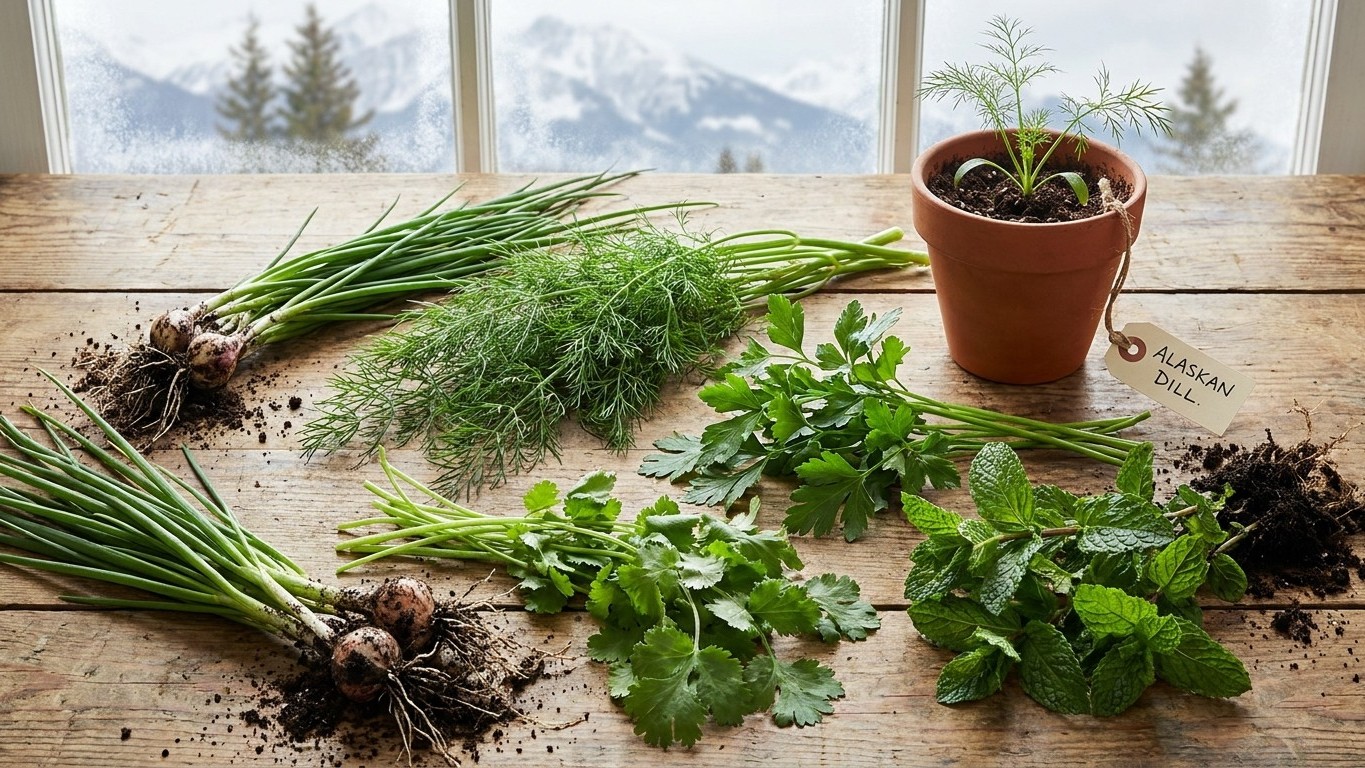

Maine gardeners get the best results from hardy perennials like chives, thyme, sage, and oregano paired with fast annuals such as dill, cilantro, and parsley. Basil earns a spot too, but only as a warm-season annual planted well after the last frost. Rosemary, bay, and other Mediterranean natives need a pot and a windowsill, not open ground.
The short answer for Maine
Start with the frost-free window, because that’s what actually decides which herbs make sense here. At the Portland reference station, the last spring freeze falls between April 22 and May 1, and the first fall freeze arrives October 9 to October 21. That gives a frost-free stretch of roughly 160 to 172 days along the coast, which is enough time for nearly every kitchen herb to reach a usable size, but not enough to coast on late planting or slow starts.
Within that window, the smart split is by plant type, not by what’s trendy at a garden center. Hardy perennial herbs, thyme, sage, chives, oregano, tarragon, and most mints, are built for this climate. They tolerate the cold month minimum of 15.6°F without much fuss once established, and they come back year after year across most of the state’s hardiness range. These are the herbs worth investing in a permanent bed for.
Annual herbs fill the gaps and use the frost-free days directly. Dill, cilantro, and parsley germinate in cool soil, mature quickly, and can go in the ground close to the last frost date without much risk. Basil is the exception that needs babying: it’s a heat-lover from a much warmer climate, and Maine’s frost dates only tell you when the cold will kill it, not when it’ll actually thrive. Wait until night temperatures have settled well above freezing before setting it out, and don’t expect the vigorous growth you’d see in a longer, hotter season further south.
Woody Mediterranean perennials, rosemary and bay laurel especially, are the ones the season length can’t save. They don’t survive Maine winters outdoors, full stop, because the state’s coldest month minimum sits far below what these plants tolerate. Grow them in containers, bring them in before the first fall frost, and treat outdoor placement as a summer vacation rather than a permanent home.
The state’s hardiness zone spans 3b to 6a, which matters more for herbs than most gardeners assume. A “hardy” perennial rated for zone 5 will sail through winter in coastal Portland and struggle or die in the colder inland pockets rated 3b. More on that split below, but the short version: pick your herbs by type first, then adjust for where in Maine you actually garden.
What will not work here

Three categories of herb consistently disappoint in Maine, and each fails for a different, traceable reason.
Cold kills the Mediterranean natives outright
Rosemary, bay laurel, and true French lavender evolved in climates where the coldest month rarely drops below freezing at night. Maine’s coldest month averages a nightly minimum of 15.6°F, a full 45 degrees or more colder than what these plants are built to handle. Left outside over winter, they don’t just get damaged, they die to the roots. This isn’t a matter of extra mulch or a sheltered spot against the house; the average cold, not just the occasional record low, is what does them in. If you want these herbs, containers and an indoor winter are not optional extras, they’re the only way it works here.
Slow-maturing herbs run out of season
A frost-free window of 160 to 172 days sounds generous until you subtract the weeks lost to slow spring soil warm-up and the early fall cooldown that slows growth before the actual frost hits. Herbs that need 90 to 100 days from seed to a full harvest, some fenugreek varieties or slow parsley strains among them, cut it close even at the coastal end of the state. Direct-sow them a week or two late, or lose a week to a cold snap, and you’re racing the October frost with a half-grown plant. This is a bigger problem inland and north, where the season starts later and ends sooner than the Portland numbers suggest.
Basil grown like a cool-climate annual
Basil isn’t killed by Maine’s frost dates the way rosemary is killed by its winters, but it’s damaged by the in-between cold that those dates don’t capture. Chilling injury shows up in basil well above freezing, and Maine’s cool spring nights linger past the point where a gardener in a warmer state would already have basil thriving. Planting it on the last-frost date rather than waiting for consistently warm nights is the single most common reason basil struggles here.
What changes across Maine
Maine is not one climate wearing a single hardiness label. The USDA Plant Hardiness Zone Map places the state across a 3b to 6a range, and that’s a wide spread for a single state’s herb garden. Zone 6a, the mild end, describes something close to the coastal Portland reference. Zone 3b, the cold end, describes conditions closer to the state’s northern interior and higher elevations, where winters run considerably colder than the 15.6°F coldest-month minimum recorded near the coast.
That difference isn’t cosmetic. A hardy perennial that shrugs off a Portland winter can still fail in a 3b location, because the actual cold it experiences is well beyond what the coastal number represents. Chives and mint tend to be forgiving across the whole range, but sage, tarragon, and some oregano varieties get noticeably less reliable as you move toward the colder end. Gardeners in the north or at higher elevation should treat borderline perennials as a gamble rather than a given, and either choose varieties bred for extra hardiness or plan to replant some herbs as annuals.
The frost dates shift too, and by more than a few days. The caution attached to Maine’s spring and fall frost data is explicit: inland and northern Maine run substantially later in spring and earlier in fall than the coastal figures used here. That means the frost-free window itself, not just the winter cold, shrinks as you move away from the coast. A planting date that works in early May near Portland can still carry frost risk several weeks later inland, and the growing season can close weeks earlier in September rather than October.
The spread is too wide, and elevation, wind exposure, and distance from the coast all shift the number locally. What it can tell you is that “Maine” isn’t a single answer here, and that checking your own zone on the USDA map before committing to a perennial herb bed is worth the five minutes it takes.
Where to check this for your own county
Everything above is a state-level starting point, built from one reference station and a statewide hardiness range. Your county almost certainly has more specific guidance, and it comes from the University of Maine Cooperative Extension at extension.umaine.edu.
Two things are worth looking for once you’re there. First, a local planting calendar, if your county office publishes one, will reflect actual frost patterns recorded closer to your garden than the Portland station. Second, look for any list of herb or vegetable varieties trialled specifically in Maine conditions. Extension programs often test which cultivars of sage, thyme, or basil perform best under the state’s shorter, cooler growing season, and that kind of variety-level detail isn’t something a statewide page can responsibly guess at.
Think of this article as the broad map and the extension office as the local guide who’s walked the actual trail. If the two disagree, follow the local source, not the statewide one.
This is also the place to ask about soil testing, which matters more for herb flavor and vigor than most gardeners expect. Extension offices typically offer low-cost soil tests, and the results will tell you more about what your specific plot needs than any general herb guide could.
Checking this against your own garden
Dates and averages get you close, but your own garden has the final word. Three simple checks will tell you more about your specific microclimate than any calendar.
Feel the soil before you trust the calendar date. Push a finger a couple of inches into the bed where you plan to sow dill or cilantro. If it feels cold and damp rather than cool and workable, the ground hasn’t caught up to the season yet, regardless of what the frost date chart says. Herb seeds sown into cold, wet soil often just sit there or rot rather than germinate.
Watch for the first true leaves on anything you’ve started from seed. The first set of leaves that emerge look nothing like the plant’s mature foliage, they’re generic seedling leaves. The second set, the true leaves, actually resemble a miniature version of the herb itself. That’s your signal the plant has enough root and leaf structure to handle a move outside or a thinning, and it’s a more reliable cue than counting days since sowing.
Pay attention to how your perennial herbs come out of winter compared to what the state-level hardiness range would predict. If your thyme or sage returns lush and early while a neighbor a few miles away is still waiting, your yard is running warmer than the average, whether from a south-facing slope, a wind-sheltered corner, or simple luck of the land. If it struggles or fails outright in a spot the map suggests should be safe, your microclimate runs colder, and that’s worth remembering the next time you’re tempted to push a borderline perennial into the ground.