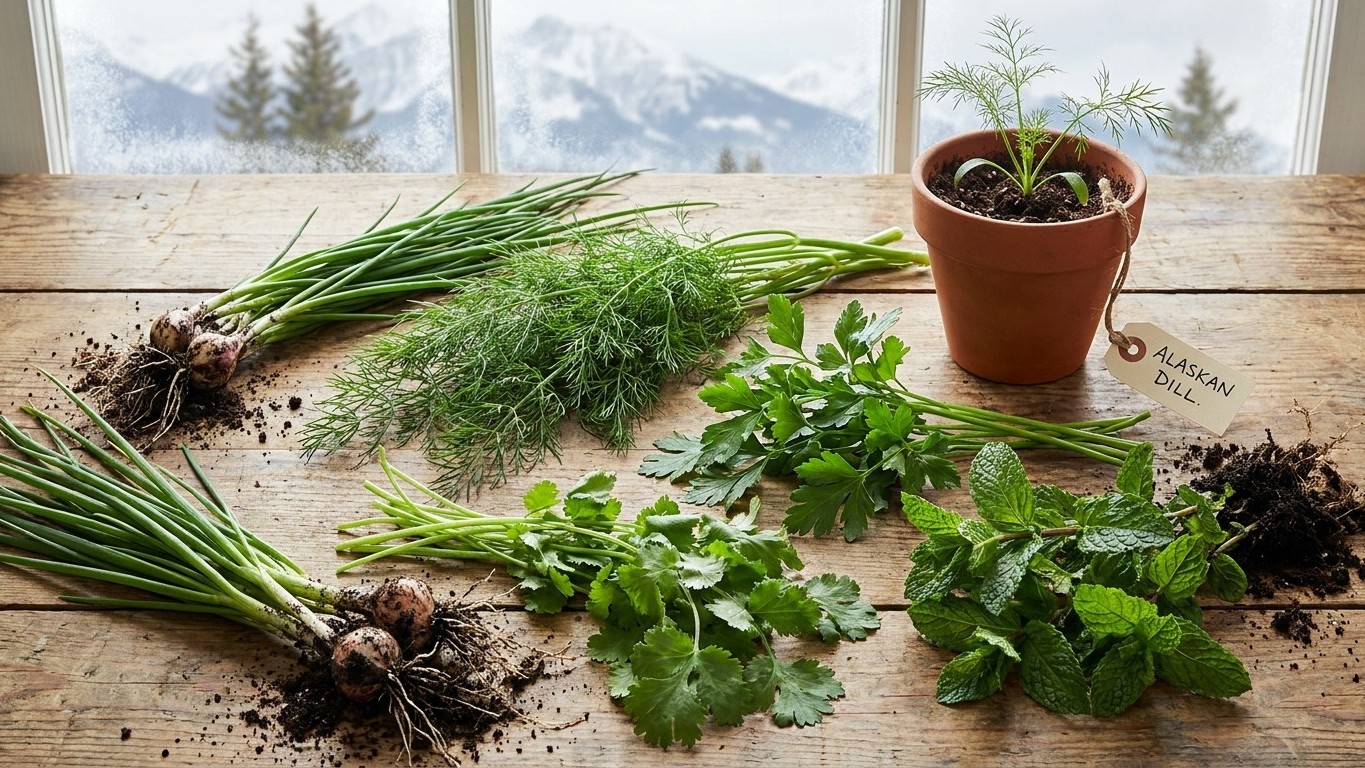

For Manitoba’s roughly four-month growing season, the herbs that consistently do well are the fast, forgiving ones: dill, cilantro, parsley, chives, and basil grown as an annual. Anything woody and Mediterranean that needs to survive winter outdoors, rosemary, bay, lemongrass, is fighting a climate it was never built for.
The short answer for Manitoba
The number that actually decides this is the gap between the average last spring frost, May 23, and the average first fall frost, September 22. That’s roughly 122 days, and it’s the frame every herb decision here has to fit inside. Environment and Climate Change Canada pulls both dates from the Winnipeg Richardson International Airport station using the 1981-2010 normals, and the agency is explicit that these are mean dates, not guarantees. In half the years on record, frost arrived after May 23. Treat the window as a midpoint, not a green light.
Within that window, fast annual herbs are the safe bet. Dill, cilantro, and parsley reach usable size in 40 to 75 days, which leaves margin even if the season runs short. Chives, once established, come back reliably from the root each spring and tolerate a late frost better than almost anything else on a typical herb list. Basil is the trickiest of the fast group: it germinates and grows quickly, but it’s frost tender at both ends, so it needs the soil warmed up before it goes in the ground and needs to be harvested or brought in well before that September date closes the door.
For anything perennial, the deciding number isn’t the frost-free window at all. It’s the coldest month’s mean daily minimum, which sits at -6.6°F here. That figure, not the record low and not a seasonal average, is what determines whether a plant’s roots survive a Manitoba winter in open ground. Combined with a Canadian hardiness zone of 3b at the reference station, that rules out most of the herbs gardeners in warmer regions treat as permanent fixtures. Sage and thyme have a fighting chance in a sheltered, well-drained spot. Mint and oregano generally handle it. Rosemary, French tarragon, and lavender do not, at least not without heavy mulch, a cold frame, or a pot that comes indoors for winter.
The practical shorthand: pick herbs by how fast they finish, not by how exotic they look in a catalog, and assume anything labeled “hardy to zone 5” or warmer is an annual here regardless of what the tag says.
What will not work here

Slow-growing perennial herbs are the clearest failure point. Rosemary started from seed typically needs well over 100 days just to reach a usable size, which already eats most of the 122-day window between Manitoba’s average frosts, before winter even enters the picture. Even a rosemary plant that makes it to fall faces that -6.6°F mean minimum in the coldest month with no realistic chance of surviving outdoors. The plant fails twice over: once on the calendar, once on the thermometer.
Tropical and subtropical herbs are a flat no for outdoor growing. Lemongrass, curry leaf, and true bay laurel come from climates where frost barely registers as a concept. Asking them to handle both a hard freeze and a season under 130 days is asking for two separate impossibilities at once. These can be grown in containers that spend summer outside and winter on a windowsill, but they’re never going into Manitoba soil as permanent plants.
Basil deserves a specific warning because it gets planted too early more often than any other herb on this list. It’s frost tender, full stop, and the May 23 average last frost is a midpoint, meaning a grower who plants on May 24 based on that date alone has roughly even odds of losing the crop to a late cold snap. The safer approach is to wait until the soil itself has warmed, not just until the calendar has passed the average date.
French tarragon sits in an odd middle ground. It’s technically perennial and often marketed as garden-hardy, but its cold tolerance is inconsistent even in zones warmer than 3b, and gardeners here who’ve had it survive one winter often lose it the next. It’s not a reliable long-term investment for a Manitoba garden bed the way chives or established mint are.
The pattern across all of these is the same: the plant either needs more warm days than the province offers between frosts, or more winter tolerance than -6.6°F allows, or both.
What changes across Manitoba
A hardiness zone of 3b describes the reference station used for these normals, not the whole province, and Manitoba is not one climate. The Canadian zone system itself is built on seven climate variables, not the single temperature threshold the USDA system uses, so it can’t be lined up neatly with US zone numbers even where the labels look similar. Natural Resources Canada’s own comparison shows a single Canadian zone can overlap several USDA zones at once, which is a reminder that these numbers describe a place, not a universal scale.
What that means practically is that a garden further north or at a different elevation than the reference station is very likely working with a colder zone number and a shorter effective season than the 3b and 122-day figures used above. The reverse can also be true in a few sheltered pockets closer to the reference city. There is no single zone number for “Manitoba,” only a zone number for a specific place within it, and the spread between the coldest and mildest parts of the province is real.
This matters most for the perennial herbs sitting near the edge of survival, sage and thyme in particular. A grower in a milder pocket might find sage overwinters more reliably than the province-wide caution implies.
Natural Resources Canada maintains an interactive plant hardiness map that lets a reader check the zone for their own location directly, rather than relying on the reference-station figure.
Where to check this for your own county
Manitoba Agriculture is the provincial extension body, and its site is the right next stop for anything more local than the frost dates and zone figure used here. What’s worth looking for there is specific, not general: a planting calendar built around the reader’s own municipality or region rather than the Winnipeg station, and any variety trial results for herbs that have actually been grown and tested in local conditions rather than recommended on paper.
This distinction matters more than it sounds. The 122-day window and the -6.6°F winter minimum are both drawn from a single reference station. They’re useful for a province-wide starting point, but they’re not a substitute for whatever Manitoba Agriculture publishes for a reader’s own district, which will reflect local frost patterns, local soil conditions, and whatever herbs local growers and extension staff have actually tried in that specific area.
A local or regional recommendation beats a provincial one every time there’s a conflict between the two. The provincial picture is broad enough to explain the mechanism (season length, cold minimum, zone spread) but not fine-grained enough to replace a resource built around a reader’s own municipality. Treat what’s written here as the reasoning, and treat Manitoba Agriculture’s local material as the final word when the two disagree.
Checking this against your own garden
Every date and figure here is an average pulled from one weather station, and a reader’s own garden will confirm or contradict it faster than any calendar can. Three things are worth watching directly.
First, soil warmth, checked by hand rather than by date. Pushing a finger a couple of inches into the bed and feeling for real warmth, not just the absence of frost, tells a grower more about when basil or cilantro can safely go in than the May 23 average ever will, since that date is a midpoint and not a promise.
Second, how a perennial herb looks coming out of winter. A sage or thyme plant that pushes new growth cleanly from the base in spring has handled the cold minimum in that particular spot; one that comes back thin, patchy, or not at all is a direct, local answer to whether -6.6°F (or whatever a reader’s own microclimate actually reached) was survivable there, no matter what the province-wide zone figure suggests.
Third, the pace of growth on fast annuals like dill and cilantro relative to what the 122-day window implies. A grower whose dill bolts and finishes weeks earlier than expected, or whose cilantro struggles to establish before slowing down, is getting a direct read on a season that’s running shorter or hotter, than the averages suggest for that specific spot. That kind of firsthand observation, repeated over a couple of seasons, ends up being a more reliable guide to a particular garden than any single frost date.