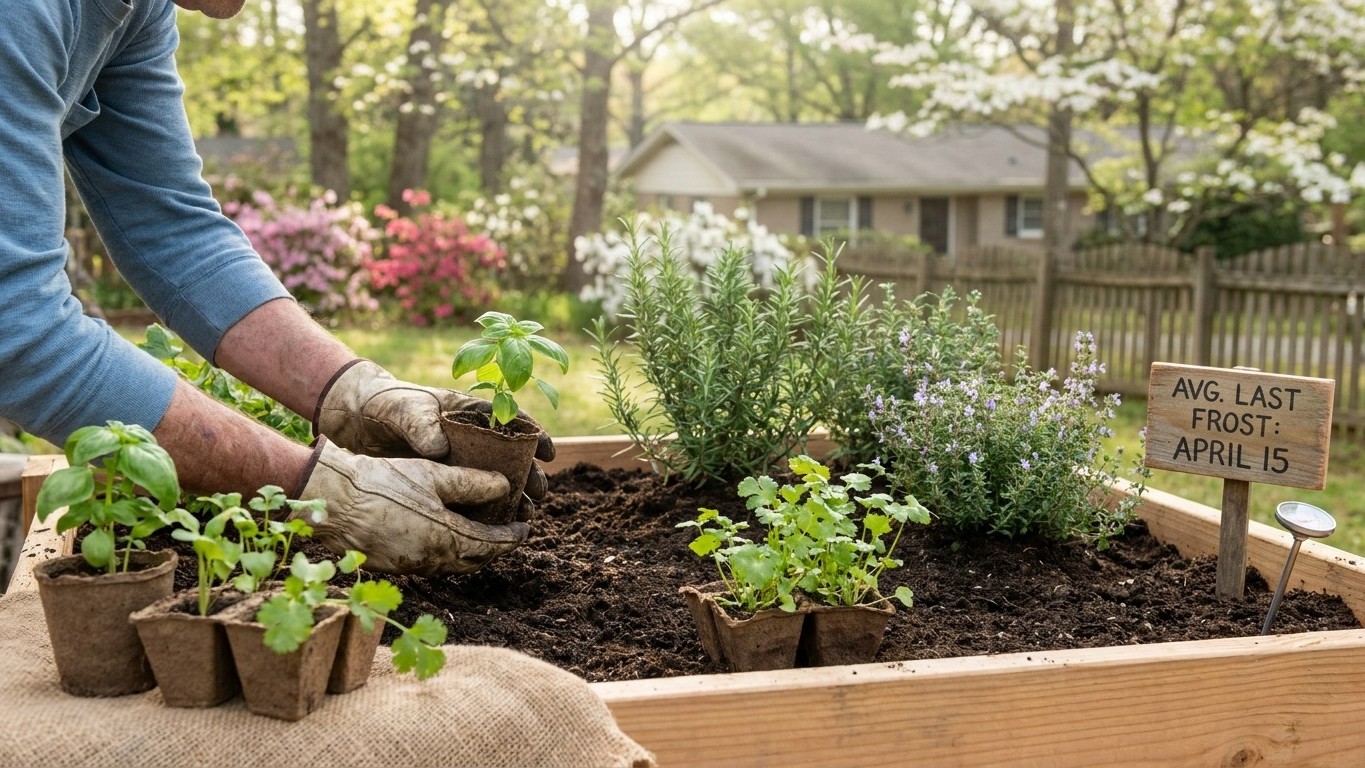

Basil, dill, and other frost-tender herbs go into Nebraska soil after the last spring frost, which falls between April 12 and April 23 at the Omaha reference station. Hardy herbs like parsley, cilantro, and chives can go in two to three weeks earlier. The exact date for your yard depends heavily on your county.
The short answer for Nebraska
Those April dates aren’t a guarantee. NOAA’s 30-70% freeze probability band means that on April 12, there’s still a 70% chance of a 32°F freeze somewhere in that data set, and by April 23, the odds have dropped to 30%. In practice, that means gardeners who plant tender herbs right at April 12 are betting against decent odds of a frost. Waiting until April 23, or later, is the more conservative play, especially for anything that dies outright at 32°F.
Herbs split cleanly into two behavior groups here, and the split matters more than any single calendar date.
| Herb type | Frost tolerance | Sowing window (Nebraska) | Examples |
|---|---|---|---|
| Tender annual | Killed at 32°F | After last spring frost (April 12-23 window, later is safer) | Basil, tender oregano starts |
| Hardy annual/biennial | Tolerates light frost, some down to the mid-20s | 2-3 weeks before last frost | Parsley, cilantro, dill |
| Hardy perennial (herbaceous) | Survives winter dormant in ground | Spring or early fall, established before hard freeze | Chives, mint, tarragon |
| Woody Mediterranean perennial | Often fails outdoors in Nebraska winters | Container culture recommended | Rosemary, some lavender |
The woody perennials are where Nebraska’s cold really bites. The coldest month here averages a daily minimum of 15.2°F, not a record low, but the typical low night in January. Rosemary varieties commonly sold at garden centers are rated hardy only into the low 20s or high teens at best, and most won’t survive a Nebraska winter left in open ground. That single number, 15.2°F, is doing a lot of work in deciding what stays outside year-round and what needs a pot you can carry indoors.
What will not work here
Run the frost dates against each other and you get the freeze-free season length, and that number sets a hard ceiling on what’s realistic. At the narrow end of the probability band (last frost April 23, first frost October 15), the frost-free stretch is about 175 days. At the wide end (April 12 to October 26), it’s closer to 197 days. Either way, that’s the window a tender herb has to germinate, grow, and produce before cold shuts it down again. Herbs that need a long, steady hot stretch to really hit their stride are working with less room here than they’d get in a longer-season state, and starting basil or other tender herbs from seed outdoors, rather than from transplants, eats into that window fast.
Planting tender herbs by the calendar instead of by the freeze odds is the most common failure point. Someone who direct-sows basil on April 12 because “that’s when the window opens” is planting into a freeze probability that’s still 70%. A single 30°F night at the two-leaf stage kills the seedlings outright, and there’s no recovery, just a bare patch and a second trip to the garden center.
The other predictable failure is treating woody perennials like permanent landscape plants. Rosemary planted in a Nebraska border in spring will often look fine through summer and fall, then die over winter when nighttime lows average 15.2°F for weeks at a stretch. That’s not a fluke year, that’s the typical cold for the coldest month. Gardeners who want rosemary as a permanent outdoor fixture are fighting the climate data, not a bad growing season. The workaround isn’t a hardier planting date, it’s a container that comes inside before the first hard frost.
Finally, hardy annuals planted too late lose their advantage. Cilantro and dill are cool-season herbs that bolt to seed once summer heat sets in; planting them in June instead of taking advantage of the early window before last frost just shortens their useful harvest period even further.
What changes across Nebraska
Nebraska spans USDA hardiness zones 4a to 5b, and that’s not a small spread. Zone 4a sits at the cold end of what the USDA hardiness system measures, the average annual extreme minimum winter temperature, while 5b is noticeably milder. A herb bed that overwinters chives without protection in the 5b end of that range may lose the same planting outright in a 4a location just a few counties away. There is no single hardiness answer for the whole state, and any planting calendar that gives one flat date for all of Nebraska is smoothing over a real difference.
Elevation and latitude both push that range around. Higher, more northern, and more western parts of the state trend colder, with shorter frost-free seasons and lower winter minimums than the Omaha reference figures used above. That reference station sits in the eastern part of the state, and its frost dates and coldest-month minimum describe that location, not the Panhandle or the Sandhills.
Rather than guessing at zone from county name or gut feel, check the reader’s own zone directly against the USDA Plant Hardiness Zone Map, which is built from the 1991-2020 climate normals and lets you enter a ZIP code for a specific reading. That step matters more here than in a state with a single, narrow zone, because a 4a-5b range means the practical advice, especially for perennial herbs and for how early to risk tender transplants, can genuinely differ from one side of the state to the other.
The general rule holds across the spread: whatever zone a reader lands in, colder zones push the safe planting date for tender herbs later and shrink the list of perennials worth leaving outdoors, while milder zones give a bit more room on both ends.
Where to check this for your own county
For anything more specific, the University of Nebraska-Lincoln’s Extension service is the right next stop: extension.unl.edu.
Two things are worth looking for once there. First, a county-level or regional planting calendar, if the local office publishes one, will reflect frost dates and season length actually observed in that county rather than at the Omaha airport station used for the statewide figures here. Second, look for herb and vegetable variety trial results specific to Nebraska growing conditions. Extension offices routinely test which basil cultivars, which parsley types, and which perennial herbs perform reliably under local soil and climate conditions, and that trial data beats a general recommendation almost every time.
A county recommendation outranks a state one for a simple reason: it’s built on data closer to the actual garden. When the two disagree, even slightly, the more local source is generally the more accurate one for that particular yard.
Extension offices also field direct questions, often by phone or email, from home gardeners trying to figure out exactly this kind of question, when to plant, what survives winter, what to grow in a container instead of the ground. That’s a resource worth using before committing a whole herb bed to a guess.
The Moon calendar is a separate, older custom: see when to plant herbs by the moon, written as tradition rather than fact.
Checking this against your own garden
None of the dates above beat what’s actually happening in the dirt. Frost probability bands and hardiness zones describe averages; a particular yard, with its own drainage, sun exposure, and windbreak, can run warmer or colder than the reference station by a meaningful margin.
Soil warmth by feel is the simplest check. Basil and other tender herbs germinate poorly, or rot outright, in soil that’s still cold from winter, even if the calendar says the last frost has passed. Push a finger a couple inches into the bed; if it feels cool rather than mild, the soil hasn’t caught up yet, regardless of what the frost date table says.
Watching for the first true leaves on any cool-season herb already in the ground, like early parsley or cilantro, tells you how the season is actually progressing that year. A slow crop of true leaves compared to a typical year usually means a colder-than-normal spring locally, and it’s a signal to hold off on the tender herbs a little longer than the calendar suggests.
For perennial herbs already established, like chives or mint, the first flush of vigorous new growth after winter dormancy is the clearest sign the plant has come through the cold and the ground has genuinely warmed. That flush arriving noticeably earlier or later than neighbors’ gardens a few miles away is a useful clue about a yard’s own microclimate, information no statewide frost date can give.