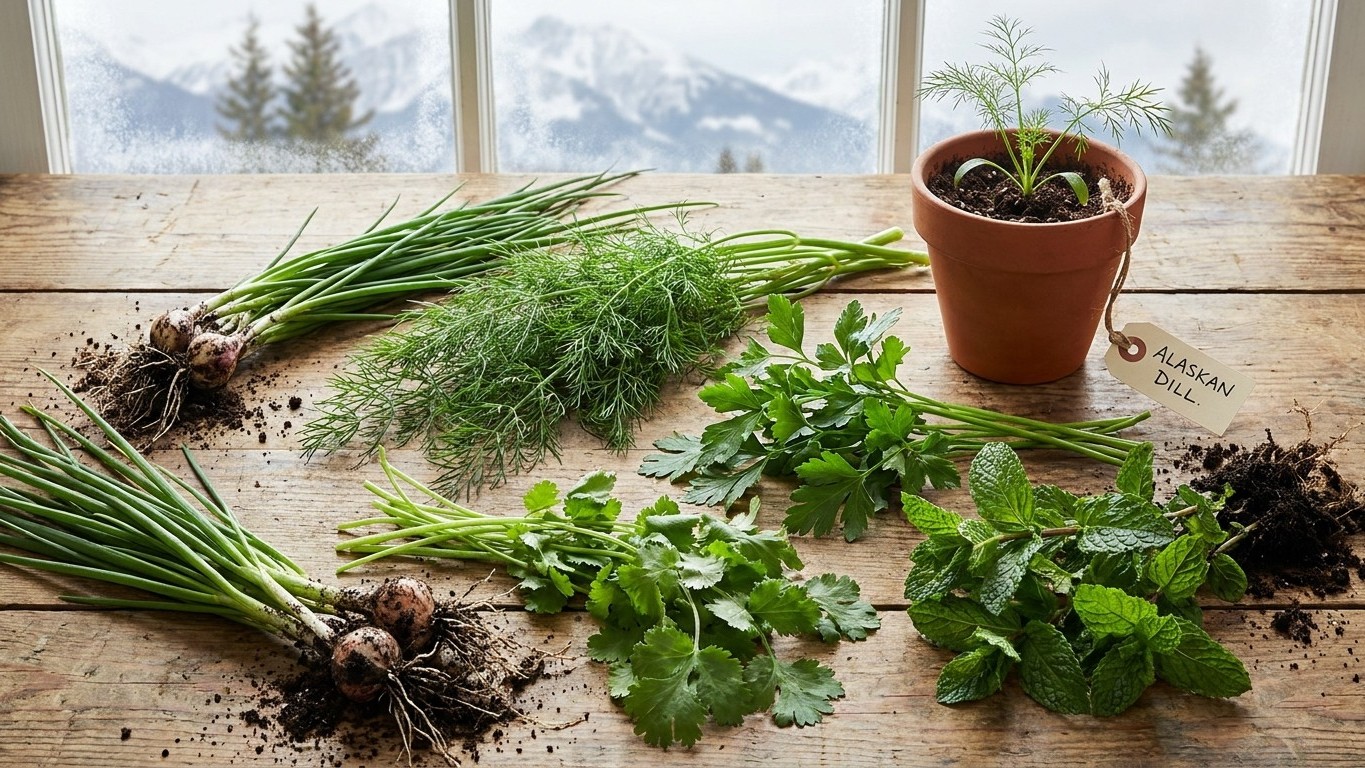

Nebraska’s short, often brutal winters and its wide 4a-5b hardiness range decide almost everything here. The herbs that thrive are cold-hardy perennials like chives, thyme, oregano and sage, plus annuals such as basil, dill and cilantro planted after the last frost. Tender Mediterranean herbs like rosemary and bay laurel need to come indoors or be replanted every year.
The short answer for Nebraska
The choice in Nebraska comes down to how a plant handles two numbers: a coldest-month average minimum of 15.2°F and a frost-free window that runs, on average, from somewhere between April 12 and April 23 in spring to somewhere between October 15 and October 26 in fall. That’s a growing season that can be as short as roughly 175 days or as long as about 195, depending on where those probability bands land in a given year.
For annual, heat-loving herbs, that window is generous enough for a full crop if you respect it. Basil, cilantro, dill and parsley all mature well within 175 to 195 frost-free days, provided they go into the ground after the last frost date has actually passed in your area rather than the date printed on a calendar. Succession-sow cilantro and dill every three weeks through early summer, since both bolt fast once daytime highs climb.
For perennial herbs, the decision hinges on winter cold, not season length. Nebraska’s hardiness zone range of 4a-5b (USDA Plant Hardiness Zone Map, built on average annual extreme minimum temperature) tells you which perennials can stay in the ground year-round. Chives, thyme, oregano, sage, tarragon and hardy mints are all rated for zone 4 or 5 cold and, combined with a coldest-month average minimum of 15.2°F, they typically make it through a Nebraska winter outdoors with mulch over the crown.
Tender perennials are the third category, and they need a different plan entirely. Rosemary, bay laurel and lemongrass are usually rated for zone 8 or warmer. Left outside through a Nebraska winter, none of them see spring. The workaround isn’t to skip them, it’s to grow them in pots that come indoors before the first fall frost, or to treat them as annuals you’re willing to replace.
So the short answer sorts into three buckets: annuals timed to the frost dates, cold-hardy perennials left in the ground, and tender perennials moved indoors or replanted. Nothing about Nebraska’s climate rewards guessing which bucket a given herb belongs in.
What will not work here

Rosemary as an outdoor perennial is the clearest failure. It’s the herb gardeners most often try to leave in the ground, and Nebraska’s coldest-month average minimum of 15.2°F is well below what a zone 8-10 plant is built to survive. Even a mild winter here still dips into territory that kills an unprotected rosemary plant outright, not just damages it back to the roots.
Bay laurel fails for the same reason and even faster, since it has less tolerance for cold snaps than rosemary does. If you want either plant, the pot has to move indoors before the first fall frost window opens in mid-to-late October, not after.
Lemongrass runs into a different wall: it’s a tropical grass that wants a long, consistently hot season to bulk up, and Nebraska’s frost-free window, even at its longest estimate of roughly 195 days, doesn’t deliver the sustained heat lemongrass gets in its native range. It survives here, technically, but rarely produces stalks worth harvesting before frost cuts the season short.
Herbs that run out of time
Slow-maturing herbs planted too late are the quieter failure. If cilantro or dill goes into the ground in June instead of right after the last frost, it’s racing a first fall frost that could arrive as early as October 15. A herb that needs 70 to 80 days to reach a real harvest, planted in early June, is cutting it close against an October frost date that isn’t guaranteed to hold off until the 26th.
Overwatering during the cool early season is another common miss. Nebraska’s spring soil, still cold from a winter that bottoms out near 15.2°F on average, holds moisture longer than gardeners expect. Herbs like thyme and oregano, which prefer drier soil, are more likely to rot from an eager watering schedule in April and May than to suffer from drought.
What changes across Nebraska
A hardiness range of 4a to 5b means Nebraska isn’t one climate, it’s at least two full half-zones stacked across the state. That’s roughly a 10°F swing in average annual extreme minimum temperature between the coldest corner and the mildest one, and it changes which perennial herbs survive without help.
A gardener in a 5b pocket can reasonably expect hardy mints, chives, thyme and oregano to overwinter with light mulch and little else. A gardener in a 4a pocket needs to plan for more insulation, heavier mulch over the crown, or accept that even some zone 5-rated herbs will need a sheltered spot against a south-facing wall to make it through the coldest stretch.
Elevation and local terrain shift this further. Low spots that collect cold air overnight behave colder than the surrounding land, sometimes by several degrees, regardless of what the regional zone map says. A garden tucked in a valley or a low corner of a yard can run a full half-zone colder than a garden on a nearby rise, which matters for a perennial herb sitting right at the edge of its cold tolerance.
None of this means guessing. The USDA Plant Hardiness Zone Map lets you check hardiness zone by ZIP code, and that’s the only reliable way to know which end of Nebraska’s 4a-5b range applies to a specific garden. A state-level range is a starting point, not a verdict on any one yard.
Where to check this for your own county
Nebraska Extension, part of the University of Nebraska-Lincoln, publishes county-level planting guidance at extension.unl.edu. That’s the resource that closes the gap.
Two things are worth pulling from that site before you plant. First, the local planting calendar for your county, which adjusts the state’s frost-date range to conditions closer to your actual garden rather than the airport weather station the national averages come from. A county calendar accounts for local frost patterns that an airport 30 or 50 miles away simply doesn’t capture.
Second, look for herb and vegetable varieties that Nebraska Extension has actually trialled in your region. County offices often track which basil types resist bolting in local heat, which sage varieties held up through a specific hard winter, or which cilantro strains bolted slowest in trial plots nearby. That’s information no state-wide article can offer, because it depends on soil, wind exposure and microclimate specifics.
A county recommendation beats a state one every time. This page works from Nebraska-wide averages, National Weather Service frost probabilities and a single hardiness zone range that spans more than half the state. Your county extension office works from what actually happened in gardens near you, sometimes over decades of recorded trials. When the two disagree, trust the local office.
Checking this against your own garden
Every date on this page is a probability from a distant weather station, not a promise about your soil. Your own garden gives better information, if you know what to watch for.
Start with soil warmth by feel. Push a finger a couple of inches into the bed where you plan to sow basil or cilantro. If it still feels cold and heavy rather than loose and faintly warm, the soil hasn’t caught up to the air temperature yet, even if the calendar says the last frost has passed. Cold soil slows germination and invites rot in seeds that would otherwise sprout within days.
Watch chives, oregano and other overwintered perennials for their first flush of new green growth at the base. That first sign of life is a better signal that the ground has warmed enough for tender annual herbs than any printed frost date, because it reflects what’s actually happening in your specific bed, under your specific mulch, in your specific amount of sun.
Check young seedlings for their first true leaves, the second set that appears after the initial rounded seed leaves. Herbs that reach true leaves quickly in your conditions are telling you the microclimate is running warm for the season. Herbs that stall at the seed-leaf stage for a week or more are telling you to hold off on the next round of transplants, regardless of what the regional frost window suggests should be happening by now.