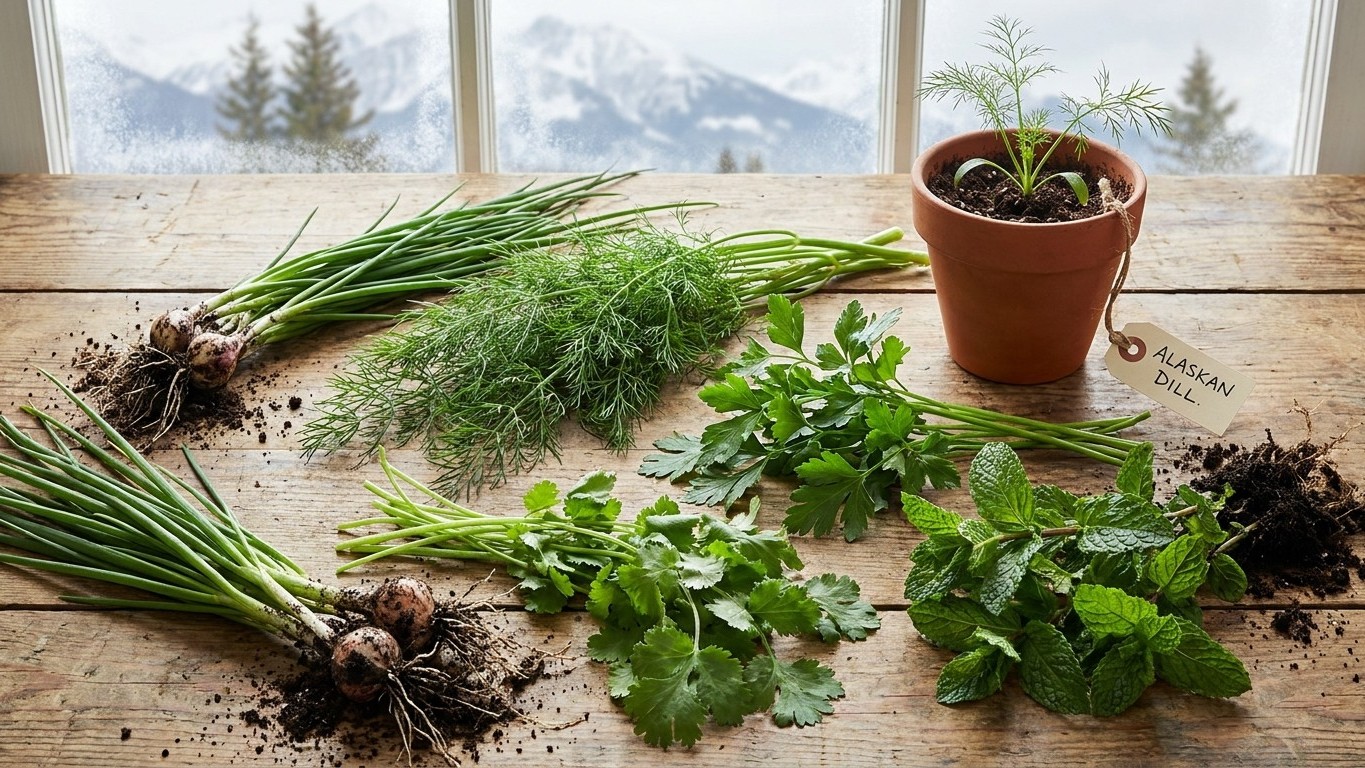

Rosemary, thyme, oregano, and sage handle New Mexico’s dry heat and thin air better than almost anything else you can plant, provided you’re in the warmer half of the state’s zone range. Fast annuals like basil, cilantro, and dill fit easily into Albuquerque’s frost-free window and don’t need to survive a single New Mexico winter to earn their keep.
The short answer for New Mexico
Start by splitting herbs into two camps: perennials that have to survive winter outdoors, and annuals that just need one good frost-free stretch to grow, flower, and get harvested before the cold comes back. That split matters more here than almost anywhere else, because New Mexico’s numbers pull in two different directions at once.
At the Albuquerque reference station, the last spring frost falls between March 31 and April 12, and the first fall frost arrives between October 29 and November 9. That’s a frost-free window stretching roughly 200 to 220 days, which is generous by national standards. Any annual herb that matures in 60 to 90 days, basil, cilantro, dill, parsley, has room to spare in that window, even with a slow start or a second sowing.
Perennials are a different story, because they don’t just need one season, they need to survive the coldest month. At Albuquerque, the mean daily minimum for the coldest month sits at 26.4°F. That’s tolerable for rosemary, thyme, oregano, and sage, all of which are used to Mediterranean hillsides that see occasional dips into the high 20s. It’s the reason these four herbs consistently top recommendation lists for New Mexico gardens: they’re built for exactly the kind of dry, sun-baked, moderately cold-tolerant conditions that define the middle Rio Grande valley.
But that 26.4°F figure is a mean, not a floor, and it comes from one station. New Mexico’s USDA hardiness zone range runs from 4b to 9a, a spread of nearly five full zones within one state’s borders. A mean coldest-month minimum of 26.4°F in Albuquerque says nothing about what happens in the mountains north of Santa Fe or the high plains near Raton, where extreme minimums can drop far below what any Mediterranean herb tolerates.
So the honest answer, by type: annual herbs are a safe bet almost anywhere in the state within the frost-free window described above. Woody Mediterranean perennials are a strong bet in the warmer, lower-elevation zones and a gamble everywhere else unless grown in containers that can be moved indoors. Your zone and your last frost date come from your own county.
What will not work here

Humidity-loving herbs are the first to struggle. Chervil, and mint grown the way it’s grown in wetter climates, expect consistently moist air and soil. New Mexico’s air is dry enough that soil moisture disappears fast, even when the calendar says it should still be damp. Mint will survive here, but only with irrigation that most gardeners underestimate, watering that would be considered excessive in a humid state is closer to normal here.
Basil is the clearest case of a plant that fails not because it can’t grow in New Mexico, but because it gets planted at the wrong moment. Basil dies at the first hint of frost, no exceptions. The last spring frost at the Albuquerque reference station falls between March 31 and April 12, which means basil set out in mid-March, a common mistake after an early warm spell, has a real chance of being killed outright by a frost that’s still statistically likely. The 30 to 70 percent probability band behind that date range means frost is neither guaranteed nor unlikely in early April. Treat the later end of that window as the safer bet, not the earlier one.
Woody Mediterranean perennials fail for the opposite reason: not the growing season, but the winter that follows it. A coldest-month mean minimum of 26.4°F at Albuquerque is workable for rosemary and sage. But that number is a mean daily minimum, not the extreme low a plant might face in a single hard freeze, and it’s specific to one station. In the colder pockets of the state’s 4b-9a zone range, a rosemary planted in open ground with no protection is likely to die in its first real winter, not because the herb is wrong for New Mexico in general, but because it’s wrong for that particular elevation and exposure.
Bay laurel belongs in the same category, worse. It’s less cold-hardy than rosemary and has no business in open ground anywhere the coldest-month minimum drops meaningfully below what Albuquerque sees. Anyone growing it here successfully is almost certainly growing it in a pot they bring indoors for winter, not as a permanent garden fixture.
What changes across New Mexico
A hardiness range of 4b to 9a is not a rounding error, it’s close to the full spread the USDA map uses across the entire Mountain West. That range is built on one variable, the average annual extreme minimum temperature, and it tells you that a herb bed in the low desert near the Rio Grande’s southern reaches and a herb bed at altitude in the northern mountains are, for practical purposes, gardening in different climates that happen to share a state line.
In the warmer end of that range, closer to zone 8 and 9a, woody perennials like rosemary, sage, and thyme can behave as true perennials, living outdoors year-round with minimal winter dieback. Gardeners there can also push their luck with borderline herbs, French tarragon, bay laurel in a sheltered spot, that would need serious protection or container culture farther north.
At the colder end, 4b and 5, the calculation changes entirely. The frost-free window shrinks compared to the Albuquerque reference figures, the coldest-month minimum drops well below 26.4°F, and perennial herbs that survive fine in Albuquerque need to be treated as annuals, replanted each spring, or grown in pots that come indoors for winter. Even fast annuals like basil and cilantro have less room to work with once the frost-free season compresses, which pushes gardeners toward earlier starts indoors or under cover rather than direct sowing.
Elevation drives most of this variation more than latitude does. Two towns at similar latitude but a few thousand feet apart in elevation can differ by a full hardiness zone or more. The USDA Plant Hardiness Zone Map, searchable by ZIP code, is the tool that answers that question for your specific location, not a state-level summary like this one.
Where to check this for your own county
New Mexico’s land-grant extension service, run through New Mexico State University, publishes county-level guidance. That’s the resource that turns a state-wide range into a number you can actually plant by.
Two things are worth pulling from that site before you plant anything. First, the local planting calendar for your county’s Cooperative Extension office, which will give you a sowing window built on frost data closer to your actual garden than the Albuquerque airport station. Second, the list of herb and vegetable varieties that county agents have actually trialed nearby. A variety that performs well in one county’s soil and elevation can underperform an hour away, and extension trial data is one of the few sources that tests this locally rather than assuming it.
This matters more in New Mexico than in a state with a narrower hardiness range, precisely because 4b-9a covers so much ground. A county recommendation accounts for your local elevation, your local frost pattern, and often your local soil type, all of which shift meaningfully across a state this varied. A state-level page, this one included, can only describe the shape of the state, not the particulars of your backyard.
If your county’s extension office doesn’t have a published herb-specific calendar, the vegetable and fruit planting guides usually carry equivalent frost-date guidance that applies just as well to herbs, since the limiting factor for both is the same last and first frost dates. Calling or emailing the local office directly is also a legitimate option, and often faster than digging through a website built for a whole state’s worth of climates.
Checking this against your own garden
Every date and figure is a probability drawn from decades of averages, not a promise about this particular spring. Your own garden will tell you things no regional dataset can, and it’s worth trusting those signals over a calendar date when they disagree.
Soil warmth, checked by hand, is the first and most useful signal. Push a finger a couple of inches into the bed in early spring. If the soil still feels cold and slightly damp in a way that chills your hand quickly, it’s too early for basil, cilantro, or any other frost-tender herb, regardless of what the date on the calendar says. Warm, dry-feeling soil that’s comfortable to leave your hand in for a few seconds is a better green light than any printed frost date.
The first true leaves on a seedling are the second signal worth watching. Seed leaves, the first two that emerge, don’t tell you much. It’s the second set, the true leaves that actually look like the herb’s mature foliage, that show the plant has enough root and energy to handle a modest cold snap without giving up entirely.
For perennial herbs already in the ground, new growth at the base after winter is the tell that matters. Rosemary, sage, or thyme that pushes fresh green growth from the crown once the weather warms has made it through the cold season in your specific spot, which is more reliable information about your microclimate than any hardiness zone map. A plant that stays bare and brittle at the base, even after neighboring plants have leafed out, is telling you that spot didn’t work, no matter what the state-wide averages suggested it should.