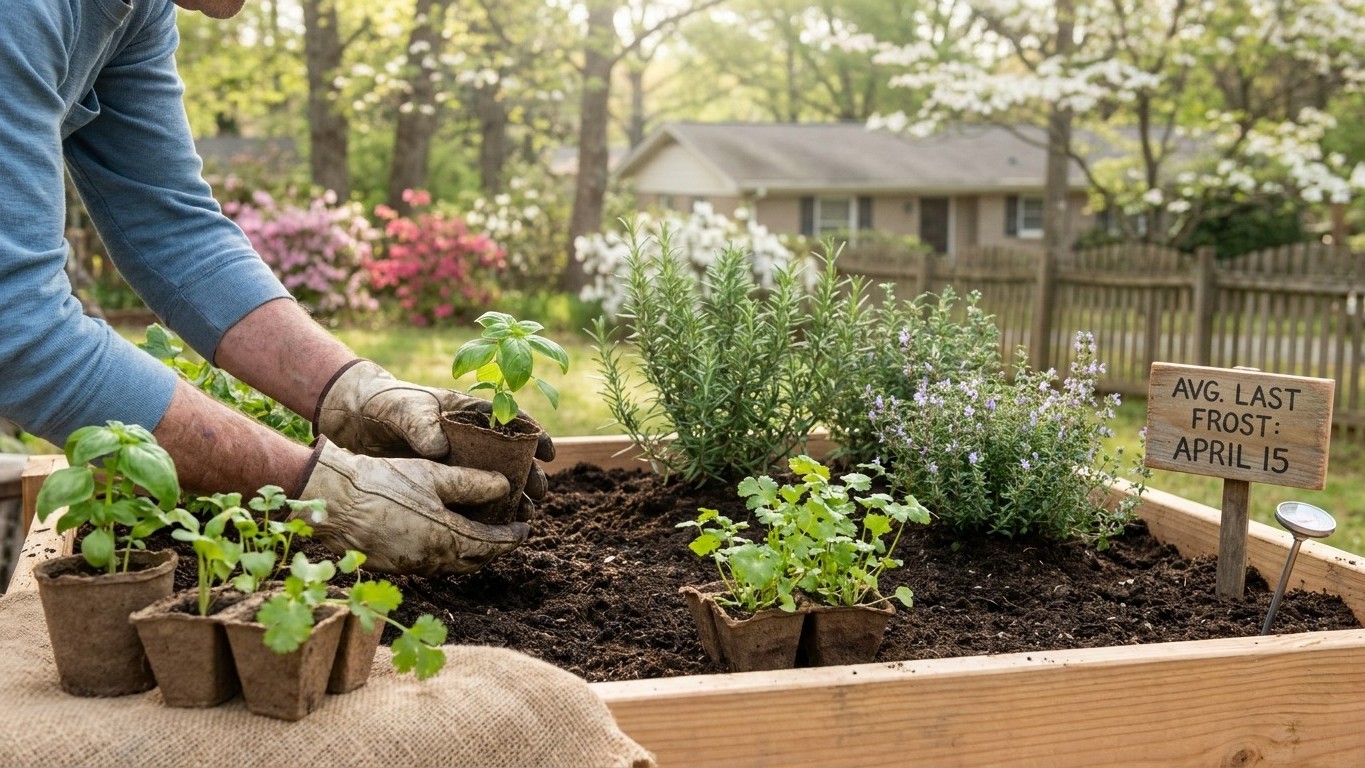

Cold-hardy herbs like chives, parsley, and cilantro can go into North Dakota soil starting in the first half of May, right as the last frost risk fades. Basil, dill in bulk, and other tender herbs need to wait until closer to mid-May, and the whole outdoor season closes by late September. That’s the short version. What decides the exact week is worth unpacking.
The short answer for North Dakota
NOAA’s Climate Normals for 1991-2020, measured at the Fargo reference station, put the last spring frost somewhere between May 4 and May 15. That’s not a guess or an average day. It’s a probability band: the window during which a 32°F freeze has between a 30% and 70% chance of happening. Before May 4, frost is more likely than not. After May 15, the odds tip solidly in your favor. Anything you plant inside that window is a bet, not a certainty.
Fall works the same way in reverse. The first fall frost at that same Fargo station lands between September 25 and October 5, again as a 30-70% probability band. Between those dates, the odds of a freeze climb fast. So the frost-free stretch a Fargo-area gardener can actually count on, planting after the window closes and harvesting before the next one opens, runs from roughly mid-to-late May through late September. Call it four and a half months if you’re generous, four if you’re not.
Inside that stretch, timing splits by herb type. Cold-tolerant herbs, chives, parsley, cilantro, dill, can go into the ground as soon as soil is workable, even while frost odds are still elevated in early May, because a light freeze won’t kill young seedlings of these species. Tender herbs, basil above all, need the odds fully in their favor. Basil planted while frost probability is still above 30% risks getting nipped or stunted, and stunted basil rarely recovers its growth rate for the rest of the season.
Winter survival for perennial herbs is a separate question, and North Dakota’s numbers on that front are blunt. The coldest month here averages a daily minimum of just 0.2°F at the Fargo reference station. That single figure, not the record low, not a seasonal average, is what determines whether a perennial herb makes it through winter outdoors at all. Very few culinary herbs are rated to survive that kind of cold without protection, which shapes almost every decision below.
What will not work here
Start with math most gardeners skip: the frost-free window, best case, runs from around May 15 to September 25. That’s roughly 133 days. Herbs that need a long runway to reach harvestable size, rosemary grown from seed, bay laurel, some slow lavenders, routinely need 80 to 100-plus days just to reach a usable size, and that assumes ideal conditions with no setbacks. In a state where the safe window itself is barely 130 days, there’s no margin for a cool spring, a late seedling start, or a September cold snap arriving early. Anyone who has watched a rosemary seedling sulk through a Midwestern June knows this isn’t theoretical.
The bigger failure point is winter, not summer. A coldest-month average minimum of 0.2°F is not a marginal cold snap, it’s a hard floor. Herbs commonly sold as “perennial” at garden centers, rosemary, bay, many lavenders, are typically hardy only into the mid-20s or low teens Fahrenheit without heavy mulching or moving indoors. Planted in the ground here and left uncovered, they don’t struggle through winter. They die. Gardeners who plant these expecting a perennial herb bed, the way someone in a milder state might, are setting themselves up for a replanting job every single spring.
Early planting is its own trap. Because the last-frost window sits between May 4 and May 15, and that’s a probability band rather than a guarantee, jumping the gun in late April or the first days of May means gambling against odds that are still worse than a coin flip. Basil in particular shows the damage even from a light frost that doesn’t kill it outright: leaves blacken, growth stalls, and the plant often never catches up to a later-sown neighbor. This isn’t a humidity problem or a heat problem the way it might be further south. It’s a short-season, deep-cold problem, and the fix isn’t different watering or spacing. It’s respecting the calendar and choosing herbs that fit inside it.
What changes across North Dakota
North Dakota’s USDA hardiness zone range runs from 3a to 4b, and that spread matters more than it looks on paper. Zone 3a and zone 4b aren’t a rounding difference, they’re roughly a 10°F gap in average annual extreme minimum temperature, the single variable the USDA map is built on. A herb bed that survives winter in a 4b pocket may not stand a chance in a 3a one just a few counties away.
There is no single planting date that covers the whole state, and treating Fargo’s figures as universal is where a lot of frustration starts. Fargo itself, the reference station behind the frost dates used here, sits toward the milder end of that zone spread. Counties further north or west, and any spot at higher elevation, should expect both a later last frost in spring and an earlier first frost in fall than the Fargo numbers suggest, sometimes by a week or two on each end. That shrinks the already-tight frost-free window even further for those gardeners.
What that means practically: a reader gardening in a colder pocket of the state should treat the May 4 to May 15 window as a starting point to push later, not an exact date to plant by. The same goes for the September 25 to October 5 fall frost window, treat it as a signal to start protecting tender herbs earlier, not a fixed deadline. This page can’t tell an individual reader which zone they’re actually standing in, that takes checking the USDA Plant Hardiness Zone Map directly for a specific address or ZIP code, since even neighboring properties can fall on opposite sides of a zone line depending on elevation, water proximity, or wind exposure.
Where to check this for your own county
Everything above comes from one reference station and a statewide zone range, which makes it useful for planning but not precise for any single backyard. The next step is checking those numbers against North Dakota State University’s Extension service. NDSU Extension maintains county-level offices across the state, and that local layer is where the real precision lives.
Two things are worth hunting down there specifically. First, a local planting calendar, if one exists for the county, will reflect actual frost data recorded closer to home rather than at the Fargo airport station used in this article. Given how much frost timing can shift even 30 or 40 miles away, that local data is the more reliable starting point for an actual planting date. Second, look for any list of herb or vegetable varieties that NDSU or a county office has specifically trialled in that area. Extension offices often run variety trials suited to local soil and microclimate conditions, and a variety proven to perform in a specific county carries more weight than a general statewide recommendation.
A county-level recommendation will always beat a state-level one, plainly and consistently. This page is built from statewide and single-station data because that’s what’s available at this scale, useful for understanding the pattern across North Dakota, not for pinning down the exact week to plant basil in a specific yard. Treat the figures here as the framework, and treat the county extension office as the source that fills in the details this page structurally can’t reach.
Checking this against your own garden
Dates on a calendar, even good ones, describe an average year. Your actual garden might run a week ahead or behind that average depending on sun exposure, soil type, and how sheltered the spot is from wind. Three simple checks, using nothing more than your hands and eyes, will tell you more about your own timing than any date range can.
First, feel the soil itself, a few inches down, mid-morning. Most herb seeds want soil that feels cool but no longer cold to the touch, roughly the temperature of tap water run for a few seconds. If the soil still feels icy or damp-cold in a way that makes you want to pull your hand back, seeds will sit and rot rather than germinate, regardless of what the calendar says.
Second, watch how quickly seedlings push their first true leaves, the second set that appears after the initial rounded seed leaves. Fast, sturdy true-leaf growth within a week or two of sprouting signals the soil and air are genuinely warm enough to support real growth, not just germination. Slow, pale, or stalled true leaves are the plant telling you it’s technically alive but not actually thriving yet, a sign to hold off on further tender transplants for another week.
Third, keep an eye on any herbs left over from last year, even ones you didn’t expect to survive. Volunteer chives or parsley pushing new growth on their own is one of the more reliable signals that a particular spot in your yard runs warmer than the rest of the property, information no regional frost date can give you. That microclimate detail, gathered over one season of paying attention, will end up guiding your planting decisions more accurately than any single date on this page.