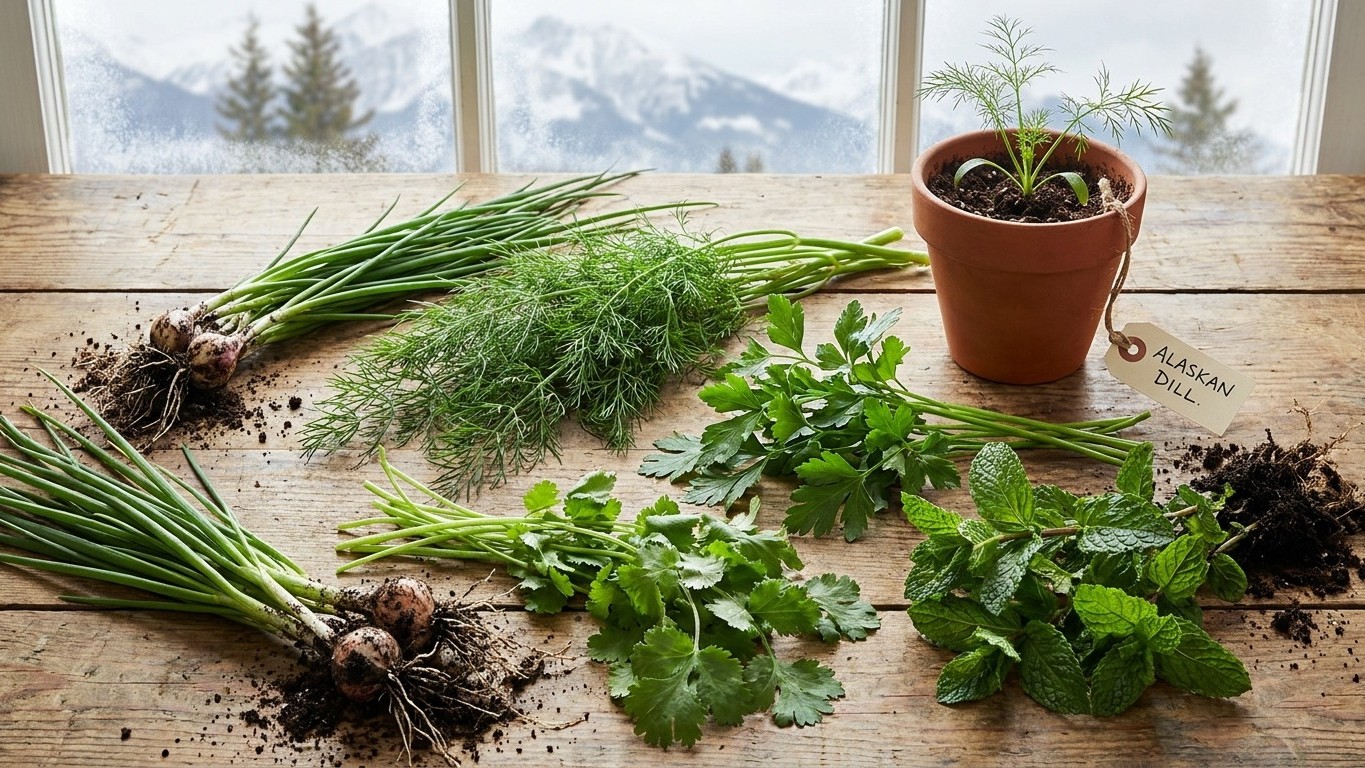

Ohio’s growing conditions favor hardy perennial herbs like thyme, sage, oregano, and chives, which tolerate the state’s winter lows without protection. Tender herbs such as basil, cilantro, and dill also do well, but only as warm-season annuals planted after the last frost risk has passed.
The short answer for Ohio
Ohio State University Extension’s Ohio Gardening Calendar puts the last spring frost between May 5 and May 15 and the first fall frost between October 5 and October 15, both figures tied to zone 6a. That gives most of the state a frost-free stretch of roughly 145 to 160 days. It’s a workable window, not a generous one, and it’s the number that should drive every herb decision you make this year.
Start with what that window rules in. Annual herbs that finish their life cycle in under 100 days, basil, dill, cilantro, summer savory, fit comfortably inside a 150-day season with room to spare for a second sowing of the fastest ones. These are the herbs where Ohio’s calendar is the limiting factor, not the plant itself: get them in after mid-May and pull them before the October frost, and they’ll do what they’re bred to do.
The harder call is perennial herbs, and here the number that matters isn’t the frost date at all. It’s the coldest month’s mean daily minimum, which NOAA’s 1991-2020 climate normals for the Columbus reference station put at 22.0°F. That’s not the record low for the winter, and it’s not the average temperature for the month. It’s the average of the daily lows across the coldest stretch, and it’s the figure that decides whether a perennial herb’s roots make it to spring.
Against that 22°F benchmark, thyme, sage, oregano, chives, and winter savory are safe bets. All five are rated hardy well below that threshold and have a long track record in Ohio gardens. Rosemary and bay laurel are the opposite case: both are commonly grown as garden herbs, but neither reliably survives a mean coldest-month minimum in the low 20s planted in open ground. Treat them as annuals, or plan to bring them indoors, rather than betting on an in-ground overwinter.
USDA’s Plant Hardiness Zone Map lists Ohio as spanning 5b to 6b, built on the average annual extreme minimum temperature rather than a typical winter low. That range matters for anything marketed as “hardy to zone 6” or borderline, since the extreme low behind that rating can dip well past what the Columbus mean-minimum figure suggests. When a tag says zone 6, read that as a description built for the milder end of the state, not a guarantee everywhere within it.
What will not work here

Rosemary planted straight into garden soil and left there over winter is the single most common disappointment reported to Ohio gardeners, and the climate data explains why. A mean daily minimum of 22°F for the coldest month is already below the comfort zone for most rosemary cultivars, and that’s the average, not the coldest night of the season. Even cultivars marketed as more cold-tolerant are a gamble against Ohio’s winter, and the safer move is a container you can move to an unheated garage or bright indoor spot once nights turn cold.
Bay laurel fails for the same reason, only more decisively. It’s a Mediterranean shrub with essentially no tolerance for sustained temperatures anywhere near freezing, let alone a monthly average minimum in the low 20s. Gardeners who want bay leaves in Ohio grow it in a pot, full stop, and treat the outdoor months as a summer vacation for the plant rather than a permanent home.
Lemongrass and other tropical-origin herbs run into the same wall. They’re not frost-tolerant at any stage, and Ohio’s frost-free window, generous as it is for basil, isn’t long enough or warm enough at the edges to let a tropical perennial establish, flower, and store enough energy to survive even a mild version of an Ohio winter. These belong in pots that come inside, not in a border bed.
On the other end of the calendar, the mistake isn’t cold tolerance but timing. Basil set out before the soil and air have warmed past the last frost risk in early-to-mid May will sit and sulk, or die outright, even if the calendar date has technically passed. The May 5 to May 15 window is a probability range built from historical data, not a guarantee, and a cold snap inside that window is common enough that gardeners who jump the gun on tender annuals lose plants most years somewhere in the state.
Slow-maturing herb varieties that need a full 120-plus days of warm growing weather to reach harvestable size are also a poor match here. With roughly 145 to 160 frost-free days total, and the coolest weeks at each end of that window not doing much for plant growth, a variety that needs the entire season just to mature leaves no margin for a late spring or an early fall, both of which happen.
What changes across Ohio
Ohio isn’t one climate. The USDA hardiness zone range for the state runs from 5b to 6b, and that spread reflects real differences in how cold the coldest nights get from one part of the state to another. A page written for the whole state can’t tell you which end of that range your own yard falls on, and it shouldn’t try. That’s a job for the USDA Plant Hardiness Zone Map, checked by ZIP code.
What the spread does tell you is how to adjust your risk tolerance. If you garden toward the colder end of that 5b to 6b range, borderline-hardy herbs that might survive a mild winter near Columbus are a poor bet for you. Push sage, thyme, and oregano toward the most sheltered spot you have, mulch the crowns going into winter, and treat anything rated exactly at the edge of your zone as an annual unless you’ve seen it overwinter locally before.
Elevation and local geography move the number too, even within a single county. A herb bed at the bottom of a slope where cold air pools will run colder on a still winter night than a bed on a gentle rise fifty yards away, regardless of what the zone map says for that ZIP code. Northeastern Ohio’s lake-effect snow belt also behaves differently from the rest of the state, with heavier and more consistent snow cover that can actually protect perennial roots better than a bare, exposed bed farther south gets.
The frost dates shift too, just less dramatically. The Ohio Gardening Calendar’s May 5 to May 15 and October 5 to October 15 windows are built around zone 6a, and gardeners at the colder edge of the state’s range should expect to lean toward the later end of the spring window and the earlier end of the fall one, shrinking their effective season by a week or two on each side compared to the milder parts of the state.
Where to check this for your own county
Everything above is a state-level answer, and a state is too big a unit for a planting decision that depends on your specific soil, slope, and microclimate. Ohio State University Extension runs the county-level offices built for exactly this gap, and the place to start is extension.osu.edu.
Once there, look for two specific things rather than browsing generally. First, the local planting calendar for your county office, which will adjust the statewide May 5 to May 15 and October 5 to October 15 frost windows to whatever your local station’s data actually shows, since a county in the Ohio River valley and one near Lake Erie don’t share an identical frost history even though both fall inside the state’s general range. Second, look for variety trial results or recommended cultivar lists specific to your area. Extension offices frequently track which herb varieties have performed well in local trial gardens, and that field-tested information beats a general hardiness rating every time.
A county recommendation will always outrank a state one, for the same reason a weather forecast for your town beats one for your entire region. This page has told you what’s true across Ohio as a whole: the frost dates, the coldest-month minimum, the hardiness zone range. Your county extension office can tell you what’s true on your street, and that’s the number worth planting by.
Checking this against your own garden
Every date on this page is a historical average, and your own garden this year is not obligated to match it. Three low-tech checks will tell you more about your actual conditions than any calendar can.
- Soil warmth by feel: push a finger a few inches into the bed where you plan to sow. If it feels cool and damp rather than merely cold, most annual herb seeds are ready to germinate, regardless of what the calendar date says.
- Weed and volunteer growth: when dandelions and other early weeds are actively growing and flowering nearby, the soil has typically warmed enough for tender herb transplants to handle outdoor conditions without stalling.
- First true leaves on seedlings: the initial pair of leaves on a sprouted seed doesn’t count. Wait for the second, true-leaf set to appear before transplanting outdoors, since that stage tells you the seedling has enough root and leaf development to handle the shock of a new bed.
None of these require a thermometer or a soil probe, just attention paid to what’s already happening in the yard. A calendar date is a bet based on decades of past weather. What your soil and your seedlings are doing this particular spring is the actual answer.