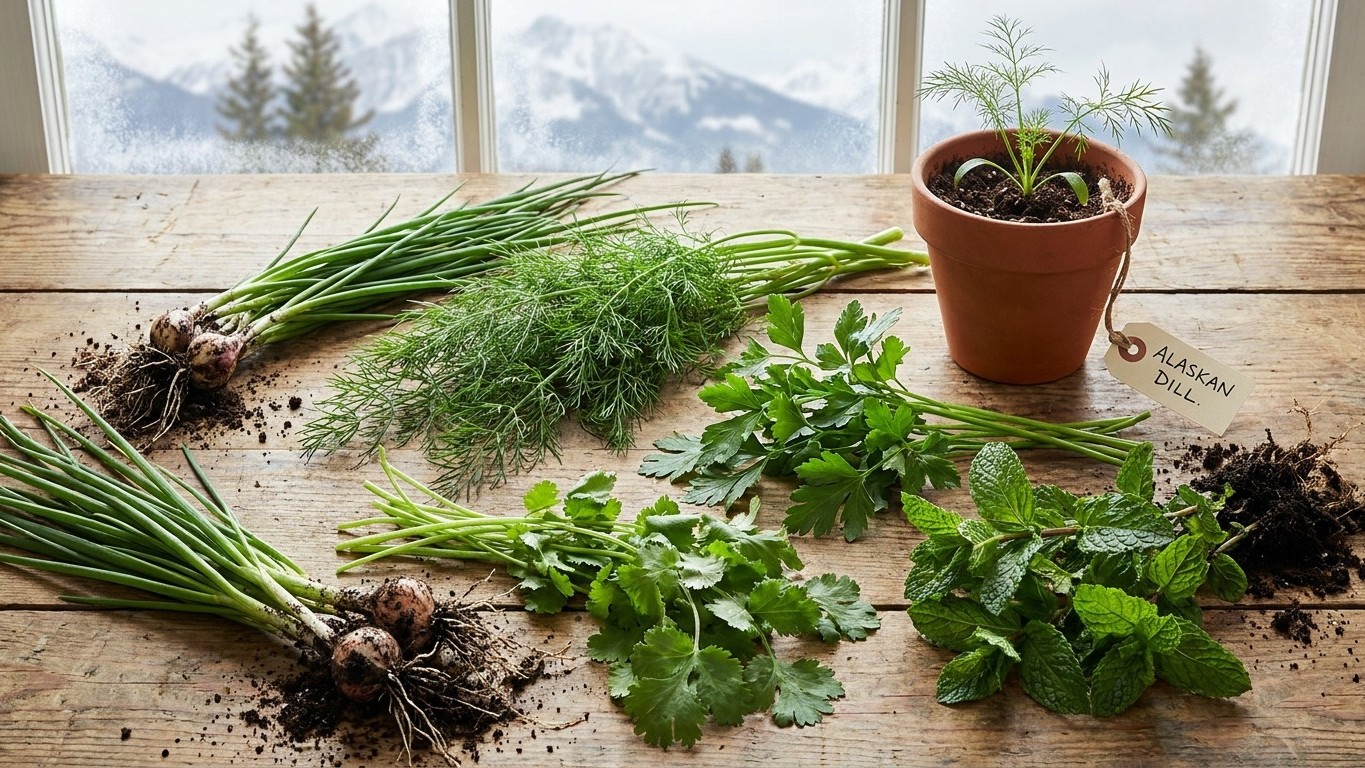

Chives, dill, cilantro, parsley, and hardy mints handle Quebec’s short growing season and cold winters without much fuss. Tender perennials like rosemary or bay laurel cannot survive outdoors here and must live in pots you bring inside before the first fall frost.
The short answer for Quebec
Start with the number that decides almost everything: the average frost-free window at the Montreal/St-Hubert A station runs from May 6 to October 5, about 152 days. That figure is a mean, not a guarantee. In one year out of two, the last spring frost lands later than May 6, and the first fall frost can arrive before October 5. Treat both dates as the midpoint of a window, not a safe bet, and build in a margin on both ends.
Inside that window, fast annual herbs win easily. Dill, cilantro, and parsley germinate and produce usable leaves well within 152 days, even accounting for a slow start or an early finish. Basil belongs in this group too, but only once the soil has genuinely warmed. It is a warm-season plant with zero frost tolerance, so it needs to go in after the frost risk has passed, not on the calendar date alone.
The second group is cold-hardy perennials: chives, established thyme, oregano, and mint. These need to survive winter outdoors, and the number that matters there is the mean daily minimum of the coldest month, 6.7°F. That is not a record low, it is the average low temperature the coldest month typically hits, which is the figure that actually determines whether roots make it through to spring. Herbs rated hardy to Canadian zone 5b or colder, the zone assigned to the Montreal/St-Hubert A reference station, generally handle that.
| Herb type | Fits the 152-day window | Survives a 6.7°F coldest-month minimum | Verdict for Quebec |
|---|---|---|---|
| Fast annuals (dill, cilantro, parsley) | Yes, with margin | N/A, grown as annuals | Grow outdoors, direct-sown |
| Hardy perennials (chives, thyme, oregano, mint) | Established plants, yes | Yes, at zone 5b | Grow outdoors year-round |
| Warm-season annual (basil) | Yes, but only after soil warms | N/A, killed by first frost | Grow outdoors, wait for warmth |
| Tender perennials (rosemary, bay laurel) | N/A | No | Container only, bring indoors |
The third group is the one that trips people up: Mediterranean perennials sold as hardy in warmer catalogs. Rosemary and bay laurel are typically rated for winters far milder than a 6.7°F coldest-month minimum. Outdoors, unprotected, they do not make it to spring in this climate. Grow them in pots and treat the outdoor season as a summer vacation, not a permanent home.
What will not work here

Two separate problems show up in a Quebec herb bed, and they are not the same problem. The first is winter. The second is a short, humid growing season, and it punishes different herbs in different ways.
The winter problem
Rosemary and bay laurel are the clearest casualties. Both are usually described as hardy into milder zones than Canadian 5b, and a coldest-month average minimum of 6.7°F simply falls outside what their root systems tolerate. Planted in the ground here, they do not overwinter, full stop. The fix is not a thicker mulch layer, it is a pot that comes indoors before the first hard cold snap, since relying on the October 5 average frost date to plan that move leaves no margin if the season runs early.
The season-length problem
A 152-day average frost-free window sounds generous until a herb needs most of it just to reach flavorful maturity. Slow Mediterranean herbs grown from seed rather than transplant, French tarragon among them, often need a long, steady stretch of warmth to develop real character, and a Quebec season that can legitimately run shorter than average in a cold year does not always give them that stretch. Starting these from an established plant rather than seed buys back weeks that the calendar does not reliably offer.
Humidity causes a third, quieter failure. Quebec summers are not the hot, dry Mediterranean summers that herbs like oregano and thyme evolved for. They are warm and often humid, and herbs planted at the spacing recommended on a seed packet written for a drier climate tend to develop powdery mildew or root rot in a wet stretch. Wider spacing than the packet suggests, and airflow between plants, matters more here than in a dry-summer state.
Basil sits at an odd intersection of both problems. It needs real heat to thrive, which in a short season means it should not go in the ground the moment May 6 passes on the calendar, since soil is often still too cold that early in an average year. But it also has zero frost tolerance, so a fall frost that arrives before the October 5 average ends the harvest without warning. The safe window for basil is narrower on both ends than the raw frost dates suggest.
What changes across Quebec
Every number above comes from one weather station, Montreal/St-Hubert A, and one hardiness zone rating, Canadian 5b, assigned to that reference location. Quebec is not one climate. The province runs from the milder river valleys near Montreal and the Montérégie region up through the Laurentians and Estrie highlands, into the Gaspé, and eventually into sub-arctic conditions near Hudson Bay and Nunavik. A hardiness map that captures that whole range necessarily shows zones shifting well beyond 5b in both directions, so the single reference station named above is not the province as a whole.
That matters in practice. A reader gardening at higher elevation in the Laurentians or in the Charlevoix region should expect a shorter frost-free window than 152 days and a colder coldest-month minimum than 6.7°F, simply because altitude and latitude both push conditions colder than the St-Hubert reference point. A reader in a warmer river-valley pocket closer to the Quebec-Ontario or Quebec-New York border may get a slightly longer, milder season than the numbers above suggest.
The honest answer is that there is no single hardiness zone for Quebec, and no single frost date either. Natural Resources Canada’s own hardiness mapping is built precisely because a province-wide average would mislead gardeners at either extreme. Rather than guess where on that spread a given location falls, check the interactive map directly at planthardiness.gc.ca for the specific municipality in question. That map is the source that can pin down a local zone.
Anyone north of the St. Lawrence lowlands, at meaningful elevation, or close to the Gaspé coast should treat every date and temperature here as a starting estimate to be adjusted colder and shorter, not as a number to plant by directly.
Where to check this for your own county
The provincial picture is built from one reference station and one zone rating. A provincial average is not a regional recommendation, and the gap between the two can matter for something as basic as when to put dill seed in the ground. Quebec’s agriculture ministry, MAPAQ, publishes the regional guidance that fills that gap, and it is the right next stop for anyone gardening outside the immediate Montreal area.
Start at mapaq.gouv.qc.ca. Two things there matter more than anything else. First, look for the planting calendar specific to the reader’s own agricultural region rather than a provincial one, since a calendar built for the Montérégie will not match one built for the Saguenay-Lac-Saint-Jean or the Gaspé, and MAPAQ organizes its regional guidance around exactly that kind of local variation. Second, look for herb and vegetable varieties that have actually been trialled in the reader’s region. A variety that performs well near Montreal is not automatically the best choice at higher elevation or farther north, and regional trial results are the closest thing to a real answer for a specific piece of land.
A regional recommendation from MAPAQ beats a provincial one every time, for the simple reason that it is built from data closer to the actual garden in question. The provincial picture works from a single station’s climate normals and a single reference city’s hardiness zone. That is useful as a baseline and a starting point for understanding how the system works, but it is not a substitute for the regional figures MAPAQ maintains for local growers.
Checking this against your own garden
Every frost date and zone figure is an average built from decades of station data. A reader’s own soil, in a specific year, outranks all of it, and it does not take a thermometer to read the signs.
Soil warmth by feel comes first. Push a finger two or three inches into the bed before planting anything heat-loving like basil. If the soil still feels cool or damp-cold rather than mild, it has not caught up to the calendar yet, regardless of whether May 6 has already passed. Basil and other warm-season herbs sulk or rot in cold soil even after the air has warmed.
Watch chives and other overwintered perennials for their first true leaves in spring. That first flush of real growth, not just a green tip poking up, signals that the ground has genuinely woken up in that specific spot, which can lag the provincial average by days or weeks depending on sun exposure, slope, and soil type.
Watch cool-season herbs like cilantro for early bolting, the point where they suddenly send up flower stalks instead of leaves. That is a heat signal from the plant itself, telling a gardener that summer warmth has arrived in that microclimate. It is also the cue to get basil and other heat-lovers in the ground, since the same conditions pushing cilantro to bolt are the ones basil has been waiting for.