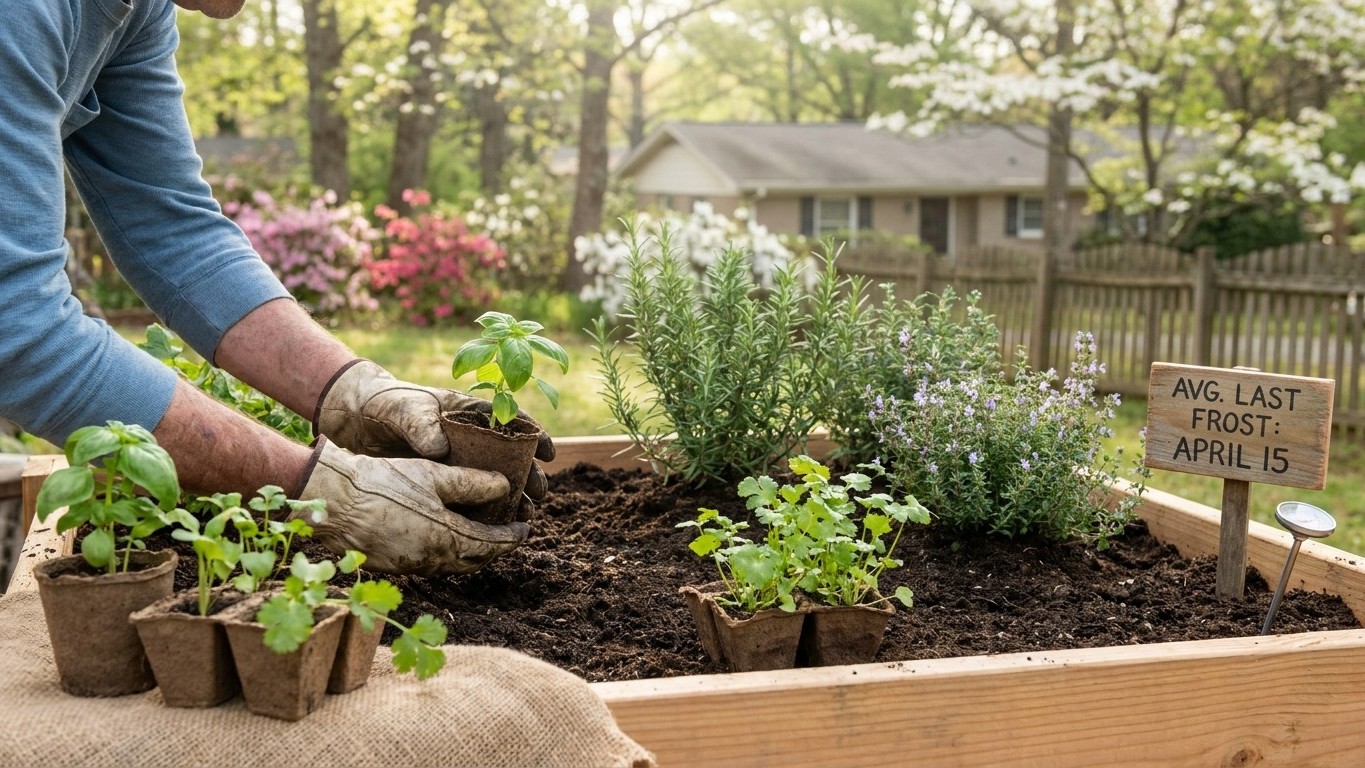

Rhode Island gardeners can start hardy herbs like parsley and cilantro outdoors around mid-April, but the safe window for tender herbs such as basil doesn’t open until early-to-mid May, once the frost risk has genuinely passed. The exact dates depend on where you garden within the state, and on how much risk you’re willing to accept.
The short answer for Rhode Island
The reference frost dates for this state come from the Providence weather station, and they’re not a guarantee: they mark the window in which the last spring freeze has a 30 to 70 percent chance of occurring. That last spring frost falls between April 7 and April 17. The first fall frost arrives between October 24 and November 3. Those two dates bracket the growing season available to every herb you plant here.
Hardy herbs that tolerate a light frost, parsley, chives, cilantro, and dill among them, can go into the ground as soon as the soil can be worked, often two to three weeks before that April 7-17 window closes. These plants don’t care much about a cold night; they care about workable soil.
Tender herbs are a different story. Basil, in particular, sulks and blackens at temperatures anywhere near freezing, and it doesn’t just tolerate the risk, it actively resents cool soil even without a frost. The practical move is to wait until the tail end of the frost window, meaning closer to April 17 than April 7, and then add another one to two weeks of cushion. That pushes safe basil planting into late April or early May for most of the state, and later still if you’re gardening somewhere cooler than the Providence reference point.
Perennial herbs like sage, thyme, oregano, and rosemary follow a separate calendar entirely. If they’ve survived the winter in your garden, they don’t get “planted” each spring so much as they wake up on their own schedule, tied to soil temperature rather than a calendar date. New transplants of these species, though, should follow the same logic as tender annuals: wait until frost risk has genuinely passed, since a young perennial herb has far less cold buffer than an established one.
Fall planting for cool-season herbs like cilantro and parsley works in reverse. Count backward from that October 24-November 3 first frost date, giving the plant enough weeks to mature before cold shuts it down. A second cilantro sowing in late August or early September, for instance, has time to produce a usable harvest before the season ends.
What will not work here
Rhode Island’s winter cold is the first wall that stops certain herbs cold, literally. The coldest month here averages a daily minimum of 22.1°F. That’s not the record low, it’s the average nightly low during the coldest stretch of winter, and it’s the number that actually decides which perennial herbs survive outdoors versus which ones need to come inside or get replanted every year.
Rosemary is the herb most gardeners get wrong on this point. In its native Mediterranean range, rosemary shrugs off light frost but has no real defense against a winter where nightly lows regularly sit in the low 20s. Most rosemary varieties sold in garden centers aren’t reliably hardy through a Rhode Island winter left outdoors in the ground, and gardeners who plant it as a permanent landscape shrub are often disappointed by February. Treating it as an annual, or bringing a potted plant indoors for winter, is the more realistic plan here.
Bay laurel runs into the same problem, only worse. It’s hardy to roughly zone 8 in most references, and this state’s coldest reference point doesn’t get there. A bay tree left outside through a typical Rhode Island winter is gambling on a mild year, not counting on a normal one.
The other failure point has nothing to do with cold and everything to do with the calendar’s short middle. The gap between that April frost window and the October one leaves a finite number of frost-free days, and herbs with a long maturity window don’t always finish before the season closes. This mostly matters for anyone trying to grow a full-season basil crop for seed, or a slow perennial started from seed rather than a nursery transplant. Starting seed indoors six to eight weeks before the last frost date closes most of that gap, but skipping that step and direct-sowing a slow herb in late spring can leave it racing a fall frost it won’t win.
Humidity plays a smaller but real role too. Herbs like oregano and thyme, which prefer lean, dry, well-drained conditions, don’t thrive when packed close together in a humid coastal summer. Powdery mildew and root rot show up faster in tight spacing here than they would in a drier inland climate, so the spacing advice on a seed packet written for a dry western state undersells what this region’s summer humidity actually demands.
What changes across Rhode Island
Rhode Island’s official hardiness range spans 6a to 7b on the USDA Plant Hardiness Zone Map, a system built on one number alone: the average annual extreme minimum temperature. That’s a wide spread for a small state, and it means there’s no single “Rhode Island answer” to when winter really releases its grip or how cold a February night actually gets in your yard.
The general pattern follows the coastline. Areas closer to Narragansett Bay and the immediate coast tend to sit in the milder end of that range, buffered by the ocean’s slower temperature swings. Inland areas, and anywhere with more elevation or more distance from open water, run colder in winter and can see a later last frost in spring as well. A garden ten or fifteen miles inland from the shore can genuinely be working with a different frost calendar than one near the water, even within the same small state.
This matters directly for the planting dates above. The April 7-17 and October 24-November 3 windows come from the Providence reference station, which sits closer to the milder end of the state’s range. A garden further inland or at higher elevation should treat those dates as a starting point, not a finish line, and should expect frost to linger later in spring and arrive earlier in fall than the reference figures suggest.
Because the range runs a full zone and a half wide, guessing which end applies to your own yard isn’t reliable from a state-level page. The right move is checking the USDA Plant Hardiness Zone Map directly for your specific address, since even neighboring towns can land in different zones depending on elevation and distance from the coast.
Where to check this for your own county
Every date and figure above describes Rhode Island in general, anchored to one weather station. Your own county, and often your own yard, will differ from that reference point by days or weeks depending on elevation, coastal exposure, and local microclimate. That gap is exactly what a county-level source closes and a state-level page cannot.
The University of Rhode Island Cooperative Extension is the place to take this next. It’s the land-grant extension service for the state, and it publishes planting guidance built from local trial data rather than a single airport station’s frost probabilities.
Two things are worth looking for specifically once you’re there. First, any local or county-adjusted planting calendar, since extension services frequently publish frost date tables broken out by region within the state, which will narrow the April 7-17 window above down to something specific to your area. Second, look for herb variety trial results or recommended cultivar lists, since extension programs often test which basil, parsley, or perennial herb varieties actually perform well in the state’s specific combination of humidity, soil, and winter cold, information no seed packet or generic gardening site can offer.
A county recommendation beats a state one every time, because it’s built on conditions closer to your own garden. Your extension office can tell you where in that spread your own county actually falls, and that’s worth the extra step before you commit seed to soil.
If you follow the almanac, here is when to plant herbs by the moon. It is a tradition, not a proven method.
Checking this against your own garden
No frost date table beats what your own garden tells you directly, and herbs are generous about giving signals if you know what to watch.
Start with soil warmth, checked by hand rather than a thermometer. Push your fingers a couple inches into the bed in mid-morning. If the soil still feels cold and damp like early spring, tender herbs such as basil will sit and sulk even if the calendar says it’s safe. Soil that feels warm to the touch, closer to the temperature of your own skin, is a much better sign that a tender transplant will actually take off rather than stall.
Second, watch your perennial herbs for their spring wake-up. Sage, thyme, oregano, and established rosemary that survived the winter will show fresh green growth at the base of old woody stems once soil temperature has climbed enough to break dormancy. That new growth is a more honest local signal than any calendar date, because it’s responding to the actual conditions in your specific yard, not an airport ten or twenty miles away.
Third, keep an eye out for volunteer seedlings. Dill, cilantro, and borage often self-seed from the previous year’s plants, and when those volunteers start popping up on their own in a bed, it’s nature confirming that soil conditions in that exact spot have become hospitable to germination. Seeing volunteers emerge before you’ve planted your intentional seeds is a strong hint that you’re clear to sow the same species yourself.
None of these signals require any tool you don’t already have. They’re slower than checking a calendar, but they’re specific to your soil, your drainage, and your yard’s own microclimate in a way that a state-wide frost table can never quite match.