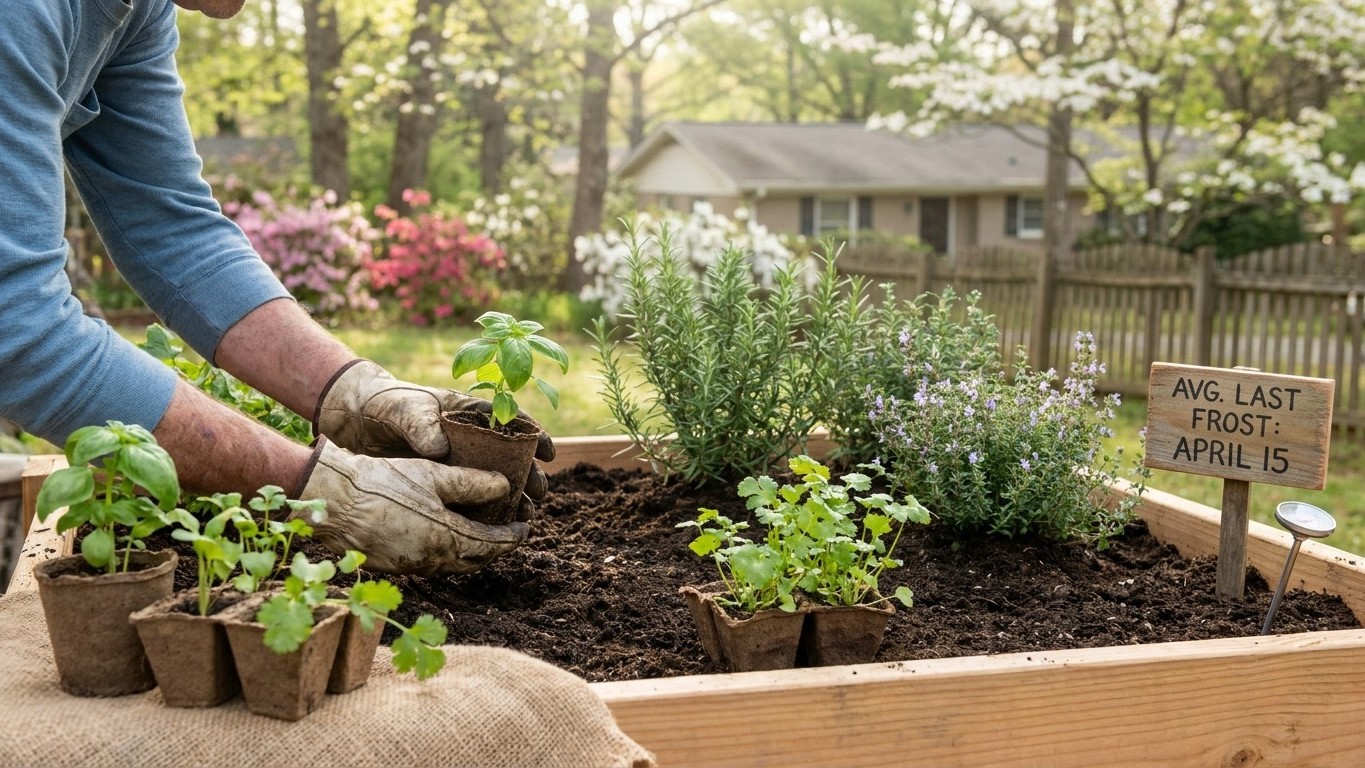

Saskatchewan’s average last spring frost lands on May 18 and the first fall frost arrives September 18, according to Environment and Climate Change Canada’s 1981-2010 normals for the Saskatoon SRC station. That gives a workable outdoor season of roughly four months, but “average” here means a coin flip, not a promise, and the calendar has to bend around that.
The short answer for Saskatchewan
Start hardy herbs from seed indoors in late March to early April, move tender herbs outdoors only after May 18 has passed with margin to spare, and expect the growing window to close around September 18 when the first fall frost tends to show up.
Those two dates are means, not safe brackets. Environment and Climate Change Canada’s normals describe the midpoint of a spread: in roughly half of all years, the last spring frost in the Saskatoon area falls later than May 18, sometimes by a week or two. The same logic runs in reverse for September 18. A gardener who transplants basil or cilantro seedlings on May 19 and calls it done is gambling on the better half of that fifty-fifty split.
The practical fix is a buffer. Treat May 18 as the earliest plausible date, not the target date, and push tender transplants toward the very end of May if the forecast allows it. That still leaves close to 115 days before the September 18 mean frost date, which covers most culinary herbs comfortably if they went in as seedlings rather than direct-sown seed.
Different herb categories need different handling inside that window:
| Herb type | Start method | Timing relative to frost dates |
|---|---|---|
| Hardy perennials (chives, thyme, mint) | Direct sow or transplant divisions | Can go in a few weeks before May 18; established roots shrug off light frost |
| Cool-season annuals (dill, cilantro, parsley) | Direct sow or early indoor start | Sow around or just after May 18; they tolerate a cool spring better than heat later |
| Tender annuals (basil, tender lemongrass) | Indoor start, transplant only | Hold transplants until late May, well past the mean frost date |
The takeaway isn’t a single sowing day. It’s a sequence: hardy herbs lead, tender herbs wait, and the calendar treats both frost dates as the middle of a range rather than a line in the sand.
What will not work here

Two numbers explain most of the failures gardeners run into in Saskatchewan: a coldest-month mean minimum of -5.3°F, and a Canadian hardiness zone of 3a for the Saskatoon reference station. Together they rule out a fair amount of what garden centers sell as “perennial” herbs elsewhere.
Rosemary and bay laurel are the classic casualties. Both are routinely marketed as perennial kitchen herbs, and in milder climates they are. Neither survives a winter where the coldest month averages a daily minimum near -5.3°F. That’s not an unusual cold snap, it’s the typical low for the season. Left outdoors past fall, these Mediterranean herbs die at the root, not just at the tips. The only way to keep them year to year here is a container that comes inside before the first hard freeze, treated as a houseplant rather than a garden fixture.
Slow-to-establish herbs run into a second problem: the season itself is short. From a mean last frost of May 18 to a mean first frost of September 18 is about four months, and that count assumes both dates behave. Herbs that need a long run from seed to usable size, sage and thyme grown from seed rather than transplants, for example, often haven’t built enough root mass to be worth harvesting before the season closes. Starting them indoors eight to ten weeks before the last frost date is less a suggestion than a requirement if seed-grown plants are the goal.
There’s also a spacing trap that works the opposite direction from what gardeners expect in a dry prairie climate. Because summers here tend to be dry rather than humid, the usual “give it room to breathe” advice for mildew-prone herbs like basil matters less than watering consistency. A once-a-week watering schedule that might suit a humid coastal garden leaves shallow-rooted annual herbs stressed and bitter-tasting in a Saskatchewan July, where dry air pulls moisture out of containers and raised beds faster than a weekly soak replaces it.
What changes across Saskatchewan
The 3a hardiness zone and the frost dates above both come from a single reference point, the Saskatoon SRC station. Saskatchewan is not one climate, and treating a province-wide answer as a fixed number for every garden inside it is where planting calendars go wrong.
Natural Resources Canada’s hardiness mapping shows zones shift with latitude, elevation, and distance from moderating water bodies. A province the size of Saskatchewan, stretching from the US border north into boreal forest, does not sit inside a single zone. The 3a figure describes conditions around Saskatoon specifically. Gardens farther north, at higher elevation, or in low-lying frost pockets should expect a colder effective zone and a shorter frost-free window. Gardens closer to the southern border, in warmer river valleys, may run a category milder.
That spread matters most for the decision this page keeps returning to: how much buffer to add past the mean frost dates. A garden that already runs colder than the Saskatoon reference station needs a bigger cushion after May 18 and an earlier eye on September, not the same margin quoted above.
Rather than guess which side of that spread a given yard falls on, the accurate move is to check the zone directly. Natural Resources Canada’s Plant Hardiness Site maps this at a resolution finer than “the province,” and it’s the only source built to answer that question for a specific location rather than a specific reference city. This page describes Saskatoon’s numbers. A garden fifty miles in any direction may need different ones.
Where to check this for your own county
This page gives the provincial picture, built from one reference station’s frost data and one reference city’s hardiness zone. A county-level source will always beat that, because it’s tuned to conditions this page can’t see.
Saskatchewan’s agriculture ministry maintains the province’s agribusiness resources at saskatchewan.ca’s agribusiness, farmers and ranchers section. That’s the starting point for anything more localized than the Saskatoon-based figures used above.
Two things are worth hunting for once there. First, any regional or district-level planting calendar that breaks the province down by growing zone rather than treating it as one block, since the zone spread discussed above means a Saskatoon date and a date fifty miles north or south of it can differ by a week or more in either direction. Second, variety trial results, if published, for herbs and vegetables tested specifically under Saskatchewan growing conditions rather than general seed-catalog claims written for a national audience. A cultivar that a seed catalog describes as “early” for the whole of North America may or may not be early relative to a 123-day mean frost-free window.
The general rule holds regardless of which province or state a reader gardens in: state-level or provincial pages describe averages across a large area, county or district-level sources describe conditions closer to an actual garden. This page is the provincial one. It’s a reasonable starting point, not the last word, and the ministry resource above is where the last word tends to live.
Checking this against your own garden
None of the dates above beat what a garden itself reports. Frost normals are averages built from decades of data at one weather station; a specific yard has its own microclimate, and three simple checks read it more accurately than any calendar date.
Soil warmth by feel is the first and most useful. Push a bare hand a few inches into the bed in spring. Cold, damp soil that feels like it’s still holding winter means seeds will sit and rot rather than germinate, regardless of what the calendar says about May 18 having passed. Soil that feels closer to room temperature, slightly cool but not cold, is doing the job the air temperature alone can’t confirm.
The first natural germination of self-seeded annuals is the second signal. Dill and cilantro that dropped seed the previous fall will sprout on their own the moment soil and air conditions suit them, well before most gardeners get around to sowing on purpose. Volunteer seedlings showing up in a bed are a more honest read of local timing than any provincial mean, because they responded to that exact spot’s soil, not a weather station’s.
The third is the appearance of true leaves on anything already sown. The first pair after the seed leaves marks the point where a seedling is actually growing rather than just surviving on stored energy, and it’s the cue that transplanting or thinning won’t set the plant back the way it would earlier.
Watched together, those three signs describe a garden’s own version of the frost dates above, built from what’s actually happening in the soil rather than a mean pulled from thirty years of station data.
Some gardeners also time this by the Moon: when to plant herbs by the moon, as almanac tradition rather than fact.