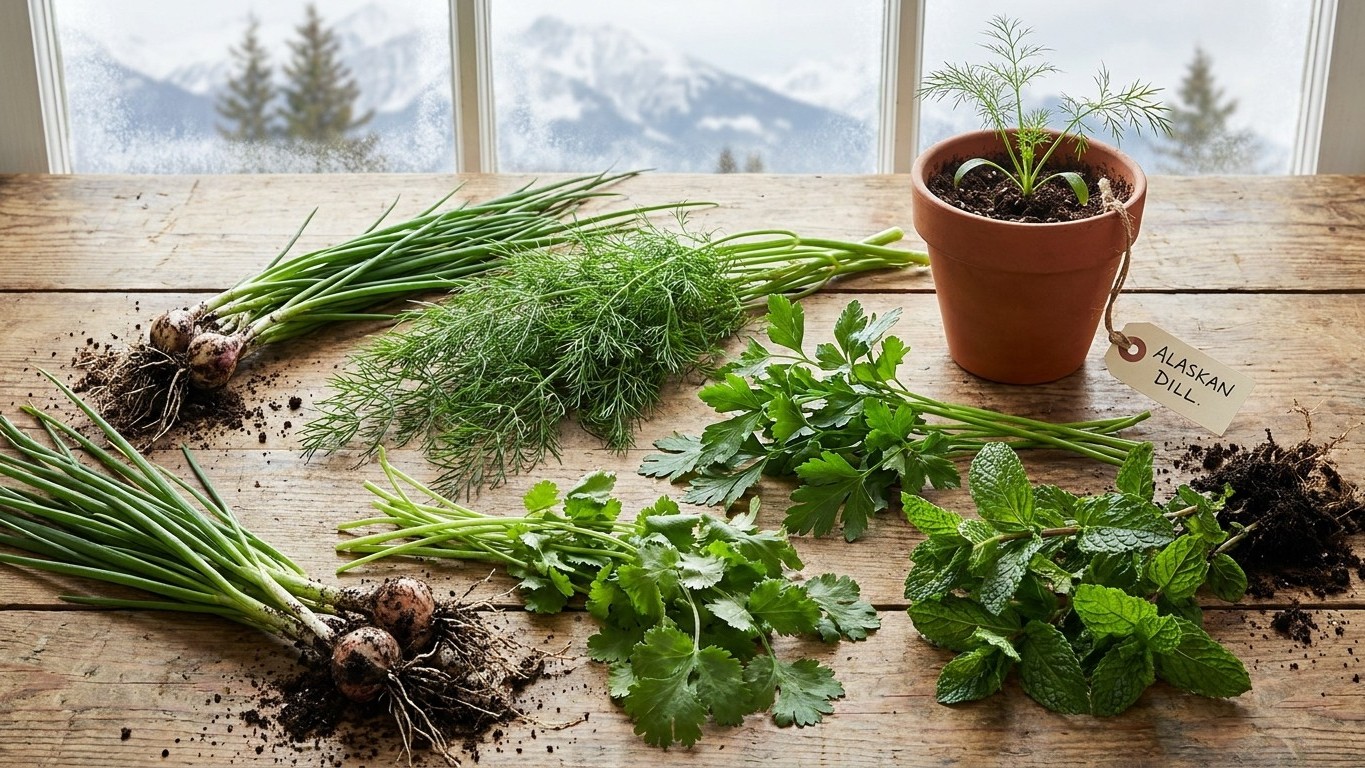

Utah’s answer depends on winter cold, not summer heat. Hardy perennial herbs like thyme, oregano, chives, and sage handle the state’s cold winters and short-to-moderate growing season without trouble. Tender herbs like basil and the woody Mediterranean types like rosemary need a warmer pocket, a longer frost-free stretch, or a pot you can move indoors.
The short answer for Utah
Split your herb list by how each plant handles cold, not by how pretty it looks in a catalog photo. Utah’s hardiness range runs from 4a to 9a under the USDA system, which is built on one number: the average annual extreme minimum temperature. That’s an enormous spread for one state, and it’s the first fact that should shape any herb decision here.
Using Salt Lake City as the reference point, the coldest month averages a daily minimum of 24.2°F. That figure, not the record low and not a seasonal average, is what decides whether a perennial herb survives the winter in the ground. Herbs rated hardy well into the 20s or lower, like thyme, oregano, chives, sage, and most mints, come through a Salt Lake winter without protection. Rosemary is the one everyone wants and the one that struggles: many rosemary varieties start showing damage below the mid-teens, and a 24.2°F average minimum means colder nights are common, not rare. Treat rosemary as a container plant you overwinter indoors unless you’re gardening in one of Utah’s genuinely mild zone 8-9a pockets in the southern part of the state.
Season length matters just as much. The last spring frost in the Salt Lake reference station falls between April 12 and April 29, and the first fall frost arrives between October 18 and October 29. That’s a frost-free window of roughly five and a half to six months in the valley, enough for a full run of tender annual herbs if you time planting correctly. But those dates describe probability, not certainty, and they apply to a mild valley station. Higher elevation and northern parts of the state see a shorter window on both ends.
| Herb type | How it fits Utah |
|---|---|
| Hardy perennials (thyme, oregano, chives, sage, mint) | Survive winter in most zones; plant once, harvest for years |
| Woody Mediterranean (rosemary, bay) | Container or warm-zone only; the coldest month usually beats them |
| Tender annuals (basil) | Full sun, full summer heat, plant after last frost only |
| Cool-season annuals (cilantro, dill) | Best in spring and fall shoulders; bolt in summer heat |
| Biennial (parsley) | Moderately cold-hardy; can overwinter in milder zones |
For most Utah gardeners, the practical mix is a permanent bed of hardy perennials plus a rotating cast of annuals timed to the frost window at their own address.
What will not work here

Basil planted on the calendar date that worked for a friend in a warmer state is the most common failure in Utah gardens. Basil has zero frost tolerance, and with the last spring frost landing anywhere from April 12 to April 29 depending on where you sit, a basil transplant set out in early April in a cooler pocket of the state gets hit by a freeze that a Salt Lake valley gardener never sees. The fix isn’t a different herb, it’s patience: wait until the frost-free window has actually opened at your address, not the state’s earliest date.
Rosemary left in the ground through a Utah winter is the second predictable failure. A 24.2°F average minimum for the coldest month sounds survivable on paper, but that’s an average, not a floor. Cold snaps that dip well below that average are routine in a state spanning zones 4a to 9a, and rosemary’s roots don’t get a vote on which winter shows up. Gardeners who insist on in-ground rosemary outside the warmest southern pockets are essentially replanting every spring, whether they mean to or not.
Cilantro and dill fail for the opposite reason: they can’t take Utah’s dry summer heat. Both are cool-season herbs that bolt, running up a flower stalk and turning bitter, the moment daytime temperatures push into the 80s and stay there. In a state where summer heat arrives hard and humidity stays low, a spring-planted cilantro crop is usually finished by early summer no matter how well it started. The workaround is succession planting: sow in early spring, again in late summer for a fall crop, and accept that midsummer is not cilantro season here.
Utah’s aridity also punishes any watering habit imported from a wetter state. A weekly watering schedule that keeps basil or parsley happy in a humid climate leaves those same shallow-rooted herbs stressed and bitter in Utah’s dry heat, where soil moisture disappears fast between waterings. Herbs with genuinely low water needs, like thyme, oregano, and sage, tolerate this. Herbs with high water needs, like basil and mint, need far more frequent attention than a once-a-week routine provides, especially in July and August.
What changes across Utah
A hardiness range of 4a to 9a means there is no single herb-growing climate in Utah. This is a state where a gardener in a high mountain valley and a gardener in the southwest corner are effectively growing in different countries, and no state-level answer covers both honestly.
Zone 4a sits at the cold end of that spread, typically at higher elevation and in northern or valley-bottom locations prone to cold air pooling. Gardeners there should expect a shorter frost-free window than the Salt Lake reference dates, colder winter lows than the 24.2°F average minimum used here, and a firm need to treat rosemary, bay, and other tender perennials as container plants without exception. Basil and other tender annuals also get a narrower planting window, since both frost dates shift toward the middle of the growing season.
Zone 9a sits at the warm end, generally in Utah’s southern lowlands, where winter lows rarely threaten hardy perennials and where rosemary has a real chance of surviving outdoors. Gardeners in that zone also get a longer effective season for tender annuals, since both the spring frost retreats earlier and the fall frost arrives later than the state’s cooler regions.
Everywhere in between, and there’s a lot of “in between” across zones 5, 6, 7, and 8, the practical move is to shift expectations toward the colder end unless local experience says otherwise. Don’t guess which zone applies to your yard from this article. The USDA Plant Hardiness Zone Map is built for exactly this question, and checking it against your own ZIP code takes less time than reading the rest of this article.
Where to check this for your own county
Utah’s state-level picture uses Salt Lake City as the reference station for frost dates and winter lows. That’s useful for a first pass, but it is not a substitute for county-level guidance, and a county recommendation will beat a state one every time.
Utah State University Extension is the resource built for that gap. It’s the state’s official land-grant extension office, and it publishes information organized by county rather than by the whole state’s average conditions.
Two things are worth looking for once you’re there. First, a local planting calendar for your specific county, which will translate the frost-probability dates into something calibrated for your elevation and microclimate rather than for the Salt Lake valley. Second, any list of herb or vegetable varieties that extension agents have actually trialled in your county’s conditions, since a variety that performs well in a mild valley can behave very differently at 6,000 feet.
If your county’s extension office publishes a herb-specific planting guide, that document should override the general zone-based reasoning in this article. State-level facts like the 4a-9a hardiness range and the Salt Lake frost dates are a starting point built from broad climate normals. County guidance is built from what actually grows there, which is the more useful number when it exists.
Checking this against your own garden
Frost dates and hardiness zones describe probability across many years, not the specific spring or fall happening in your yard right now. Your own observation, made with nothing more than your hands and eyes, outranks every date.
Start with soil warmth. Herbs like basil germinate and grow poorly in cold soil no matter what the calendar says, and warm soil is easy to check by feel: press a bare hand into the top few inches of your planting bed in mid-morning. If it feels cool rather than merely cool-ish, tender annual herbs will sit and sulk rather than grow, even past the average last frost date.
Watch your seedlings for their first true leaves, the second set to appear after the rounded seed leaves. That’s the signal a young herb plant has actually established roots and is ready for its first light feeding or for transplanting outdoors, rather than a fixed number of days after sowing.
Once summer heat sets in, watch cool-season herbs like cilantro and parsley for the first sign of a central flower stalk starting to rise from the center of the plant. That’s the plant telling you it’s bolting, and it’s a far more reliable signal to harvest or replant than any date, since the exact week bolting starts shifts with how hot your particular yard runs compared to the valley average used to build the state-level frost and temperature figures above.