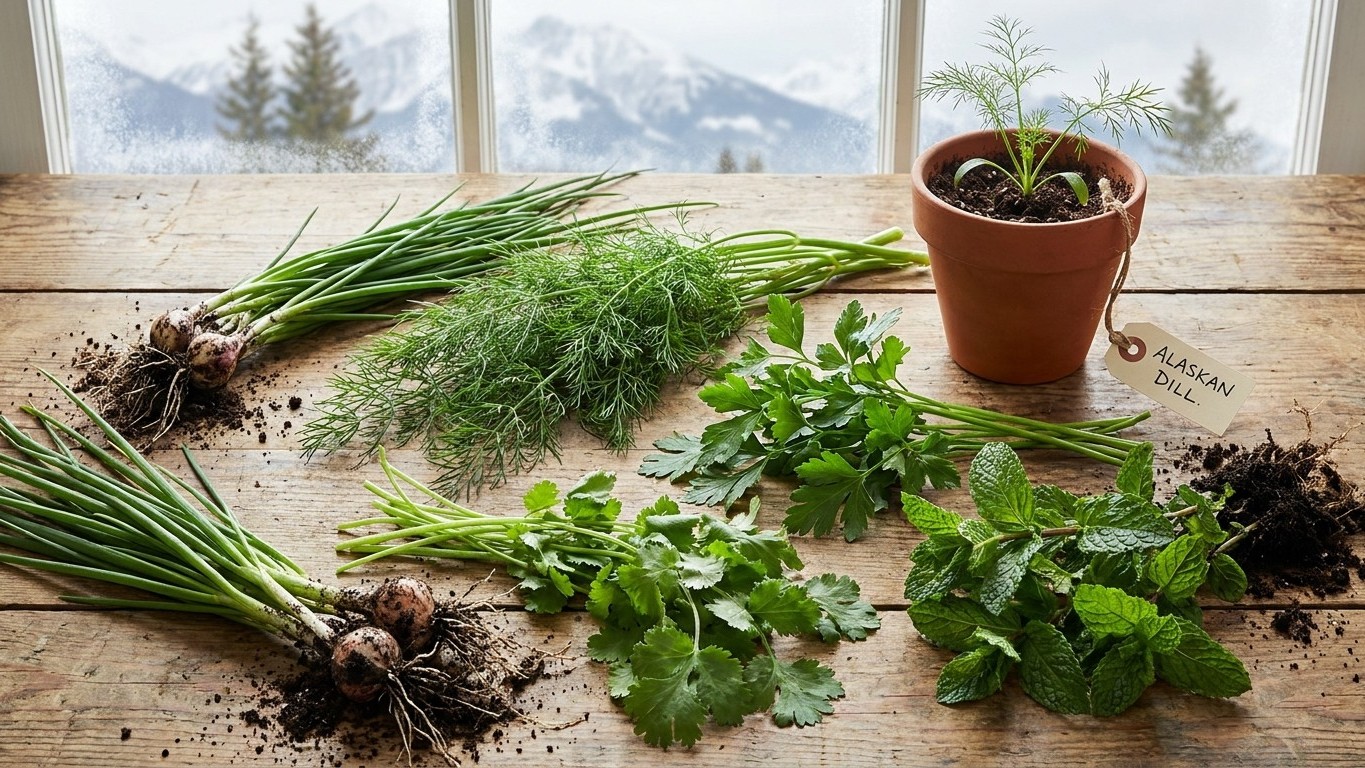

Virginia’s growing season runs long enough for nearly every kitchen herb worth planting: basil, dill, cilantro, parsley, and the whole Mediterranean crew of rosemary, thyme, sage, and oregano. The catch isn’t the calendar, it’s geography. A herb that overwinters happily in Virginia Beach can freeze solid in Floyd County the same January night.
The short answer for Virginia
Start with the numbers, not a wish list. Virginia’s last spring frost falls between March 20 and April 3, and the first fall frost arrives November 10 to November 24, based on NOAA’s 1991-2020 climate normals at the Oceana station. That’s a frost-free window stretching from roughly 220 to nearly 250 days depending on the year and the site. That’s long. Long enough to grow heat-loving annual herbs like basil, dill, and cilantro through multiple succession plantings, not just one shot in June.
For annuals, the decision is simple: anything that finishes in under 90 days (basil, dill, cilantro, most annual parsley) fits inside that window with room to spare, even accounting for a slow spring. Two or even three sowings of basil between May and August is realistic almost anywhere in the state, since each planting only needs about 60 to 75 days before first harvest.
Perennial herbs are a different calculation, and this is where Virginia’s numbers actually matter. The coldest month’s mean daily minimum runs 31.6°F at the Virginia Beach reference station, a mild coastal reading. That single figure tells you whether a plant merely survives an average winter night, not whether it survives an extreme one. Rosemary, borderline hardy at best, tends to make it through winters where nights don’t regularly dip into the teens. Near the coast, in the warmer end of the state’s 8b zone, established rosemary often persists as a shrub for years. Move inland or up in elevation, and that same plant is playing a much riskier game.
Thyme, sage, and oregano are the safer perennial bets across nearly the entire state. All three are rated hardy well into USDA zone 5, which covers even the coldest corners of Virginia’s mountain counties. Plant them once, mulch lightly, and they come back reliably from the Blue Ridge to the Chesapeake. If you want one perennial herb bed that doesn’t need rethinking every spring, build it around those three before you build it around rosemary or lavender.
What will not work here

Virginia’s growing season isn’t the obstacle for most herbs, which means the usual “too short a season” excuse doesn’t apply here the way it might further north. What actually trips people up is humidity, not day count. Basil, especially planted in tight rows or dense pots, is prone to downy mildew in the wet, sticky air that settles over much of the state from June through August. The fungus shows up as yellow patches on top of leaves with a fuzzy gray growth underneath, and once it’s established, no amount of extra sun fixes it. Wider spacing and morning watering (so leaves dry by midday) matter more here than they would in a drier climate.
Lavender is the other repeat disappointment. It’s not a frost problem, since lavender tolerates cold better than most gardeners assume. It’s a drainage and humidity problem. Virginia’s clay-heavy soils hold water, and lavender’s roots rot in soil that stays damp for days after a storm. Combine that with the humid summer air and you get a plant that looks fine in April, then declines through a soggy July before dying outright by fall. Raised beds with heavy sand or gravel amendment fix this in some yards, but a straight in-ground planting in unmodified clay is a losing bet almost anywhere in the state.
Rosemary left unprotected in the colder third of Virginia is the third predictable failure. The state’s hardiness range spans zone 5a to 8b, and rosemary’s cold tolerance runs out well before it reaches the 5a end of that spread. A shrub that survives outdoors year-round near the coast can die back to the ground, or die outright, in a single hard freeze in the mountains or the northern Piedmont. Treating rosemary as an annual, or bringing a potted plant indoors for winter, is the realistic plan outside the mildest zones.
Cilantro fails for a different reason entirely: heat, not cold. It bolts (runs to seed and turns bitter) once temperatures climb into the mid-80s, which happens early and often across most of Virginia’s summer. A late-May cilantro planting is often finished by mid-June. Growers who want a full season of leaves plant it in early spring, let it bolt in summer, then plant it again once fall temperatures cool back down.
What changes across Virginia
A hardiness range of 5a to 8b isn’t a narrow band, it’s nearly the entire practical range used across the eastern United States, compressed into one state. That spread means there is no single answer to “will this herb survive winter here.” A gardener near the coast is working with a genuinely different climate than one in the far southwest or up in the Blue Ridge, even though both live in Virginia and both read the same seed catalog.
The frost dates back this up. NOAA’s data, drawn from the Oceana coastal station, already carries a caution built into it: that station represents the mild end of the state. Inland and at elevation, both the last spring frost and the first fall frost shift by weeks, not days. A last frost that lands in late March near the coast can be a late-April or even early-May event in the mountains, and the first fall frost that hits the coast in mid-November can arrive in early or mid-October at higher elevations. That compresses the frost-free window considerably for anyone gardening above roughly 2,500 feet or in the state’s northwestern counties.
What that means practically: a coastal gardener can treat rosemary as a genuine perennial shrub and plan two clean basil successions with room to spare. A gardener in the mountains should treat rosemary as a plant to overwinter indoors or replace annually, and should watch the fall calendar closely rather than assuming a mid-November cutoff for tender herbs.
None of this is something to guess at from a general description of “Virginia.” The USDA Plant Hardiness Zone Map lets you look up hardiness zone by ZIP code, and it’s the tool to use rather than assuming your own zone from a state-level range. The zone that applies to a specific yard, not the state’s full spread, is what should drive any decision about leaving a perennial herb outdoors over winter.
Where to check this for your own county
Everything above is a state-level picture, built from one coastal weather station and a hardiness map that covers the entire commonwealth in a single range. That’s useful for a general sense of what’s possible, and it’s exactly why it shouldn’t be the last word for any individual garden. County-level guidance beats state-level guidance every time, because it accounts for local elevation, local frost pockets, and years of trial data specific to that area.
Virginia Cooperative Extension, run jointly by Virginia Tech and Virginia State University, is the source to check next. Its site, ext.vt.edu, organizes information by county office, and that’s the level of detail worth seeking out. Two things are worth looking for specifically once there: a local planting calendar adjusted for that county’s actual frost dates (which, as shown above, can differ from the coastal numbers by several weeks), and any list of herb or vegetable varieties that local extension agents have actually trialled in that county’s soil and climate.
That second point matters more than it sounds. A variety recommendation that’s been tested in a specific county’s clay, humidity, and frost pattern carries more weight than a general “grows well in zone 7” statement pulled from a seed packet. County extension offices often publish exactly this kind of localized variety data, sometimes down to which basil cultivar resisted downy mildew in a particular season’s trial.
This page gives the state’s shape: the broad frost windows, the hardiness range, and which herbs tend to succeed or fail across Virginia generally. It’s a starting point, not a final answer. The county office is where “generally” turns into “specifically, in your soil, this year.”
Checking this against your own garden
Dates on a page, even a well-sourced one, are averages built from decades of weather. Your own garden runs on its own schedule, and it tells you that schedule if you pay attention to three simple signals.
First, soil warmth by feel. Basil and other warm-season herbs germinate and grow slowly, or not at all, in cold soil, no matter what the calendar says. Push a finger a couple inches into the bed in spring; soil that still feels cool and damp like early April, even in May, means the ground hasn’t caught up to the air temperature yet, and warm-season herbs will sit and sulk if planted too soon.
Second, watch for the first true leaves on anything you’ve direct-sown. Seedlings push up their initial pair of rounded seed leaves first, but the second set, the “true leaves” that actually look like the mature plant’s foliage, is the sign the plant has real roots established and is growing on its own terms rather than living off the seed’s stored energy. That’s the point where a light feeding or thinning does some good.
Third, watch how fast cilantro or basil responds to a hot stretch. If cilantro starts sending up a central flower stalk within a few weeks of a run of 85°F-plus days, that’s your yard telling you its own bolt threshold, which can run earlier or later than a neighbor’s garden depending on shade, wind exposure, and soil. A gardener who’s paid attention to how their own cilantro behaves for one season knows their microclimate better than any regional frost map ever will.