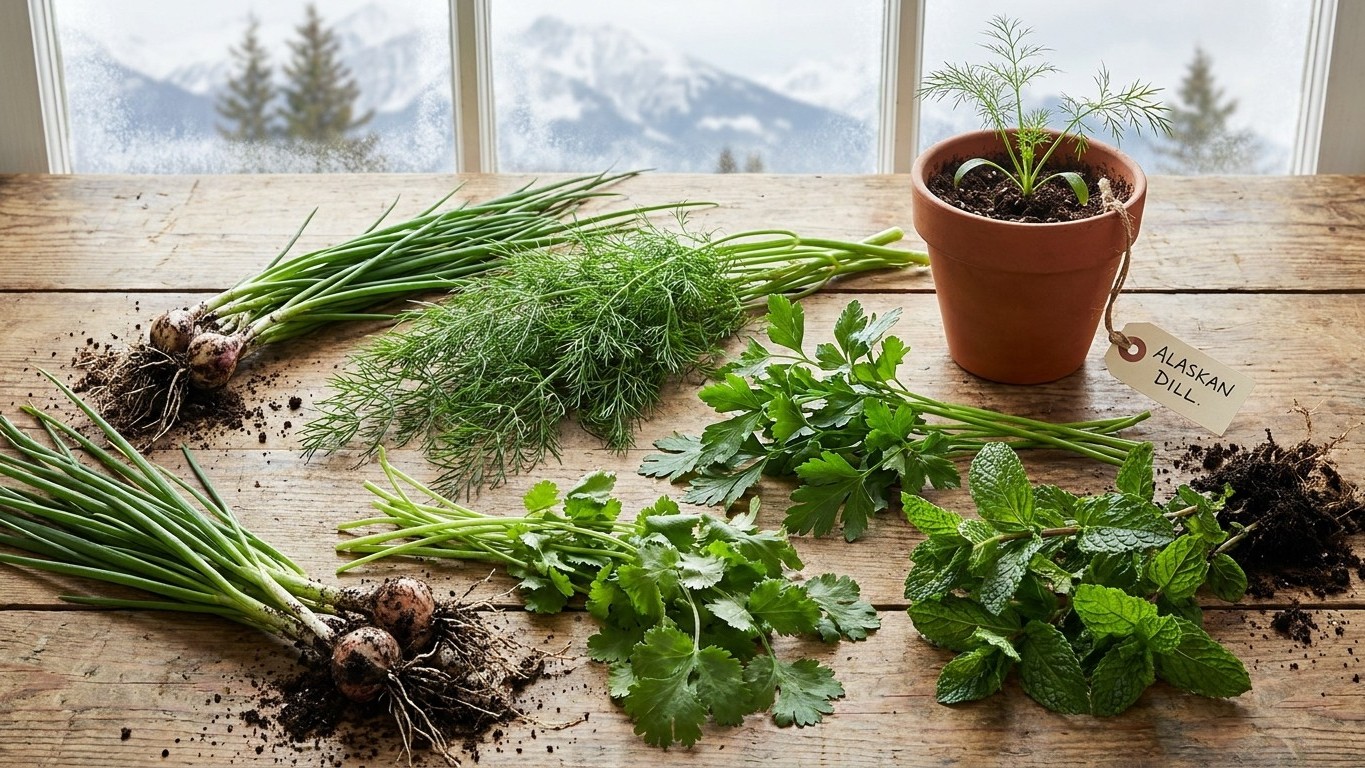

Wyoming’s short growing season and wide temperature swings favor cold-hardy, fast-maturing herbs. Chives, thyme, oregano, sage, mint, dill, and cilantro handle the state’s roughly 130 frost-free days and cold winters. Rosemary, bay, and lemongrass need protection or containers you bring indoors, because outdoor winters here go well below what those plants tolerate.
The short answer for Wyoming
Start with the calendar, because it dictates everything else. The last spring frost lands anywhere from May 7 to May 18, and the first fall frost arrives September 24 to October 5, based on NOAA’s 1991-2020 normals for station USW00024018. That’s a frost-free window of roughly 130 days at 6,000 feet, and the same NOAA data carries a blunt warning: at higher elevations, frost is possible in any month. This isn’t a state where you gamble on a long season.
That window sorts herbs into two workable camps. Quick annuals that mature or produce a usable harvest in 50 to 70 days, dill, cilantro, basil started under cover, fit inside the frost-free stretch without much drama. Slower annuals, especially basil varieties bred for humid Southern summers, run out of runway before the first fall frost shows up, particularly at elevation where that runway is even shorter.
The second camp is perennials, and here the decision hinges on winter, not summer. The coldest month’s mean daily minimum sits at 18.1°F, using Cheyenne as the reference station. That’s the number that predicts whether a perennial herb survives the winter outright, not just whether it looks sad in October. Combine that with a hardiness zone range of 3a to 6a under the USDA system, and you get a filter: perennial herbs rated hardy to zone 4 or colder, chives, most thymes, oregano, sage, mint, stand a real chance of coming back. Herbs rated for zone 7 or warmer don’t belong in open ground here, full stop.
So the short answer by type: lean on hardy perennials for the backbone of a Wyoming herb bed, fill in with fast annuals for variety, and treat anything Mediterranean-tender as a container plant you move indoors or replace every spring. That’s not a workaround, it’s just how the numbers land in this state.
What will not work here
Rosemary is the obvious casualty. Most rosemary cultivars are rated hardy to USDA zone 7 or 8, expecting winter lows nowhere close to the 18.1°F average minimum Wyoming logs in its coldest month, let alone the extreme lows that come with a 3a-6a zone spread. Left in the ground over winter almost anywhere in the state, rosemary dies. It’s a container herb here, brought inside before the first fall frost between September 24 and October 5.
Lemongrass and bay laurel fail for the same reason, just more predictably. Both are tropical or subtropical by origin, and neither has a realistic path through a Wyoming winter outdoors. If you want them, they’re patio pots that come in for the season, not garden plants.
Timing failures, not just cold failures
Basil trips up a different way. It’s frost-sensitive at both ends, and with a last spring frost that can run as late as May 18, transplanting basil outdoors in early May is a bet against the calendar. Wait for the frost date to clear, and even then, watch the forecast, because the NOAA caution on this station is explicit that frost can occur in any month at higher elevations. A single cold night in June has killed more basil in this state than any pest.
Slow-maturing herb varieties run into the other wall: the fall frost. Anything that needs 90-plus days from transplant to a meaningful harvest is racing a season that’s roughly 130 days long at best, and shorter at elevation. That includes some long-season parsley strains and certain seed-grown perennials that won’t establish enough root mass before the ground freezes. If a seed packet’s maturity date pushes past mid-September assuming a May planting, it’s a poor fit without row cover or a cold frame extending both ends of the season.
Finally, don’t assume a dry Wyoming summer behaves like a dry Texas one. The failure mode here isn’t heat stress from triple-digit days, it’s the swing: warm, often windy days followed by nights that can still dip low enough to stress tender seedlings, especially early and late in the season. Herbs planted on a “set it and forget it” watering schedule modeled on a milder climate tend to either dry out between waterings or sit too wet if the schedule doesn’t account for how fast wind pulls moisture out of raised beds.
What changes across Wyoming
A hardiness range of 3a to 6a isn’t a rounding error, it’s close to the full width of USDA’s cold-hardiness scale for the temperate US. There is no single answer for “will this herb survive winter in Wyoming,” because a plant that sails through in a 6a pocket can die outright in a 3a one. That’s the honest starting point for this section: the state doesn’t have one climate, it has several, stacked mostly by elevation and latitude.
Areas trending toward the warmer end of that range, roughly matching the Cheyenne reference station’s profile with its 18.1°F coldest-month minimum, give a gardener more room to experiment with borderline perennials like some oregano or thyme cultivars near the edge of their hardiness rating. Push north or up in elevation toward the 3a end of the spread, and that margin disappears. The same thyme that overwinters fine in one part of the state can die back to the roots, or die completely, thirty miles away and a couple thousand feet higher.
Elevation does double duty here. It doesn’t just push the hardiness zone colder, it also shortens the practical frost-free window below the roughly 130 days already noted for the reference station, and it raises the odds of an out-of-season frost hitting in June or August. A reader gardening at higher elevation should treat the state’s frost dates as optimistic and lean harder on row cover, cold frames, or simply starting herbs later and pulling them earlier than the calendar dates suggest.
None of this can be resolved from a state-level page, and it shouldn’t be. If you don’t already know which part of that 3a-6a range you’re in, the USDA Plant Hardiness Zone Map is the tool, not a guess based on how cold last winter felt.
Where to check this for your own county
The state-level facts on this page are a starting point, not a final answer. For anything more specific, the right stop is the University of Wyoming Extension, the land-grant extension service for the state. This page draws on statewide climate normals; a county office draws on what’s actually been trialed and observed on the ground where you live.
Two things are worth looking for specifically when you get there. First, a county-level or regional planting calendar, if one exists, that translates the statewide frost-date range (May 7 to May 18 for last spring frost, September 24 to October 5 for first fall frost) into something narrower for your elevation and microclimate. Second, look for any lists of herb or vegetable varieties that extension staff or master gardener programs have actually trialed locally. A variety that performs well in a university test plot near your county carries more weight than a general hardiness rating printed on a seed packet.
It’s worth saying plainly: a county recommendation beats a state one, every time. This page works from statewide NOAA normals and a hardiness zone range spanning most of the USDA scale. That’s useful for understanding the general shape of the challenge, quick annuals versus hardy perennials, short season versus severe winter, but it can’t tell you what happens in your specific soil, at your specific elevation, behind your specific windbreak or lack of one. Extension offices exist precisely to close that gap, and in a state with this much internal climate variation, that gap matters more than it would somewhere flatter and more uniform.
If your county doesn’t publish its own calendar, the statewide extension office can usually point you to the nearest one that does, or to a master gardener volunteer who’s grown herbs in conditions closer to yours than any national dataset can capture.
Checking this against your own garden
Every date on this page is a probability built from thirty years of averages at one weather station. Your own garden will tell you something more current and more local, if you know what to watch for.
Start with soil warmth, checked by hand rather than by calendar. Push a finger a few inches into the bed in spring. If the soil still feels cold and damp rather than merely cool, seeds like cilantro and dill will sit and sulk regardless of what the frost-date range suggests, and transplants like basil will stall or yellow. Warm, crumbly soil that feels closer to room temperature is the better cue than any date on a chart.
Second, watch how fast seedlings push their first true leaves, the second set that looks like the actual adult plant rather than the rounded seed leaves. A quick, vigorous emergence of true leaves within a week or two of the seed leaves means the microclimate in that particular bed is running warm and favorable. A long stall between seed leaves and true leaves is a sign that spot is colder or shadier than the rest of the yard, useful information for where to place tender herbs next year.
Third, for perennials like chives, thyme, oregano, and sage, watch what comes back at the base of the plant once the soil thaws. Vigorous new growth low on the crown means that plant made it through winter in that spot with room to spare. Weak, sparse regrowth, or none at all, is the garden telling you that particular location sits closer to the harsher end of your local hardiness range than the state average suggests, and it’s worth noting for next season’s planting choices.