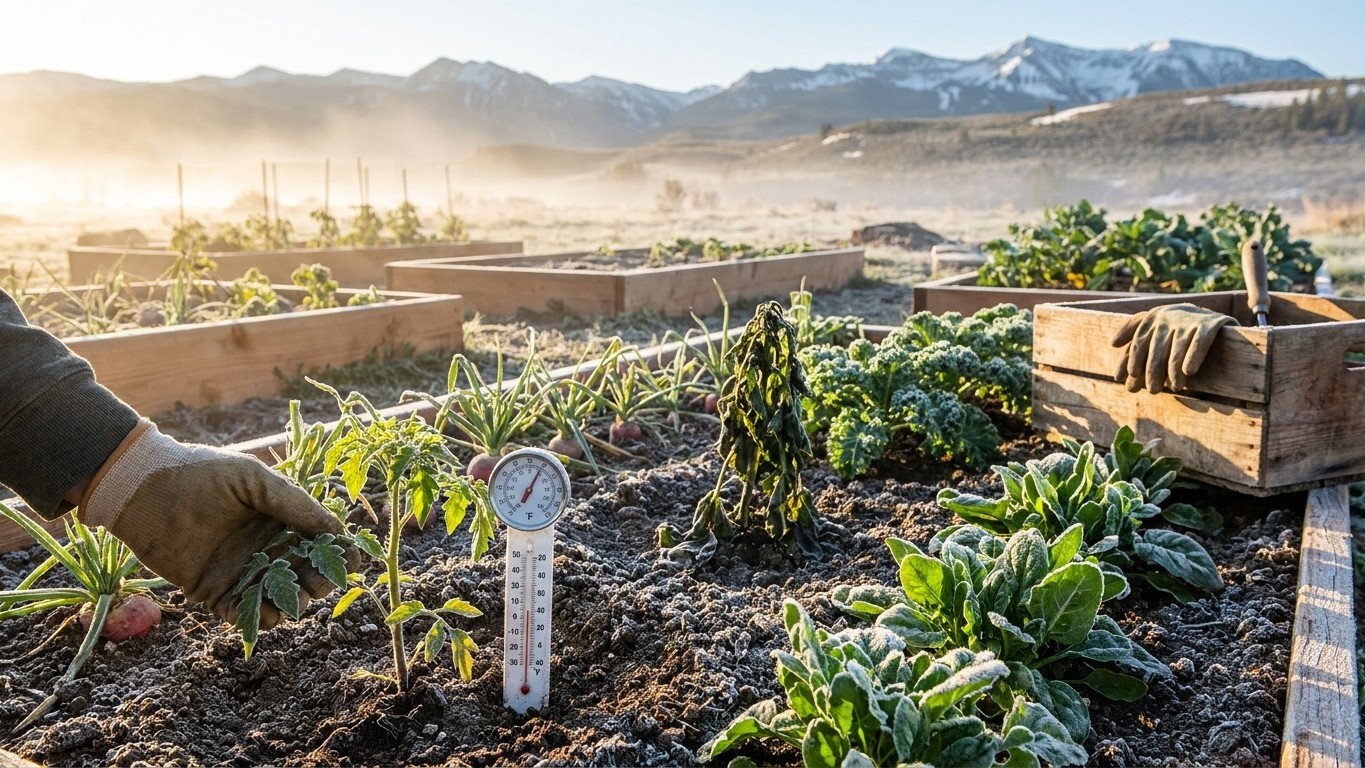

Ask what a Wyoming garden can actually pull off, and the answer starts with three numbers: a hardiness zone that spans 3a to 6a, a last spring frost that lands sometime between May 7 and May 18, and a first fall frost arriving September 24 to October 5. Do the math and you get a frost-free window that rarely stretches past four months.
How long your season really is

Subtract the early date from the late one and you land on roughly 130 to 150 frost-free days, depending on where in that spring window you fall and where in the fall window the first hard freeze shows up. That’s the number that governs everything else. It’s not a suggestion, it’s a ceiling. A 90-day tomato variety fits inside it with room to spare, and it’s also why Growing Peppers in Wyoming tends to hinge on starting transplants early rather than direct-seeding. A 100-day winter squash is cutting it close in a bad year, and Growing Pumpkins in Wyoming in particular means planning backward from that fall frost date, since knowing When to Carve a Pumpkin in Wyoming starts with getting the planting date right. That same short window is exactly why Growing Potatoes in Wyoming tends to favor early varieties over long-season ones, and it’s also short enough that Growing Carrots in Wyoming works best with quicker-maturing varieties sown in succession rather than one long-season crop. Anything that needs 120 days or more from seed to harvest, think certain heirloom melons or long-season dry beans, is asking for a season Wyoming doesn’t reliably deliver. On the other end of the spectrum, Growing Sweet Corn in Wyoming is a good fit for that same frost-free window, since most varieties mature well within 60 to 90 days and leave a comfortable margin on either side.
Those dates come from NOAA’s 1991-2020 climate normals for station USW00024018, and they’re built on a 30 to 70 percent probability band for a 32F freeze. That detail matters more than it sounds. A frost date isn’t a line the calendar respects. It’s a midpoint. Half of all years on record saw frost arrive later than May 18 in spring, or earlier than September 24 in fall. Planning around the average date means you’re planning to lose the argument roughly half the time, which is exactly why Growing Spinach in Wyoming makes so much sense: it tolerates a light frost on either end and doesn’t need the full season to produce a harvest. The same logic applies to Growing Beets in Wyoming, since beets shrug off a light frost and mature well within even the shortest of these windows, and it’s the same reason Growing Asparagus in Wyoming pays off over time: as a hardy perennial, it pokes through in early spring well before the average last frost and simply shrugs off the cold snaps that follow windows, and it’s the same reasoning behind Growing Parsnips in Wyoming, a root crop that actually improves in flavor after a hard frost sweetens the roots frost-free windows.
Elevation makes this worse in the parts of the state that sit highest. At around 6,000 feet, growers are working with something closer to 130 frost-free days, and frost itself can show up in any month once you’re up in the higher country. That’s not an exaggeration for effect, it’s a documented feature of high-altitude climate. It means row cover, cold frames, and season-extension tunnels aren’t a nice-to-have for a Wyoming gardener. They’re closer to standard equipment.
None of this rules out a productive garden. It rules out treating Wyoming like a Zone 7 climate with better mountain views. Short-season varieties, transplants started indoors well ahead of the last frost, and a willingness to protect plants on either end of the calendar are what turn a 130-day window into a real harvest.
What the summer does to a garden here
The reference station at Cheyenne averages 10.4 days a year at 90F or hotter. That’s not a brutal number by national standards, but it’s enough to reshape how a garden behaves in the thick of summer. Tomatoes stop setting fruit once temperatures climb much above 90F, the flowers drop instead of pollinating. Lettuce and spinach bolt and turn bitter in that same heat. Cool-season crops that thrived in May simply can’t be grown in the same bed in July.
The other half of the picture is the cold side. The coldest month at Cheyenne averages a daily minimum of 18.1F, and that figure is what actually determines whether a perennial, a shrub, or a fruit tree survives the winter here at all. It’s not the record low anyone remembers from a bad year, it’s the typical nightly floor during the coldest stretch, and it’s the number that separates plants rated for this climate from plants that will die here on a normal winter, not just an unusual one.
Put those two numbers together and a pattern emerges. Wyoming’s growing year isn’t one long stretch of steadily rising and falling temperatures. It behaves more like two workable seasons, a spring push and a late-summer push, with a stretch in the middle where heat suppresses the cool-season crops and the frost-free window hasn’t given the long-season crops enough runway yet. Gardeners who plant lettuce in spring, let it finish before the heat hits, and then plant a second round in late summer for a fall harvest are working with the climate instead of against it. That rhythm, two shoulder seasons bracketing a hot middle, is a more honest way to picture the Wyoming growing year than “spring to fall.”
What tends to go wrong in Wyoming
The University of Wyoming Extension’s home vegetable garden guide names a specific set of pests that home gardeners in the state actually deal with, not a generic list pulled from a national pest chart. A few of them show up on a predictable schedule.
- Potato psyllid: moves onto wild host plants around mid-May, and its feeding causes psyllid yellows on potato and tomato, a condition that stunts growth and discolors foliage well before tubers or fruit form.
- Flea beetles and cutworms: early-season problems, hitting young transplants and seedlings hard enough to end a planting before it gets established.
- Colorado potato beetle: a mid-summer regular on potato foliage, capable of stripping leaves down to bare stems if it’s left unchecked.
- Grasshoppers: a late-summer pressure that builds through the hottest, driest stretch of the year and can move through a garden fast once numbers climb.
That’s four, not twenty. The extension’s fuller list also includes aphids, sugarbeet root aphid on table beets, blister beetles, cabbage worms, hornworms, root maggots, Mexican bean beetle, and garden slugs, and none of those are absent from the state, they’re simply less universal than the four above. The point isn’t to memorize every name on that list. It’s to know that pest pressure in Wyoming follows the same rhythm as the growing season itself, an early wave tied to transplanting, a mid-summer wave tied to established plants, and a late wave tied to heat and dryness. Positive identification and any treatment decision belong with the county extension office, not a general guide.
Where to check before you plant
Every figure above is a state-level average, and Wyoming is not a state where that average holds evenly. A hardiness zone range of 3a to 6a means the coldest pockets and the mildest pockets of the state are separated by more difference than most gardeners assume from a single number. The frost dates cited here come from one reference station. A planting calendar built around that station can run two or three weeks off at either edge of the state, and at higher elevations, the gap can be wider still.
That’s exactly what a land-grant extension service exists to correct. The University of Wyoming Extension maintains county-level offices that track local frost dates, soil conditions, and pest pressure specific to that part of the state, not the statewide blend. A gardener outside Cheyenne is working with a different frost calendar than one at 7,000 feet in a mountain valley, even though both fall under the same state-level hardiness range.
Before committing a planting date, a variety choice, or a pest treatment to memory, the county extension office is the place that turns a state-level estimate into something usable on a specific plot of ground.