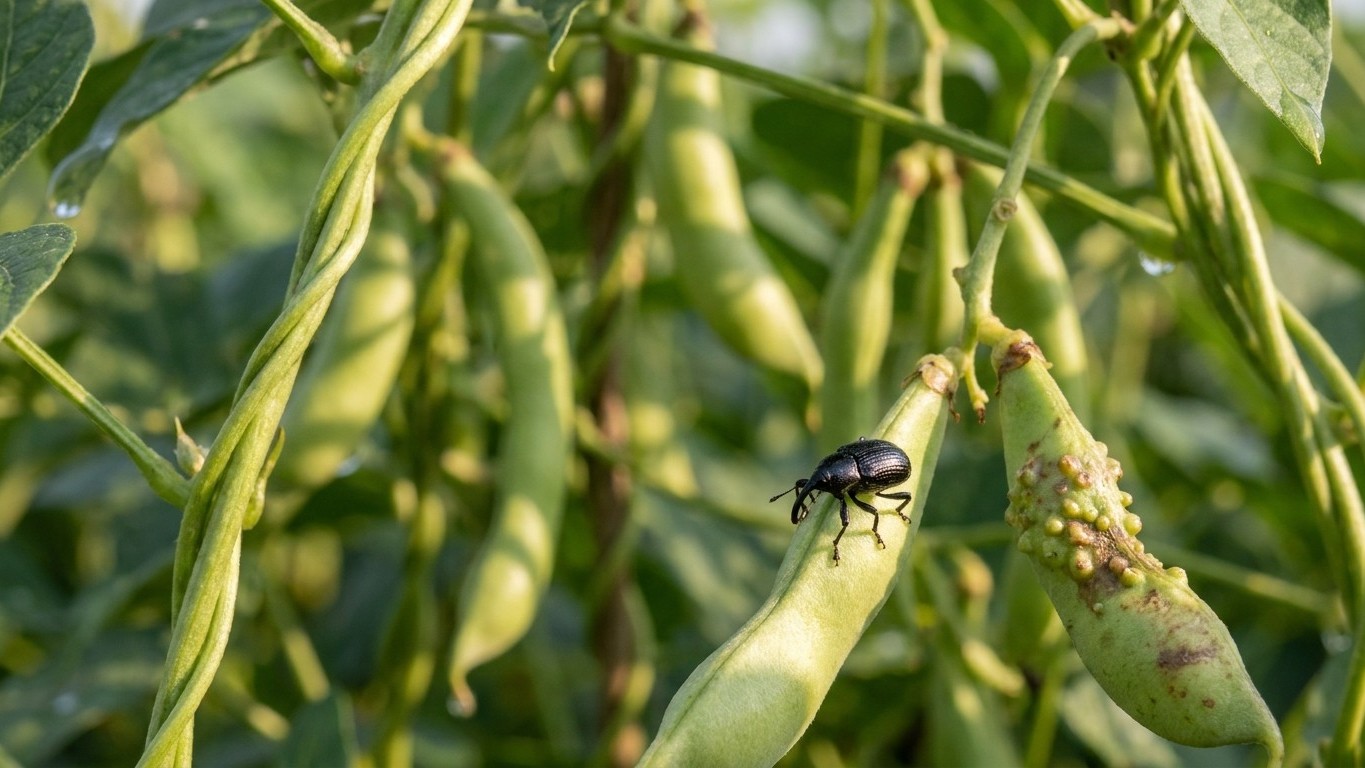

Cowpea curculio shows up in Louisiana gardens and fields as soon as cowpeas, black-eyed peas, and other southern peas start setting pods, typically from late May through the end of the growing season. The insect thrives in the state’s warm, humid climate, and because Louisiana growers often plant two rounds of southern peas each year, the pest gets multiple chances to build up numbers before frost. Stopping it means combining early detection, timely insecticide applications, and cleanup practices that break its life cycle between seasons.
What Cowpea Curculio Looks Like and What It Damages

The adult is a small, shiny black snout beetle, roughly the size of a match head, with a curved, weevil-like snout that makes it easy to distinguish from other bean pests once you know to look for it. It moves slowly and often drops to the ground or plays dead when disturbed, a defense trick that can make it hard to spot during a quick field walk.
Damage comes from two directions. Adults chew small pits into pods and stems, but the real economic loss happens underneath the surface. Females drill tiny holes into developing pods and lay eggs inside the seeds themselves. The larvae that hatch feed inside the pea, hollowing out the interior and leaving behind grubs that are impossible to see from the outside until you shell the peas. Infested pods often develop small, warty, discolored bumps on the surface, a telltale sign that something is feeding inside.
This hidden feeding pattern is what makes cowpea curculio frustrating for home gardeners and commercial growers alike. A pod can look perfectly fine on the vine and still be worthless once shelled, because the larva has already eaten through several peas inside a single pod. In heavily infested fields, growers can lose a large share of a harvest to interior damage that never shows up until it’s too late to salvage.
Life Cycle: Why Timing Drives Control in Louisiana
Cowpea curculio overwinters as an adult, tucked into leaf litter, crop debris, or the edges of wooded areas near fields. When spring temperatures warm the soil, adults become active and start searching for host plants. Southern peas are the preferred host, but adults will also feed on related legumes if peas aren’t yet available.
Once pods begin to form, females lay eggs directly into the developing seeds. Larvae feed inside the pod for roughly two to three weeks before chewing their way out, dropping to the soil, and pupating a few inches underground. New adults emerge within a few weeks, ready to start the cycle again on a later planting or a neighboring field.
In Louisiana’s long growing season, this cycle repeats two to three times between spring and fall. That’s the key difference between managing this pest here versus in cooler states further north, where a single generation may be all growers have to contend with. Each successive generation in Louisiana tends to build on the population left behind by the last one, which is why fields planted later in the summer often see heavier pressure than early spring plantings.
Peak Activity Windows
Based on the pest’s biology, Louisiana growers typically see the first wave of adult activity in late spring as pods begin forming on early plantings. A second, often larger, wave follows in mid to late summer as the first generation’s offspring emerge and find a fresh crop of pods on later-planted peas. Fields planted in July or August without any intervention frequently carry the highest curculio numbers of the year, since the pest population has had two full generations to multiply.
Cultural Practices That Reduce Populations Before They Start
Sanitation matters more with this pest than with many other bean insects, because the adults overwinter so close to where they fed the previous year. Removing and destroying old pea vines and fallen pods right after harvest deprives adults of the sheltered debris they need to survive winter. Leaving a field littered with spent vines essentially builds the pest a home for the cold months.
Rotating southern peas away from the same plot for a season or two also helps, since it forces overwintering adults to travel farther to find a host, and travel increases their exposure to predators, weather, and starvation. Where rotation isn’t practical, at minimum till the soil after harvest to disturb pupae resting a few inches underground; disrupting that pupation zone kills a portion of the next generation before it ever becomes a flying adult.
Staggering planting dates can work against growers here rather than for them. Because later plantings coincide with peak adult activity from earlier generations, pushing a crop later in the season without added protection tends to concentrate curculio damage rather than avoid it. Growers aiming for a fall harvest of southern peas should plan on more aggressive monitoring and treatment than they would for a spring crop.
Monitoring: Catching the Problem Before Pods Are Ruined
Because the larval damage is invisible until the pod is opened, monitoring has to focus on adults and early pod symptoms rather than waiting for obvious crop loss. Walking rows early in the morning, when adults are less active and more likely to be sitting still on pods or stems, gives the best chance of spotting them. A simple beat-sheet method, gently shaking a few plants over a light-colored cloth or tray, can reveal how many adults are present per row.
Checking pods for the small puncture marks left by egg-laying females is another useful signal. Those punctures often show a slightly discolored ring around a pinhole-sized opening. Finding several punctured pods in a sample area is a signal to treat before the next generation of larvae hatches and burrows deeper into the crop.
Shelling a random sample of pods from different parts of the field, particularly if damage is suspected but adults haven’t been seen in large numbers, remains one of the most reliable ways to confirm an infestation. If more than a small fraction of peas inside sampled pods show grub damage, treatment decisions for the next planting should assume pressure is already established in that field.
Insecticide Timing and Practical Application Notes
Once populations are confirmed, insecticide applications need to target adults before they lay eggs, since sprays have no effect on larvae once they’re sealed inside a pod. That makes timing far more important than product choice. Applications made as soon as pods begin to form, and repeated on a schedule through the pod-set period, catch adults while they’re still exposed on the plant surface rather than protected inside developing peas.
Louisiana State University’s AgCenter, along with other regional extension services, recommends scouting-based spray decisions rather than calendar sprays, since curculio pressure varies significantly from field to field and year to year depending on how much overwintering habitat was left nearby. Growers who spray on a fixed schedule regardless of scouting results often either waste applications on light-pressure years or under-treat during heavy outbreak years.
Home gardeners managing a small patch of southern peas have fewer product options than commercial operations, but the same principle applies: treat at first sign of adult activity or pod punctures, not after larvae have already tunneled in. Rotating between different insecticide classes, when using more than one product across a season, helps slow the development of resistance in a pest that already produces multiple generations per year in Louisiana’s climate.
Resistant Varieties and Long-Term Field Strategy
Some southern pea varieties show measurably lower curculio damage than others, largely due to pod texture and thickness, which can make it harder for females to drill successful egg-laying punctures. Extension trial data from the Gulf South region has identified varietal differences in susceptibility, though no widely available commercial variety offers complete resistance. Choosing a less-susceptible variety can reduce, not eliminate, the need for insecticide intervention.
For growers dealing with recurring, severe infestations year after year, the most effective long-term shift is treating cowpea curculio as a field-level problem rather than a single-season one. Debris removal, rotation, and post-harvest tillage compound their benefits over consecutive seasons, gradually lowering the overwintering population available to start each spring’s cycle. A field that’s been cleaned up and rotated for two or three years typically starts the season with noticeably lighter pressure than a field where vines and pods were left to decompose in place.
Woodland edges and hedgerows bordering pea fields deserve attention too, since they often provide the exact kind of sheltered leaf litter adults use to overwinter. Clearing or mowing a buffer strip along those edges before winter sets in removes one more refuge the pest depends on to survive Louisiana’s mild, but not always freezing, winters.