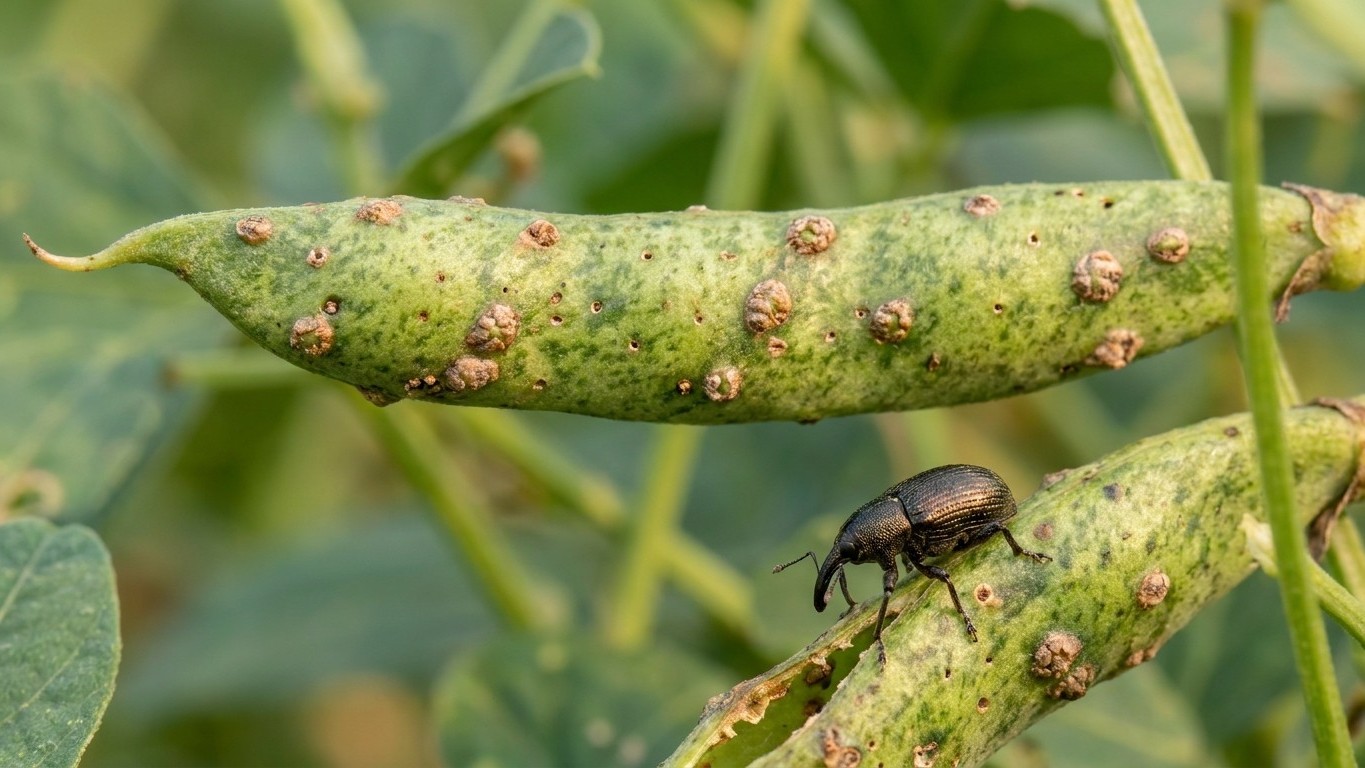

Cowpea curculio damage in Alabama typically starts showing up in mid-to-late June, once cowpea and southern pea pods begin filling out, and it keeps building through August as multiple generations overlap. The weevil itself, a small bronze-black beetle with a curved snout, overwinters in soil and old vine debris near last year’s pea patch, then walks or flies into new plantings once soil temperatures warm. Breaking its life cycle comes down to three things: destroying crop residue right after harvest, rotating pea plantings away from last year’s field, and timing insecticide applications to bloom and early pod set rather than waiting until pods already show the telltale warty scars.
What the Cowpea Curculio Looks Like and How It Damages Pods

Adult cowpea curculios (Chalcodermus aeneus) measure about 1/5 inch long, dark and shiny, with the downward-curving snout typical of weevils. They’re easy to miss on a quick walk through the garden because they drop off plants and play dead the moment a leaf shakes. That defensive habit, called thigmotaxis, is actually one of the easiest ways to confirm you have them: tap a few pods over a white bucket or sheet, and if beetles fall off and lie motionless, you’ve found your culprit.
The real damage happens after mating, when females chew small holes in developing pods and lay eggs inside. The larvae feed on the seeds within, and the visible sign on the pod surface is a raised, warty, discolored bump, often described by growers as looking like the pod has a small tumor. Cut open an infested pod and you’ll usually find a grub tunneling through one or more peas, sometimes with a dark stain trailing from the entry hole. Peas that survive are frequently unmarketable, and seed saved from infested pods often carries hidden larvae that emerge weeks later in storage.
Why This Pest Matters More in the Southeast
Cowpea curculio is essentially a regional specialist. It ranges through the Southeastern United States and causes far more consistent damage in states with long, humid growing seasons, Alabama, Georgia, South Carolina, and parts of the Gulf Coast among them, than it does farther north. The extended warm season here allows for several overlapping generations rather than just one, which is the main reason infestations that look manageable in June can spiral by August.
When It Shows Up in Alabama, Season by Season
Overwintering adults emerge from soil and leaf litter as temperatures climb in spring, generally April into May across most of the state, though timing shifts a couple of weeks earlier in south Alabama compared to the Tennessee Valley region up north. These first adults feed lightly on foliage and stems before cowpea plants set the first flowers, causing damage that’s mostly cosmetic at this stage.
The real pressure builds once pods start forming, usually by mid-June for spring-planted cowpeas and southern peas. Females target young, tender pods for egg-laying, and because the life cycle from egg to adult can complete in about a month under Alabama’s summer heat, a single planting can face two or three generations before the last pods mature. That overlap is what makes late-summer plantings especially vulnerable: a field planted in June faces a population that’s already several generations deep by the time its pods develop in August, compared to an April planting that gets ahead of the worst pressure.
Activity tapers off with the first cool nights of fall, typically late September or October depending on the year, when adults seek out soil, plant debris, and leaf litter to overwinter. That overwintering habit is the single biggest reason cultural control works so well against this pest, because the population has nowhere to hide if the debris it depends on gets removed.
Cultural Controls That Break the Cycle
Because cowpea curculio spends the winter in the soil and crop residue right where last season’s peas grew, the most effective long-term fix has nothing to do with sprays. It’s sanitation and rotation.
- Pull and destroy vines immediately after the last harvest instead of leaving them to break down in the field, since intact residue shelters overwintering adults.
- Rotate cowpeas, southern peas, and black-eyed peas to a different part of the property each year, ideally at least 100 to 200 feet from the previous plot, since adults have limited flight range early in the season.
- Deep-till or turn the soil after removing residue to expose overwintering adults to predators and temperature swings.
- Clear nearby wild legume hosts, particularly partridge pea and other native Chalcodermus-attracting plants along fence lines, since these serve as a bridge population between growing seasons.
- Harvest promptly and don’t let mature, over-ripe pods sit on the vine, since older pods draw heavier egg-laying pressure.
None of these steps eliminate the pest completely in a region where it’s already established across the landscape, but combined they can cut populations enough that chemical intervention becomes a backup rather than the main plan.
Variety Choice Has Limited Impact
Unlike some legume pests, cowpea curculio doesn’t have widely available resistant cowpea varieties that solve the problem on their own. Pod texture and maturity timing can influence pressure somewhat, with quicker-maturing varieties sometimes slipping through a window of lower adult activity, but growers shouldn’t expect variety selection alone to prevent damage in a heavily infested area.
Monitoring and Chemical Control Timing
Scouting matters more with this pest than with many garden insects, because by the time visible pod damage appears, the eggs are already laid and the larvae are already feeding inside, out of reach of any spray. The window that actually matters is bloom through early pod set, before pods reach about an inch long.
A simple sweep-net check, or the drop-and-play-dead test with a white sheet under the plants, done two or three times a week starting at first bloom, gives a much better read on population buildup than waiting for warty pods to show up. Once adults are consistently found during scouting, that’s the signal to treat, not after damage is already visible on maturing pods.
Insecticide applications timed to bloom and the earliest pod formation interrupt egg-laying before larvae get established inside the pod wall, where no topical treatment can reach them. Because Alabama’s warm season allows several generations, a single spray round often isn’t enough; growers managing a known infestation typically plan for repeat applications on a schedule tied to bloom cycles through the pod-filling period, then stop once the crop nears the end of harvest. Any product choice and application interval should follow label directions and preharvest interval requirements exactly, since these vary by active ingredient and by whether the crop is intended for fresh eating or seed saving.
Home gardeners managing just a few rows sometimes get more practical value out of hand-picking adults during the early morning cool, when the beetles are sluggish and easier to knock into a container of soapy water, combined with the sanitation steps above, than from a spray program calibrated for field-scale production.
Which Crops in Alabama Gardens Are at Risk
Cowpea curculio isn’t picky within the legume family. Southern peas, black-eyed peas, crowder peas, and field peas, the crops most Alabama home gardeners actually call “cowpeas,” are the primary hosts, but the pest will also attack snap beans and lima beans when cowpeas aren’t available nearby. Gardens that rotate cowpeas with unrelated crops like tomatoes, squash, or corn see noticeably less carryover pressure than gardens that plant peas or beans in the same bed year after year.
One detail that surprises a lot of gardeners: seed saved from an infested planting can look perfectly fine on the outside while still harboring a larva that finishes development in storage. That’s why growers who plan to save cowpea seed for next season should inspect a sample by cutting a handful of dried peas open before committing an entire batch to storage, since a hidden infestation in stored seed reintroduces the pest into next year’s planting no matter how clean the field was otherwise.