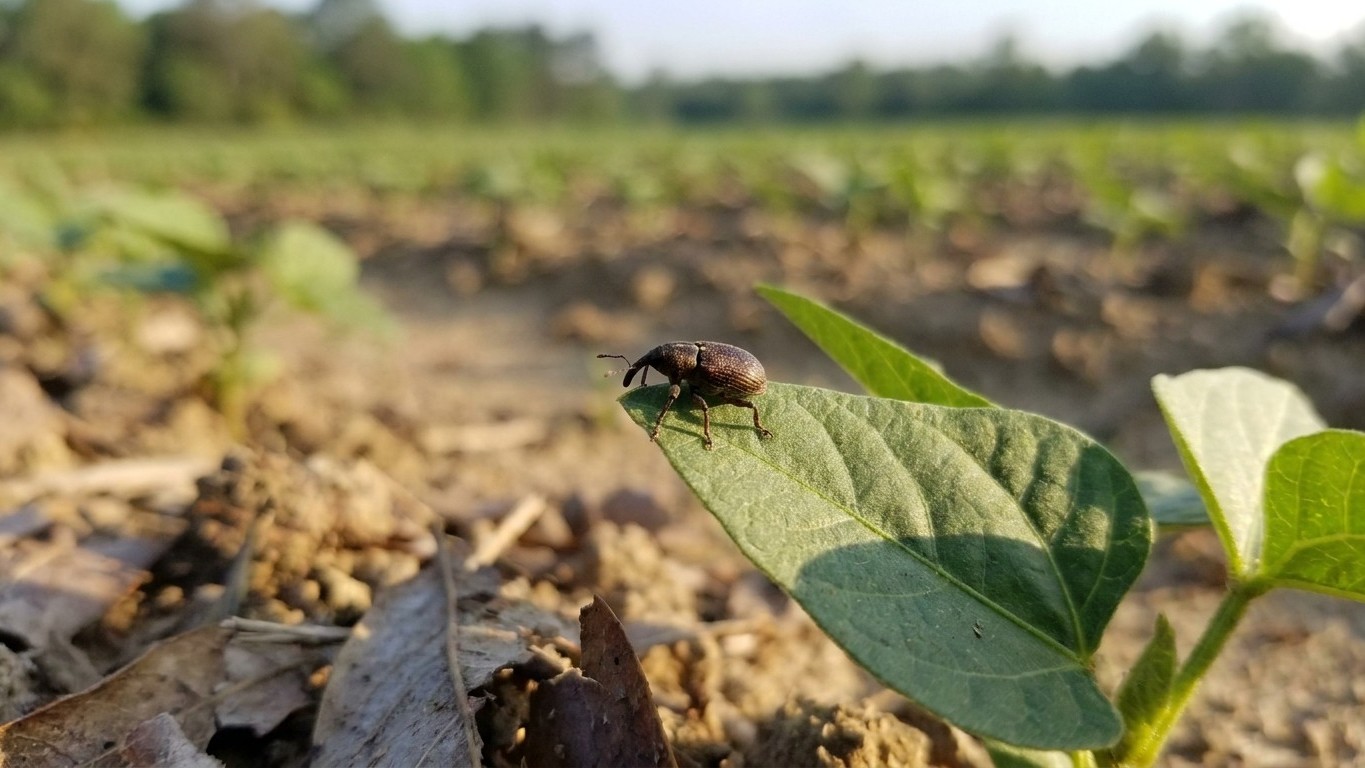

Cowpea curculio activity in Georgia typically kicks off in late April to early May in the southern part of the state, once soil temperatures climb into the 60s, and it keeps going through September in a good year. The pest overwinters as an adult beetle tucked into leaf litter and field edges, so anywhere cowpeas, southern peas, or black-eyed peas have grown in past seasons is a candidate for early, heavy infestation. Growers in the Coastal Plain, from Tift County down through the Wiregrass region, see the worst pressure because the growing season there stretches long enough for two or three generations to stack up.
Stopping it comes down to timing insecticide applications to adult emergence and egg-laying, before pods form, combined with destroying crop residue right after harvest so overwintering beetles have nowhere to hide. Neither step alone does much. Together, they cut damage significantly.
The Cowpea Curculio’s Calendar in Georgia

Adult weevils spend the winter as small, dark, hard-shelled beetles, roughly 1/5 inch long, buried in soil debris or leaf litter near where cowpeas grew the previous year. They don’t travel far. A field that had a curculio problem last August will almost certainly have overwintering adults nearby this spring, sometimes within just a few hundred feet of last year’s rows.
Warming soil triggers emergence. In south Georgia, that’s usually late April; farther north, closer to mid-May. Adults feed briefly on young foliage, then shift their attention to blooms and developing pods as soon as those appear. Females use their curved snout to puncture the pod wall and lay eggs directly inside, which is what makes this pest so hard to catch early. The damage starts before you can see it from the outside.
Larvae hatch inside the pod and feed on developing seeds for one to two weeks. Once mature, they chew their way out, drop to the soil, and pupate a few inches down. A new generation of adults emerges anywhere from three to five weeks after the eggs were laid, depending on temperature. In Georgia’s long, hot summers, that cycle can repeat two or three times between May and early fall, meaning the pest population you’re fighting in August may be several generations removed from the one that showed up in spring.
Why South Georgia Sees More Pressure
Field data collected across the Southeast consistently shows cowpea curculio populations building faster and larger in areas with longer warm seasons and a history of legume production. Georgia’s Coastal Plain checks both boxes. Rotation gaps matter here too. A field that alternates cowpeas with corn or cotton every other year gives the beetle a break, while continuous cowpea production, or fields planted near last year’s cowpea patch, lets the population carry over with almost no interruption.
How to Spot the Damage Before It’s Too Late
The giveaway on the outside of the pod is a small, dark, water-soaked looking spot, often slightly sunken, where the female punctured the wall to lay an egg. These spots can look minor at a glance, which is part of why growers underestimate infestation levels until harvest.
Crack a suspect pod open and the real damage shows up on the seeds themselves. Look for:
- Small, round exit holes where larvae chewed their way out
- Discolored, shriveled, or partially hollowed-out peas
- Dark frass (larval waste) inside the pod cavity
- Warty, roughened growths on the seed surface where feeding occurred
- Whole clusters of seeds within one pod affected, since a single female can lay multiple eggs per pod
Unlike some pod-feeding insects that damage a few seeds and leave the rest, cowpea curculio larvae can render an entire pod unmarketable for fresh market sales, since even light feeding scars show up as unappetizing spots to a consumer. For growers selling to processors, the seed damage affects grade and, in bad years, can push whole loads into a lower-value category.
What Actually Stops Cowpea Curculio
No single tactic handles this pest well on its own. Georgia growers who keep populations manageable generally layer three approaches: sanitation, timing, and targeted insecticide use.
Cultural Controls That Reduce the Starting Population
Destroying crop residue immediately after the last harvest is one of the higher-value, lower-cost moves available. Disking under vines and pods within a few days of the final pick removes the food source and shelter that late-season larvae and pupae rely on, and it disrupts the overwintering cycle before beetles have a chance to settle into the soil for winter.
Crop rotation helps for the same reason. Moving cowpea production to a field that hasn’t hosted cowpeas, or closely related legumes, for at least a year forces overwintering adults to travel farther to find a host, and fewer of them make the trip successfully. A rotation gap of two years is better still, based on general pest-management guidance for soil-overwintering weevils, though it’s not always practical on smaller operations with limited acreage.
Early planting is a third lever. Cowpeas planted as soon as soil temperature and frost risk allow tend to set pods before curculio populations build to their seasonal peak, since the first generation of adults each year starts small and grows through repeated breeding cycles. A crop that’s already podding out heavily by the time populations spike gets a head start on maturity, shrinking the window of vulnerability.
Chemical Control and Timing
Because eggs are laid inside the pod wall, insecticides work almost entirely on the adult stage, before egg-laying begins in earnest. Scouting fields starting at bloom, and continuing through early pod set, is what tells growers when adults are active and feeding. Once significant pod damage from egg-laying punctures shows up, the insecticide window for that generation has largely closed, since the eggs and larvae are already protected inside the pod tissue.
Pyrethroid-class insecticides are commonly used against cowpea curculio adults in southern pea production, applied at bloom and repeated on a schedule tied to label instructions and continued adult activity. Because Georgia’s climate supports multiple generations per season, a single application early in the year rarely holds. Growers scouting regularly through the season, and reapplying as new adult flights appear, get noticeably better control than those treating once and moving on.
Resistance management matters here too. Repeated use of the same insecticide class across multiple generations in a single season can accelerate resistance development in weevil populations, so rotating modes of action, where labeled options allow it, is a practice worth building into a season-long plan rather than an afterthought.
Resistant and Tolerant Varieties
Variety selection offers a partial edge. Some southern pea varieties have thicker pod walls or bloom timing that reduces overlap with peak curculio activity, giving them a modest tolerance advantage over more susceptible types. This isn’t a standalone fix, since even tolerant varieties can suffer real damage under heavy pressure, but paired with sanitation and timed sprays, variety choice adds one more layer of protection.
What Home Gardeners in Georgia Should Know
Backyard cowpea and southern pea growers face the same insect, just at a smaller scale, and the same overwintering biology applies. A garden bed that grew cowpeas last summer is a likely emergence site this spring, even in a suburban yard far from commercial fields.
For home plantings, pulling and disposing of pea vines and pods right after the final harvest, rather than leaving them to break down in place over winter, removes a chunk of the local overwintering population. Rotating cowpeas to a different bed each year, even within a small garden footprint, adds another buffer. Home-scale insecticide options are more limited than commercial ones, which makes sanitation and timing even more important for gardeners trying to keep a fall crop of black-eyed peas or crowder peas clean.
Checking pods regularly through the season, rather than waiting until harvest, catches infestations early enough to remove and destroy affected pods before larvae mature and drop to the soil to start the next generation. It’s a small habit that pays off disproportionately, since every larva removed before pupation is one less adult weevil looking for a mate and a new pod to puncture next month.